Monday, May 26, 2008

Indiana Jones and the Kingdom of the Crystal Skull

Toward the end of Indiana Jones and the Kingdom of the Crystal Skull, as things are starting to go pretty haywire, Indiana Jones says, "I've got a bad feeling about this." There's a bit of action, then the next line is spoken by the villainess: She want to know more, she wants to know everything.

Spoiler alert: Indy lives, and the villainess meets the same face-imploding fate as most of Indy's nemeses do.

The lesson here, kids, is to pay attention to how you feel, and not ask too many questions. That may be a dubious life lesson, but it's a perfect primer on how to enjoy Indy 4--and, really, any of Steven Spielberg's movies. Indy 4 delivers the chills, thrills, and spills, and if you were looking for anything else, well, you were at the wrong movie.

Right off the bat, Indy 4 tests our suspension of disbelief as a psychic, dominatrix-esque KGB agent (Cate Blanchett, who almost maintains a Ukrainian accent) forces Indy to show her where an alien is buried in Area 51. If you can go along with this, you'll enjoy the movie just fine.

Really, though, Indy 4 is no more or less ridiculous than any of its predecessors; it's just less steeped in the Judeo-Christian tradition. But if you can accept an ark that makes an army invincible, or a chalice that grants eternal life, you should be able to accept this.

In addition to eschewing traditional religious iconography, this installment of the Indiana Jones saga also finds itself in 1957, several years after the original 3 (hence KGB as the token baddies, rather than Nazis). A significantly older Dr. Jones gets roped back into the action when a young greaser named Mutt (Shia LaBeouf) tells Indy that his old archeology buddy, Professor "Ox" Oxley (John Hurt), and Mutt's mom are in trouble down in South America. There's a map, there's eluding some KGB agents, there's a few flights, there's a tomb raiding (featuring ninja aborigines), there's more eluding KGB agents, and so on.

Actually, the best bits of the film are these early scenes between Indy and Mutt: Mutt's growing appreciation of Indy's prodigious abilities remind us how impressive even the very basic of Indy's skills are--skills such as not quivering in fear while spelunking in a very creepy grave.

And, really, it's myth of Indiana Jones the man--more than the contrivances of plot that he finds himself in--that keep audiences coming back. The wide-ranging knowledge of all sorts of arcane information, the resourcefulness, the fighting skills, the ability to tolerate an absurd amount of pain, the strong moral compass, the unflappability in any situation--like James Bond, he's a projection of an idealized male. And that, for some reason, is something audiences want to see.

And that's why we don't get too upset when he does things that no human should be able to do (like surviving a nuclear blast, as he does in this film). This isn't about what life is like; this is about what life could be like, if you're willing to dream just a little bit. That's what the Indiana Jones saga has always been about, and--unless you have an allergic reaction to CGI--this installment delivers on that promise just as well as any of the others have. It won't change your life, it won't teach you much about history, it won't speak any deep intellectual truths, but it will give you two hours of healthy hero worship and a good shot of adrenaline. In my book, that's worth a 10.

Thursday, May 22, 2008

Speed Racer

When writing critical pieces, I like to accentuate the positive, and not tear things down arbitrarily. This in turn leads to probably the highest average review score for me as opposed to my fellow TMBC reviewers. This is mostly because I'm picky as hell about what I watch, and generally have a good idea about what I'll like. But, back on the other hand, I don't love championing things that are generally pretty popular....it can feel a bit too safe. Which is why I am taking great pleasure in lauding a movie that is getting widely panned and underperforming at the box office, like many other works of true genius: Speed Racer.
Adapted from the beloved anime series, Speed Racer tells the story of Speed (Emile Hirsch), a young man obsessed with racing. He is the son of Pops (John Goodman) and Mom (Susan Sarandon) Racer, and older brother to Spritle (Paulie Litt), the original trouble-making little brother, along with his pet chimpanzee Chim-Chim. Rounding out the ersatz family are mechanic Sparky (Kick Gurry) and Speed's longtime girlfriend Trixie (Christina Ricci). Speed grew up idolizing his brother Rex (Scott Porter), who became estranged from the family, and apparently died during a particularly dangerous cross-country rally. Now grown up and a promising driver, Speed is approached by Mr. Royalton (Roger Allam) of Royalton Industries, who wants Speed to join his massive stable of drivers. Of course, Speed turns him down since his father has always been independent and Royalton tells him that the Grand Prix has always been fixed, and Royalton warns Speed that he will never succeed without his backing. Speed is eventually approached for help by Inspector Detector (Benno Furmann) with a conspiracy linking Royalton to mobsters. Guiding and watching over Speed during this time is the mysterious Racer X (Matthew Fox).
At the heart of the story is love for something, and the importance of family. The crux of that love is racing in its purest form, but it could easily be about a number of things. While the story is solid but nothing that you haven't seen before, I can guarantee you've never seen a visual treat like Speed Racer. The Wachowski Bros wanted to make it a "live-action anime", and they succeed wildly. The only drawback (this is debatable) is that there is so much going on for so long that one needs to have a relatively high threshold for sensory overload. The universe of Speed Racer definitely tends towards cartoon behavior with anime flourishes, speed lines, etc, but wisely keeps one foot in reality, keeping the film grounded. I was a little unsure of this from the previews, but there is more realism there that I had been lead to believe. The cast is extremely instrumental in doing this: there is a lot of love for the characters, and everybody clearly did their character homework. But hands down, the real breakout performance is from Fox, who shines as the enigmatic badass Racer X. I never thought of the Wachowskis as actor's directors, but they have done a fine job with Fox, who obviously worked his ass off. I find it a little ironic that he comes across as so much looser than Dr. Jack Shepherd playing a laconic character like Racer X, but after seeing him in this I lamented what a great job he could have done had he been cast as Cyclops in the X-Men movies. After the ninja fight, I was even convinced that he would have been a great Batman.
But I enjoyed the hell out of this movie. It moves quickly for a film of its length, and I was left slightly exhausted, like the Flash just took me out for a job. Sadly, this movie got crushed in opening weekend by current box-office champ Iron Man, and won't be able to catch up much between Prince Caspian and the imminent release of Indiana Jones 4. But I feel that Speed Racer is a future cult classic and family favorite, and hope that people warm up to it soon, as it is more than worthy. I give Speed Racer a 15 on the 22 scale.

Best Lines:

Trixie: "Oh my god, was that a ninja?"
Pops Racer: "More like a "non"-ja. Terrible what passes for a ninja these days."

Spritle: "I'm going to send that guy some Chim-Chim cookies!"
Pops Racer: "You'll do no such thing!"

Speed: "Get that weak s*** off my track!"

[catching Spritle playing with his chimp in the living room]
Mom: "Hey, what are you two doing?"
Spritle: "Nothing."
Mom: "Was that the same nothing that broke my last couch?"
Spritle: "No, that was a totally different nothing."

Monday, May 19, 2008

Lars and the Real Girl

When this movie was recommended to me, it sounded just crazy enough to be really good, but I got stuck on the crazy part. I was told “Ryan Gosling is this guy and he ends up with a doll for a girlfriend. It’s really good.” Yeah, crazy. Straight-jacket wearing, padded-room-dwelling, pink elephant crazy.

But let me lay it out for you. Gosling plays Lars Lindstrom, a young man living in a small northern town (seems like Minnesota) who is an extremely shy loner. The opening scene shows us Lars standing in the shadows of his small dwelling, surreptitiously watching his neighbor from the window. This woman turns out to be his sister-in-law Karin, and she walks over to his door and pleads with him to come over for breakfast. He’s reluctant, but agrees, and right away we get a very good feeling for what Lars’ life is like and how others see him. He’s very quiet and keeps to himself, and when the caring people around him take such great pains to get him involved and out of his shell, he proves socially awkward at best.

It seems as if there is a history here, but we aren’t pulled into a dark past. Karin is very concerned for Lars, and seems to believe that his actions are getting more and more extreme. Gus, Lars’ brother, seems more or less unconcerned. He passes Lars’ actions off as just a part of who he is, and tries to convince Karin that he doesn’t want or need their help. However, it seems that help may be needed: When Lars is addressed by anyone, he barely responds and hurries away as soon as possible.

Then one day, this quickly shifts. Lars goes to Gus and Karin’s door and asks to speak with both of them. He tells them that he has a visitor, and that he was hoping to introduce her to them. He met her on the internet, and she had come to meet him while on sabbatical from being a missionary. Karin and Gus are thrilled (mostly because he is seeking out human contact) and invite him to bring her for dinner. Cut to the next scene: Gus and Karin staring dumbfounded across the living room at Lars and a giant doll sitting on the couch.

Lars ordered a life-sized sex doll from a website called Real Girls. He names her Bianca, calls her his girlfriend, and seems thoroughly convinced that she is a real person. The following scenes consist of Lars integrating Bianca into his life: taking her out, meeting people, getting to know her, etc. He suddenly becomes happy, friendly and willing to spend time with other people. One might assume that Lars’ relationship with Bianca is just a crazy cover-up so Lars can satisfy his carnal lust. After all, she is a sex doll. But this isn’t the case. In fact, he asks Gus and Karin if Bianca could sleep at their house because she is “very religious.”

The movie goes on as Lars and Bianca’s “relationship” progresses, and as the people in their lives make choices about how to deal with this very inconvenient situation. Ryan Gosling is wonderful as Lars. He accurately reflects the simplicity as well as the complication of his character, and delivers a very moving performance. Emily Mortimer and Paul Schneider as Karin and Gus are perfect as family members dealing with the pain of wanting to help Lars but having no idea how to do so. Overall, the roles were very well-cast and each character provided so much depth without needing tons of screen time.

Somehow, this film manages to avoid wackiness and embraces real life. By convincing Lars that Bianca is sick and needs to see a doctor, Karin is able to get him to see a therapist. When Dr. Dagmar (played by a nicely cast Patricia Clarkson) encourages his family to go along with his delusion, they struggle to accept this but eventually see the futility in trying to change him. They meet with neighbors, friends, and fellow church-goers to explain what is going on, and everyone gradually climbs aboard the crazy train. They open their arms to her and by doing so effectively open their arms to Lars.

Rating: 17

This movie is about Lars, but it isn’t about Lars. Yes, he’s the central character whose name is in the title, but the story is about us, people in community, and what we can do to help others. We’re forced to evaluate what we believe to be “normal” and ask ourselves whether or not the word really matters anyway. It has a great balance between seriousness and light-heartedness and isn’t as off its rocker as it originally may seem. Well directed, well acted, thought-provoking and affecting, Lars and the Real Girl is as genuine as it gets.

Monday, May 12, 2008

Enchanted

So close………… This is a feeling I experienced while watching the movie Enchanted.
Enchanted
is the story of Giselle, a fairy tale maiden who has finally met her true love, who just happens to be a prince named Edward. They decide to get married, but Edward’s stepmother has another idea. She knows that if Edward gets married that she will no longer be queen, so she decides to send Giselle to someplace sad where no one lives happily ever after: present day New York City. Giselle must learn how to make it in her new world, with the help of the kind lawyer Robert and his daughter Morgan. Although Giselle wants nothing more than to get back to her home and marry Prince Edward, she soon realizes that her life at home might not be all she thought.
I was very skeptical about this film. It seemed to be treading a very fine line between good idea and extremely campy. However, as it was a musical I felt I must see it. I was actually pleasantly surprised by the film, which seemed to delight in making fun of itself. (For example, Giselle, who was friends with the animals in her fairy tale home, enlists the help of the animals that can be found around New York, such as rats, cockroaches, and pigeons.)
When I first saw the previews for this movie I thought that it was just a typical chick flick, something I was not in the mood for. However, after many recommendations by friends I decided to see it. As I said, I was surprised by the movie, which--while it definitely was a chick flick--had me engaged until the ending, when it succumbed to the typical chick flick trap.
Amy Adams was very charming as the lost Giselle, and Patrick Dempsey did well as Robert, the man who takes Giselle in. However, my favorite character is the chipmunk Pip, who comes to New York to find Giselle. I won't tell you too much about Pip because I don’t want to ruin some great parts of the movie.
Overall, Enchanted was good. I enjoyed the music and the story, and the acting was well done. I was slightly disappointed in the very chick-flick ending, but I don’t know what I expected from a movie called Enchanted. This enchanted movie receives a 9.

Monday, May 05, 2008

Iron Man

There's been a long period of relative inactivity here at TMBC, partly due to sickness, partly due to school, and partly because.....nothing really notable has been out. But we're out of the horse latitudes at last, since the summer movie season began, and it does so in fine form with Iron Man, the best Marvel Comics movie made thus far, in my opinion.
Iron Man follows the story of Tony Stark (Robert Downey, Jr., in the most high profile role of this career thus far), a genuine prodigy, and head of Stark Industries, a company known mostly for its weapons manufacturing. The film begins in Afghanistan, where Stark is giving a demonstration of his company's deadly new missile. On the way back, the convoy is ambushed, and one of Stark's own weapons blows up in his face. When he comes to, he finds himself in the clutches of the "Ten Rings" terrorist organization, who demand that he build them a version of his new missile. Tony was badly injured in the explosion, and is being kept alive by a jury-rigged pacemaker/electromagnet powered by a car battery made by Stark's fellow captive Yinsen (an excellent Shaun Toub). Stark reflects on his life's work, and proceeds to build his new legacy, a suit of mechanized armor. Once back in America, he continues his moral re-evaluation, flirts with his assistant 'Pepper' Potts (Gwyneth Paltrow), and clashes with his war-mongering partner Obidiah Stane (an unrecognizable Jeff Bridges).
One thing I've been saying to people for a while is that I suspected this film would do for Robert Downey, Jr what the Pirates of the Caribbean films did for Johnny Depp, and I think the stellar opening weekend gross of Iron Man goes a long way towards proving me right....but he had it coming. As troubled visionary Tony Stark, Downey turns in the single best performance as a hero anybody has turned in since the new wave of comic book films began with the first X-Men film in 1998. He is the complete package, able to handle romance, action, suspense, and comedy with equal virtuosity. The comic beats, in particular, are wonderful and quick-paced without dipping into Jim Carrey-esque wackiness. Watching Downey in Iron Man crashing through walls and monologuing to his workshop droids, one can see why Richard Attenborough cast him as Charlie Chaplin. The other important thing Downey does in his performance is completely sell Stark's manic genius, which other actors have had varying levels of success playing similarly super-intelligent characters (looking at you, Ioan Gruffid.....thanks for screwing Reed Richards up so badly. Next time, do your damn character research.) Even though there are strong performances throughout the film, Downey basically carries it himself. Terence Howard turns in a strong yet quiet performance as Stark's pilot/friend/future War Machine James Rhodes, and Jeff Bridges gives a competent yet unremarkable rendering of the malevolent Obidiah Stane.
The beauty of Iron Man is how it has ground-level accessibility for those unfamiliar with the source material, remains faithful to said material, and manages to get in sly nods and foreshadows for those in the know. As far as the overall package, Iron Man is a hell of a summer film. It moves quickly despite it's two hour, ten minute running time, maintains energy even during talky bits, and rocks like crazy compared to many other stiff Marvel entries. It is artfully, yet appropriately shot by (future) cinematographic legend Matthew Libatique (Pi, Requiem For A Dream), and skillfully directed by Jon Favreau, building on the promise he showed with Elf. There are some sly nods to Robocop in there, for the observant. I consider Iron Man the strongest adaptation of a Marvel comic character yet, just barely edging out Spider-Man 2.
So, stop reading this review...no, don't do that yet. MAKE SURE you stay past the credits to catch an extra scene featuring the appearance of a major player in the Marvel Universe (and a high-profile actor, for you non-Marvel Zombies out there), and portents of things to come. I give Iron Man a titanium-alloy clad 16 out of 22 on the 22 scale.

Memorable Quotes:

Tony Stark: "They say the best weapon is one you never have to fire. I prefer the weapon you only need to fire once. That's how dad did it, that's how America does it, and it's worked out pretty well so far."

James Rhodes (looking wistfully at a spare set of armor): "Next time, baby."

Tony Stark (testing flight capacity of the suit): "Day 11, Test 37, Configuration 2.0....(looks at droid)...For lack of a better option, Dummy is still on fire safety. (Points at droid) If you douse me again, and I am NOT on fire, I'm donating you to a city college."

Monday, April 28, 2008

The Darjeeling Limited

Wes Anderson and Christopher Guest have a lot in common as directors. Both tend to rely on the same stable of actors. Both direct character-driven comedies. Both appreciate their characters to have a touch of zaniness. And both organize their films around the hopelessly optimistic quests of their very flawed main characters.

Of course, there are differences. Guest films straightforwardly and values improvisation. Anderson constructs incredibly detailed and meticulously composed shots. Guest goes for the chuckle; Anderson goes for the smirk.

These tendencies continue unabated in Anderson's The Darjeeling Limited--fortunately, they're almost entirely endearing.

The Darjeeling Limited begins with Bill Murray--an Anderson staple--racing to catch a train. He's eventually overtaken by Adrien Brody--an Anderson newcomer--and the scene seems to suggest nothing more than the fact that Brody will be occupying a central role in this film rather than Murray this time around. Murray appears only once more in an inconsequential scene.

That's how The Darjeeling Limited starts, but that's not where we begin. We begin with a short film called Hotel Chevalier, which introduces Jack Whitman (Jason Schwartzman--Anderson regular) and his complicated relationship with his (ex?) girlfriend, played by Natalie Portman, an Anderson newcomer. Seen before the main feature, Hotel Chevalier leaves the viewer with more questions than answers, and seems to have little purpose more than displaying Portman semi-nude.

The relationship is further explained in the main feature, though Portman never appears again. In any case, that relationship is secondary to the film; the primary relationship is that between brothers Francis Whitman (Owen Wilson--Anderson regular), Peter Whitman (Brody), and Jack Whitman (Schwartzman). After Francis' disfiguring motorcycle accident, he decides that he wants to reconnect with his estranged younger brothers on a spiritual journey through India. Peter and Jack consent to the idea, but it's clear that it's neither are too excited about it.

The series of events that follows seems to pale in importance compared to the character tics that each of the leads establish: Francis' overprotective older-siblingness, Peter's tendency to nick their deceased father's personal effects, Jack's crush on one of the train's attendants, and the tendency of all three to confide things in one that they keep from the other. And--in another Andersonian theme--all three demonstrate the various ways in which their parents have screwed them up.

Watching an Anderson film puts you into a certain mode: two parts confused, one part amused. Anderson doesn't go for many laugh-out-loud moments--which may be frustrating for those used to the Will Ferrell school of comedy--but he does throw in plenty of smirks. And, in large part, the reason you can't laugh out loud more is because Anderson keeps so many details close to the vest--it's hard to be sure what's funny and what's not, but the films almost always warrant and reward a repeat viewing.

That said, it's difficult to fully gauge The Darjeeling Limited having only seen it once. As it stands right now, I'd put it behind Rushmore and The Royal Tennenbaums--both of which I've seen multiple times--but ahead of The Life Aquatic, which I've also seen once. The movie is intriguing and the characters are endearing--and while it seems to wear on a bit long (suffering a bit from multiple-ending syndrome), it offers a satisfying (if just a tad too neatly wrapped) conclusion. Given the caveat about Anderson movies improving with repeat viewings--as Guest's movies do--I'll give it an 8 for now.

An Iconic Lines section might be helpful here:
Jack: What did he say?
Peter: He said the train is lost.
Jack: How can a train be lost? It's on rails.

Francis: [
Francis and Peter are beating each other up] You don't love me!
Peter: Yes I do!
Jack: I love you too, but I'm gonna mace you in the face!

Jack: I wonder if the three of us would've been friends in real life. Not as brothers, but as people.

Monday, April 07, 2008

Face/Off

I remember loving this movie when I was in high school. I was less experienced then, and my tastes were a little different, though they hinted of things to come. Now, approximately ten years later, I can recollect exactly the things that made this movie so great to me then, even though they don’t really have that effect now. Eleven years later, Face/Off doesn’t have the same effect on me, but it still holds a bit of the person I used to be, and I’m kind of fond of that person.

Directed by John Woo, the king of modern Hong Kong action flicks, Face/Off is only his third North American offering, though he has over 20 Hong Kong films to his credit. It stars John Travolta and Nicholas Cage, both playing the same two characters: FBI supercop Sean Archer and criminal kingpin Castor Troy. After a high-action first act with Travolta playing Archer and Cage playing Troy, they do a little switch. The movie, very wisely, doesn’t do this through some mystical means that makes them trade bodies; it’s not that kind of movie. Instead, it uses ordinary science… Okay, not ordinary, as this advanced of science isn’t actually possible, but the movie certainly goes all out to make you believe it. Both starring actors did extensive development of the characters, and also studied each other very minutely, getting all the movements and mannerisms of the other one down. The results are the viewer having a very definite idea of who’s Castor and who’s Sean, despite the fact that each is played by two different actors. You see Troy and Archer, not whoever is playing them at the time.

Face/Off contains all the prerequisite explosions, gun battles, and general mayhem for any John Woo film, but what I found more interesting was the question of self that the movie presents. There is one scene where Archer and Troy are facing each other with guns drawn, only there is a mirror between them on each side. So each is seeing himself in the reflection, only it’s not really himself; it’s his rival. The hatred these two share for each other is long-standing, and in that moment, you see it in both of their eyes; not only in the men, but their reflections as well. It is a masterfully done scene.

Face/Off doesn’t get everything right, though. Like in any action movie, every single character in it is an absolutely terrible marksman. There is shooting up the wazoo, but people only actually get shot when it serves the story. Dominique Swain, who plays Archer’s teenage daughter, proves her utter uselessness and lack of any acting chops here. When Troy masquerades as Archer, living in his home and interacting with his family, he is so obviously not Archer, and Dr. Eve Archer (Joan Allen) should have realized that from her first encounter with him. The entire sequence where Archer (as Troy) goes to prison stretches believability beyond its limits. Everything from the prison being a giant magnetic field to the set-up and layout prove that the designers didn’t have a freakin’ clue how a prison actually works. But the best part is this: the prison is built on a converted oil rig, and there is just ocean all around. Despite this, Archer escapes by jumping in the water and swimming to shore… which is where, exactly? About 100 miles sound right? Also, the guys in the helicopter fire their guns where the bullets could reach explosives stored on the rig’s deck. Oops, I guess they forgot where they were. WTF???

But, it’s an action flick, so those issues can be put aside with a little effort. The mano a mano fight scenes are top notch, and the two stars play both of their characters extremely well. The ending, however, is so sappy that it almost cancels out the rest of the film… almost, but not quite. I can understand what got me so jazzed about it when I was in high school, but I’ve moved on the what I think are better things. Still, Face/Off provides great thrills, and even a bit of nostalgia for me.

Iconic Lines:
“I could eat a peach for hours.”
“Wheeeeee! What a predicament!”
“No more drugs for that man.”

22 Rating: 6

Particle Man

Monday, March 31, 2008

Once

Once won an Oscar for Best Original Song. That's fitting, since the film is more about the music than the story. In fact, it might be fitting to consider Once a visual LP.

Once introduces Glen Hansard and Markéta Irglová, though their character names are listed as simply "Guy" and "Girl," and it's really tempting to read this movie as their autobiography. That's not entirely wrong, as Irglová, a Czech immigrant, plays a Czech immigrant. And Hansard, who got his start as a street musician in Dublin, plays a street musician in Dublin. And the two are responsible for almost every song in the film.

So maybe it's not entirely inappropriate to see this movie as a bit of a joint autobiography. But there's another temptation in this film: As it's a semi-autobiography about Guy and Girl--a Guy and Girl who are dating in real life--it's very tempting to see this as a prototypical love story. It's not. Love has its place in the story, but it's not a love story. It's all about the music. (In fact, Hansard and Irglová didn't start dating until after Once started filming.)

If the story is about the music, it's only appropriate to ask: How's the music? It's quite good. The Oscar-winning "Falling Slowly" is the best of the bunch, but there's not a dud to be found here. The sound isn't all that dissimilar to Dashboard Confessional, if you just replace the adolescent whine with Irish-lilted adult poignancy. The focus is on the music's authenticity, as evidenced by Hansard's absurdly beat-up acoustic guitar. The authenticity comes through, though. Hansard and Irglová seem like two people who genuinely like making music, and who genuinely like each other.

The low-budget authenticity is not just Hansard's guitar; the entire film cost only $150,000 to make, so you can feel good about shelling money out for it in a way that you might not feel good about paying to see, say, Shrek the Third (which cost $160 million to make, or about one thousand times as much as Once). In the end, your $4-5 rental will get you an hour and a half worth of good music made by endearing people, and that's worth about a 9 on the 22 scale.

Wednesday, March 26, 2008

Batman Begins

Unlike a lot of people (I suspect), I have a very, very specific idea of what kind of art I love best: a subversive/dark sensibility, with a strong commercial bent. This is what I like about old spaghetti westerns, The Warriors, Fight Club, etc. It's also what I love about Christopher Nolan, and my favorite of his films (so far), Batman Begins.
Had you told me a couple of years ago that the director of Memento and Following was going to revive the Bat-franchise, I would have thought you crazy. Nolan seemed like too much of an artiste for lowly comic-book adaptations. Not that there's anything wrong with Batman--inner comic book geek aside, Batman is arguably one of the greatest fictional characters ever created. He has gone strong as a media icon for over seven decades now, with literally thousands of stories written about him, and has thusly been given levels of characterization that dwarf "greater" characters. The billionaire whose philantrophist parents were gunned down before his eyes, Bruce Wayne dedicates himself to a war on crime, while trying to keep what soul he has left intact, fighting conflict all the while. Does Batman attract greater trouble to Gotham by his flamboyant nature? Is it right for him to enlist partners (especially younger ones) in his war on crime? Will he ever be free of the Bat, and be able to live a "normal" life as Bruce Wayne? When you take a closer look, it's really not hard to figure out what drew Nolan to the material.
Batman Begins gives us a take on the Dark Knight previously unseen in film: We open with Bruce Wayne (Christian Bale) in a Chinese prison, suffering from nightmares and beating the crap out of would-be bullies in the prison yard. How did he get there? A large portion of the first half of the film is told seamlessly in flashback, detailing Bruce's love of his parents and trauma over their death, his friendship with Rachel Dawes (Katie Holmes), and his failed attempt at avenging their murder. Henri Ducard (Liam Neeson) of the mysterious League of Shadows recruits him, and helps complete his training, especially in terms of mastering his fear. But the League's goals don't meet with Bruce's, and he destroys their headquarters, returning to Gotham to begin his campaign to save the city.
The script of this film, by Nolan and comic veteran David Goyer, is tightly crafted, and is both artistic and structured. There are some new twists to this somewhat-origin story (Ra's Al Ghul being the primary threat), which pays tribute to Frank Miller's (300, Sin City) Batman: Year One in many of its elements (corrupt cop Flass, Batman's abortive first crime-fighting attempts). Along with the script, and the lovingly rendered performances of its characters drive this film: Carmine Falcone (Tom Wilkinson), the mob boss of Gotham, who seems to have stepped out of a Warner Bros gangster film from the 40s. Thomas Wayne (Linus Roache), Bruce's loving father who informed the type of man that his son would become. Jonathan Crane (Cillian Murphy), the corrupt psychiatrist who becomes the Scarecrow. Lucius Fox (Morgan Freeman), the kindly, Morgan Freemanesque inventor who helps Bruce along his path. Jim Gordon (Gary Oldman), seemingly the one honest cop in Gotham City. Don't get me wrong, Christian Bale is more than competent in this film, but there's a difference between being able to share a scene with the likes of Roache and Wilkinson, and then there's the altogether different matter of outshining them.
The film is a treat to look at, thanks to the masterful cinematography of Nolan regular Wally Pfister and editor Lee Smith. The things I would normally complain about (jerkily shot fight scenes) are actually assets here that enhance the story. Gotham City has never looked better. There are things about the movie that bug me (C'mon......would Batman really be so reckless with the safety of police (or anybody), even if a life was at stake? I don't think so...), but they are few and far between. Batman Begins is a near-perfect film, but it has some serious room for improvement. More/better action. A story that's no parts origin. No Katie Holmes. Hopefully, July's The Dark Knight will deliver on that. But Batman Begins is still worth a by-no-means-shabby 20 out of 22.

Monday, March 17, 2008

Before Sunrise

Thankfully, I've recently connected with a coworker who seems to have the same exact movie taste as I do. This is nice because I can get film recommendations I know are quality, and I also don't have to think very hard when making recommendations of my own. My introduction to the movies Before Sunrise and Before Sunset are a result of this alliance.

For some, I think this film is probably rather polarizing, either you love it or hate it. It's different from nearly all of the romantic movies out there because it doesn't trifle with it's characters too much. It doesn't set us up to believe that they are currently with the wrong person, or try to ruffle us by creating a far-fetched misunderstanding. Before Sunrise just allows us to follow a pair of travelers as they get to know each other more and more intimately. The nice thing is that we are introduced to the characters, Celine and Jesse, at the same point that they are introduced to each other. They are both traveling on a train in Europe and happen to strike up a conversation. Jesse needs to get off the train in Vienna so that he can catch his flight back to the United States in the morning, but is so intrigued by this connection he's made with Celine that he asks her to get off the train with him so they can hang out and continue their conversation. Both are awkward and hesitant about it, but see it as an opportunity that neither want to pass up.

So for the rest of that day and through the night, Jesse and Celine walk around the city, go into bars, tour parks, all the while getting to know each other. The end.

Seriously, that's pretty much it. If you're looking for an exciting or action-packed plot, try pretty much any other movie. Now, I wouldn't want you to think that because of this fact I enjoyed the movie less. On the contrary, I loved this film. It was ripe with the realness of a new relationship, with a clumsy beginning and tense, and goose-pimpley sensations throughout. Jesse, played by Ethan Hawke, is an American in the middle of young adulthood angst in thinking about his relationships and his future (thus the trip to Europe). I wouldn't say that Jesse is the most loveable male romantic lead, but I like that. He's clearly flawed, pessimistic to a fault and sometimes letting his opinions run away with him. French actress Julie Delpy is Celine, and she is a delightful match for the character of Jesse. She's an ambitious young French woman with a "seize the day" attitude towards life and a hint of a superstitious nature.

They talk about many topics, because the conversation is really what drives the movie. After looking through some other reviews, I found that the common complaint is that all Jesse and Celine do is talk. Don't get me wrong, things happen throughout the night, but the things that they share with each other through conversation are central. This is the same for the movie's sequel, Before Sunset, in which (slight spoiler!) the two meet up once again at a later point in Europe. While the plot is similar, I highly recommend the sequel as an excellent continuation of Jesse and Celine's story.

Rating: 13

Before Sunrise is a memorable experience. Hawke and Delpy easily pulled me into their chance, short-lived meeting. What I like so much about this movie is its honesty. It doesn't try to fool us, take us for a ride, or make us believe in something that doesn't exist. It just takes a slice from the pie of life and lets us sample the flavor.

Monday, March 10, 2008

The Motorcycle Diaries

I don't know if it was my love for history or my love for musicals that drew me to The Motorcycle Diaries. For those who are not as into musicals as I am, Che Guevara, historically known as the leader of the Cuban Revolution, is the main character of this film but also plays a big part in the musical Evita. No matter what drew me into this story I was still very much captured by it. The Motorcycle Diaries is the story of Che when he decided to have some last moments of fun on a road trip before graduating and becoming a doctor. The script is actually based on the diary that Che wrote in throughout the trip.
Che (Gael García Bernal) and his friend Alberto (Rodrigo De La Serna)set off on a trip to travel from Argentina to Venezuela. At the beginning of the journey, they have somewhat similar hopes for the trip, but as they continue on their journey they realize that they need to grow up and each decides what the path of his life is going to be. García Bernal does an amazing job of turning subtlety into art. His performance is not enhanced by any kind of special effects and the only thing available to him is his ability to act, which he certainly proves he has in this film. De La Serna provides levity as Che's fun-loving and woman-loving friend.
This is a very simple story. Two friends decide to go on an adventure to see what else is out there in the world and they are never the same afterward. It is an exceedingly emotionally gripping story that has laughs thrown in for good measure. In fact I would say that the amount of laughs that are in this film was just the right amount. In many films, too many laughs are put in to ease the tension, but this film actually lets the audience feel other things. The scenery from the film was amazing. There were many shots of the landscape of the countries that just added to the simplistic beauty of this movie.
Everything in this movie seemed to work for me. The acting was as beautiful and compelling as the scenery and the plot. I was absolutely blown away by this film and I was not expecting it. This film also had a lingering effect of the emotion in the film. I was amazed at the story that it portrayed and feel it fully deserves the 18 I'm giving it.

Tuesday, March 04, 2008

21 Grams

The best movies combine a deep and philosophical message with an entertaining story. You feel as though you might have been enriched as a person, or you see something from a new angle, plus you feel good about having spent the last two hours just sitting in a chair. But sometimes a movie just isn’t built to do both things, so it just focuses on doing one of them well. Movies like Independence Day and The Princess Bride go for story over meaning, and I think I would prefer that if it has to go down just one of those two roads, that it be the one marked “story.” Movies like 21 Grams choose the other road, the one marked “meaning,” and generally neglect the story, or make it very simple.

The thing about 21 Grams, though, is that it’s even pretty hazy on the meaning part. It’s definitely not popcorn fare, and I don’t think friends will be sitting around with nothing to do and saying, “Hey, let’s watch 21 Grams! That’ll be fun!” The message it conveyed was actually valuable, and it (I guess) was “life carries on.” The title is a reference to the work of Dr. Duncan MacDougall, who in the 1900s attempted to quantify the human soul by measuring a person’s weight just before death and after. The movie just states as fact that a person loses 21 grams at the time of their death, when actually Dr. MacDougall’s findings were that different people lose different amounts, and are widely considered to have little if any scientific value.


What I got out of the movie, or what I think it was saying, was that 21 grams goes on forever, shifting from body to body in an endless cycle, and that even though it’s such a small mass, it lasts forever. This is a very Buddhist idea, given a somewhat more palatable and applicable packaging.


Alejandro González Iñárritu directs the film in a non-linear, voyeuristic fashion, and one which I found to be pretty annoying. The film jumps between multiple storylines and characters, which is fine, but it has no regard for the usual beginning-middle-end paradigm. This goes beyond even what Pulp Fiction did. It’s all well and good to think outside the box, but not to leave the viewer behind in pursuit of one’s originality. I can see what Iñárritu was doing, though. By presenting events out of order, he created a disconnection in the storyline, one which the viewer is constantly trying to resolve. As the viewer, I was able to resolve it, but only a short time before another disconnection was presented. After awhile, it got tiring.


Originality gone awry aside, the three main actors in 21 Grams did wonderful jobs. Sean Penn plays his heart transplant patient with his usual subtlety and skill, though he’s not treading ground that we haven’t seen him tread before. Naomi Watts plays her instant childless widow with vast amounts of honesty, and really puts herself on the line. Her character is pretty predictable, though, which is her biggest failing, and sometimes her actions just don’t make sense. On the other hand, she goes for realism over melodrama, which is good. But the real jewel is the always-great Benicio del Toro, who plays a multiple convict/outreach preacher. His character has to struggle with the most universal things, and faces demons that, despite his unusual circumstances, we can all identify with a little.


21 Grams has a lot of problems, but some of them were just “that’s not my bag” things, and they might be someone else’s bag. Evidently they are, because this movie was nominated for a boatload of awards, mostly for the acting. Really, the acting was the best thing about this movie. It was awesome enough to overcome the annoying storytelling style, but just barely.

Iconic Lines:
“So this is death’s waiting room.”
“That’s a lie. Life does not just ‘go on.’”
“Jesus didn’t come to free us from pain. He came to give us the strength to bear it."

22 rating: 3

Particle Man

Monday, February 25, 2008

The Simpsons Movie

Early in The Simpsons Movie, Homer stands up in the middle of an Itchy & Scratchy film and shouts, "I can't believe we're paying to see something we get on TV for free!" It's an acutely self-aware moment from a franchise that's never been short on self-awareness. But making a joke about it doesn't make it not true.

There's nothing particularly wrong with The Simpsons Movie, but there's nothing particularly great about it either. It really is just an 87-minute long episode with better production values. It's a pleasant waste of an hour and a half, if that's the sort of thing you're looking to do.

The plot? Okay, if you want. Homer--through an act that's 75% idiocy and 25% negligence--causes Springfield to be declared an environmental disaster area by the EPA, who then promptly cover the entire city with a gigantic dome. The Springfield citizens form an angry mob (as they are wont to do), and only a way-too-convenient twist of circumstance allows the Simpson family to escape with their lives. On their own, the Simpsons try to make a new life for themselves in Alaska, but Homer alienates his family by being too selfish to help the Springfield residents he left behind. Eventually (spoiler alert?) Homer learns the error of his ways and saves the day.

The plot, of course, needs only to be thick enough to hang the jokes off of, and it meets that requirement. In fact, it's kind of impressive how the show's creators manage to keep a selfish, brainless, boor like Homer just sympathetic enough that we hope he wins in the end. The selfishness, brainlessness, and boorishness are, of course, a surprisingly fecund supplier of comedy, but the show's (and movie's) real magic moments come from its more subtle gags--such as Marge, after Springfield has been enclosed in the dome, writing "Dome Sweet Dome" in her needlepoint, and later "Nome Sweet Nome" after the family has moved to Alaska.

It's hard to imagine spending $10 (or even $7, depending on where you live) to see this movie in theaters--you'd have to be really set on seeing a movie and there would have to be precious little else out. And, unless I were interested in accumulating as many Simpsons collectibles as possible, I wouldn't purchase the DVD either--it contains an appalling paucity of special features (a few mediocre deleted scenes, the highlight of which is Mo's line: "Many dead, I'm afraid. Many others ... also dead.") If you want to see this movie, I recommend seeing it the way I did--by borrowing it from your roommate, who got the DVD for Christmas.

In the end, it seems a rating of 4 is appropriate. The Simpsons Movie is doubtless on the positive side of the scale, but, ultimately, it's exactly what it was created to be: disposable entertainment.

(A movie like this really calls for an iconic lines section.)
Iconic Lines:
[Bart is skateboarding naked across town]
Ralph Wiggum: [brightly] I like men now.

Tom Hanks
: Hello, I'm Tom Hanks. The US Government has lost its credibility so it's borrowing some of mine.

Todd Flanders
: I wish Homer was my father.

Ned Flanders: ...and I wish you didn't have the devil's curly hair.

Monday, February 18, 2008

There Will Be Blood

Initial Reaction: Some combination of "Wow!" "Oh Dear..." and "huh?"

You may be led to believe from my initial reaction that I didn't like There Will Be Blood. Sorry to mislead you...I did like it, but there is a caveat: I wouldn't watch it again. I find that there is a growing category of film that is defined as "greatly liked but only watchable once." TWBB neatly falls into this category.

Though the title was a bit off-putting, the fact that I had only seen one other Oscar nominated film motivated me to see this one. And while I was adequately warned that there would be blood, it wasn't overkill. No pun intended.

If anything, TWBB is worth watching for the sheer skill of Daniel Day-Lewis. Even though he is known for his quality acting (and his intense devotion to method acting), I would say that this is the performance of a lifetime. He plays the character of Daniel Plainview, a self-proclaimed oil man in the early 20th century. The film begins with an anonymous miner digging a site by himself. This scene is pretty intense, and perfectly suited to setting us up for the rest of the film. We learn that the man is Daniel, most likely starting out in his mining career.

There Will Be Blood is based on Upton Sinlcair's novel Oil! Overall, the movie is a timeline of Daniel's oil mining business, showing us a glimpse of his past, focusing on a chunk in the middle, and fast-forwarding to later in his life. The chunk in the middle is about an opportunity he gets to drill for oil in Little Boston, California. At this point in his life, he is accompanied by his son H.W. who is 9 years old and learning the trade from his father. Daniel hears about potential oil from a character named Paul Sunday (played by an impressive actor by the name of Paul Dano.) Paul lives on a goat ranch with his parents and siblings (including his twin brother Eli, also played by Dano) where they can't really grow anything. It's a poor family, but Eli isn't stupid, and understands that oil found on their land is a very big deal. Daniel finds out that there is indeed plenty of oil. Conflict ensues.

It doesn't take long to figure out that Daniel is a pretty bad person. The plot follows him as he convinces the people of Little Boston to sell their land to him so he can access whatever oil is there. Sounds pretty straightforward, but there's a twist: Eli is a man of God. He is the preacher at the Church of the Third Revelation and is officially "on fire" for God and filled with the Holy Spirit. Daniel clearly hates religion, but because of the oil is forced to deal with the people he can't stand. (Side note: In my opinion, the best scene of the film is when Daniel agrees to be baptized so that he can buy more land.)

There Will Be Blood is so good because of its effectiveness. I mean, it's about this evil man and his unquenchable thirst for oil. This may not sound very impressive, but I found Plainview fascinating: because you know he's bad, you can't help but sadistically want to see what he's going to do next. Acting-wise, Daniel Day-Lewis and Paul Dano rock. Their characters are opposites--and yet are so similar in so many ways.

It's a very interesting study in human behavior; it's about Daniel and the choices he is forced to make in life, where those choices lead him, and his attitude towards everyone around him because of those choices. The entire experience is intense and affective, which is the reason why I don't think I'll see it again. It's like watching The Passion of the Christ or Hotel Rwanda (though not as disturbing). Not many people who have seen The Passion say to their friends "Hey! I just bought The Passion of the Christ! It's really good, I'm in the mood to watch it again. Want to come over and join me?" No. Once you see it, you admire the quality, appreciate the message and lesson that is present, and move on with your life. That's where TWBB fell for me, though it may not for others.

My one (dare I say?) problem with the movie is the ending. It's not that it's bad or confusing, it's just...sudden. Made me scratch my head a bit and consider what it meant in relation to the rest of the film. But I'd be pleased to discuss said ending with others who have seen it.

Rating: 13

There Will Be Blood is not funny, action-packed, romantic or thrilling. By no means is it a feel-good movie. However, it's an excellent film that is a well-balanced, interesting, meaningful work of art with superb acting. Because of this, it goes beyond entertainment. There Will Be Blood gives us a fascinating view of an evil man's psyche, and by doing this, nudges us to take a look at our own.

Iconic Lines:

"I am a false prophet! God is a superstition!"

"That was one goddamn helluva show."

Monday, February 11, 2008

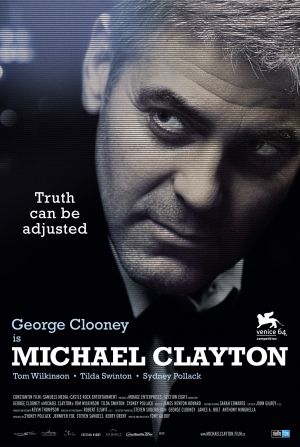
Michael Clayton

I could never be a lawyer. It’s too expensive, it takes too much studying, I’m not good at public speaking, and as Michael Clayton taught me, it’s too dangerous. If I want my car blown up, I’ll go to the demolition derby.

Not just an educational experience, Michael Clayton is a great movie, and a nominee for Oscar’s Finest Honor to boot. Atonement may have been groomed to win the award, but it’s a movie like Michael Clayton that you really want to see win it. It’s smart and unassuming, features grand performances, and is understated in a “little engine that could” way. We as Americans naturally root for the underdog, and Michael Clayton has a lot to root for.

It stars George Clooney in the title role, and he’s his usual spectacular self in it, but the reason you’re going to see the movie is Tom Wilkinson. And if it isn’t, it should be. To use an analogy from a college professor of mine, Wilkinson takes the top of your head off and throws it into outer space in this movie. He plays Arthur Edens, a top-notch lawyer at a top-notch firm who’s a little nutty… Alright, he’s totally freakin’ insane. He speaks the very first words of the movie, while the screen is still black, and it’s clear from the get-go that this is man who’s frighteningly bonkers. But he’s not bonkers in the off-the-wall, silly sort of way. Insanity is really easy for an actor to play badly, but to play it convincingly takes a real pedigree, which Wilkinson proves that he is. Seriously, if he doesn’t win Best Supporting Actor, I’m moving to Canada.

But let’s not forget George Clooney, who plays close to type, but plays it well. Michael is dark, brooding and jaded, which George does very well. His distance from his son, his weakness to addiction, and his lack of ambition all play to Clooney’s strengths, and I can’t actually imagine anyone better for this role. Tilda Swinton is very sympathetic, and plays her blood-sucking corporate juggernaut with complete humanness and vulnerability. Writer/director Tony Gilroy, while peripherally guilty of being within 500 yards of Armageddon (he did some work on the screenplay), does very well with this one. Despite that this is his first time in the director’s chair, he sets up some brilliant shots. On the same token, he has great actors to work with, and with dynamos like Clooney and Wilkinson, a large chuck of the work is done for him. The script, penned by Gilroy, reveals a lot of skill in the craft, with smart dialog and great pacing.

I can’t say if this deserves the Best Pic Oscar, as I’ve only seen one other film that got the nod. I’m hoping to see two more by the 24th. But I can confidently say that it deserves to be seen. Wilkinson is phenomenal in it, but the other elements that go into a Best Picture nod are there, too. It was a little hard to keep up with, but I managed to do it. It’s not flashy or overblown, but instead delivers a subtle and rewarding package that makes you glad you spent your $8.00 on it.

Iconic lines:
“Pretend it’s not just madness!”
“I am Shiva, the god of death.”
“Do I look like I’m negotiating?”

22 Rating: 14

Particle Man

Monday, February 04, 2008

Juno

Imagine being pregnant at 16. You might not imagine that situation to have many laughs or moments of levity. However, Juno, starring Ellen Page, proved to be the exception to this rule.
We are introduced to Juno as she guzzles Sunny Delight and waxes poetic about a chair in the front yard. We learn that she had sex with her "boyfriend” recently and suspects that she may be pregnant. She walks to the local convenience store where the clerk, played by Rainn Wilson, tell her that she should stop taking pregnancy tests because they are going show that she is pregnant. Juno then goes on to tell those in her life about the baby and deals with the decision of whether or not to abort the baby and the ramifications of that decision.
I was not expecting this movie to be funny. I had not seen many advertisements. I was told by a co-worker that it was funny, but our senses of humor tend to differ. However, the number of laugh out loud moments caught me totally by surprise, from Rainn Wilson’s one scene in the movie to Ellen Page and Michael Cera’s conversations to Allison Janney and her dog obsession I found myself laughing a whole lot.
One person I feel I must give kudos to is Jennifer Garner, who plays the prospective adoptive mother of Juno's baby. Her acting pleasantly surprised me. Her character is someone who is at first seen as extremely controlling but as the film continues you see deeper into her persona and begin to understand where that controlling demeanor stems from. While Jennifer Garner’s character seems to grow as the movie goes on, Jason Bateman, who plays her husband, seems to regress as the movie goes on. He starts out very likable but as you see his character more in the movie his sketchiness definitely comes out.
While I was impressed by those surprising portrayals, the one that blew me away was Ellen Page. Her character in this movie goes through a growing process that is atypical at the age of 16 but she portrays it in a very believable way. Most movies that have the characters going through situations that make them grow up, force their characters to grow up too soon. This is deftly avoided in this movie. I think Ellen Page definitely deserves the nomination for Best Actress. I was stunned by her portrayal of something so sensitive in a comedic way. She is an exquisite actress.
Immediately after the movie, I gave it a rating of 11. However, after thinking about the movie for this review that rating has significantly gone up to a 16. There was excellent acting and the plot was interesting and entertaining. In short this movie had all the ingredients of an excellent movie.

Tuesday, January 29, 2008

Cloverfield

Back in July, when Transformers came out, there was this really mysterious trailer in front of it. It had these kids at a party, and it was shot on handheld camera, kinda like The Blair Witch Project. Then there was all this noise and running around and OMG WHATS GOING ON THATS THE STATUE OF LIBERTYS HED IN THE STREETZ, and it was all very enigmatic. There was no title attached, just the date 01-18-08. There was bupkis about it on the internet, other than that it was a JJ Abrams Joint (Alias, Lost, MI3). People talked and talked about what it was. Was it Voltron? Was it H.P. Lovecraft, maybe Cthulhu (my personal hope, but no)? As time went on, the title of the movie was revealed as Cloverfield. The marketing for this film will have gone down as one of the great viral marketing campaigns, like The Blair Witch Project, or Snakes on a Plane. But while Cloverfield has borrowed Blair Witch's lo-fi aesthetic, it borrows just as much fizzle from the latter movie, in not quite living up to the hype it promised in early trailers.
The plot is Bourne Ultimatum-simple: some kids in NY are throwing a going-away party for Rob (Michael Stahl-David), and it's being filmed by Rob's brother Jason (Mike Vogel), and later Rob's friend Hud (T.J. Miller, who carries most of the film on his shoulders), who is crushing on Marlena (Lizzy Caplan, who REALLY NEEDS TO RETURN ZOOEY DESCHANEL'S DNA RIGHT NOW). Rob's "best friend" Beth (a very good Odette Yustman) comes to the party with man-friend in tow, drama ensues, and then the power goes out. When it returns, reports on the TV abound of a capsized oil tanker in the harbor......and then the Statue of Liberty's head rolls down the street, and it's all south from there.
The entire film is shot on handheld camera, which works very well for it. I liked the street level feel and how it worked in the giant monster genre. I liked the unavoidable allusions to 9/11, and I felt that they added weight to the film. Unfortunately, the story is so paper-weight that it wouldn't hold up to repeated viewings. There is a lot of fat in the form of a too-long intro before the action happens, which isn't good for a 75-minute movie. Gojira (the name of the movie is Gojira, not Godzilla....I don't want to hear about American edits with an added Raymond Burr........) was a great film because it tied fears about nuclear technology and the psychic residue leftover from WWII together, and made what would have been a mere popcorn film into something else. Cloverfield is pretty much popcorn, and not much else. There is good stuff. The monster, and its spawn. One character has a death that can only be described as............colorful. The ruined city. The acting is pretty good, but I was surprised later on that the young woman playing Marlena was not the great ZD, but a carbon copy. Not since the great Skeet Ulrich/Johnny Depp heist have I seen such a blatant aping of an actor's style and look, and that's distracting.
This is a short review for a short film. While I enjoyed Cloverfield for what it was, I was left wanting a lot more, and not in a good way. Those of you prone to motion sickness would do well to stay the heck away from Cloverfield, since there is a lot of turbulence involved in the shaki-cam-ness. I give Cloverfield a 9 out of 22 on the 22 scale.

Monday, January 21, 2008

Atonement

Atonement won the Golden Globe for Best Drama a little over a week ago, and it seems a likely candidate to be nominated for an Oscar the morning after I post this, so I don't think I was wrong in having heightened expectations. And Atonement is indeed an awardsy movie: A sweeping drama about two lovers torn apart, first by a misunderstanding and then by the second world war. It's spectacularly shot with some impressive set pieces. It's got an haunting, evocative score. And it boasts some terrific performances. But something was missing.

Here, roughly, is the story: Cecilia Tallis (Keira Knightley) and Robbie Turner (James McAvoy) have grown up together; he is the son of her family's housekeeper. At the start of the movie their relationship is fairly siblingly, but their latent passion for one another is awoken after Robbie sees Cecilia dive into a fountain to retrieve part of a broken jug wearing naught but her underthings. Also witnessing the fountain-dive is Briony (Saoirse Ronan), Cecilia's 13-year-old younger sister and a fledgling writer. Briony isn't sure what to make of all this, but after intercepting a naughty letter from Robbie to Cecilia, Briony and her older cousin Lola (Juno Temple) determine that Robbie must be a sex maniac. Later that night, Briony catches a couple having sex in the bushes (clearly, this is not a good day for her). The male runs off, but the female, it turns out, is her cousin Lola. Lola claims ignorance as to who was on top of her, and Briony--believing Robbie to be a sex fiend--assumes the assailant must be him. When Briony gives this as her testimony, Robbie is sent to prison and later to fight with the British Army. Robbie and Cecilia are torn apart, and Briony is left to fight her guilt.

It's a good, gripping plot, and it's aided by capable direction from Joe Wright (who also directed 2005's Pride & Prejudice), stellar cinematography from Seamus McGarvey (World Trade Center, Sahara) and an absolutely top-notch original score by Dario Marianelli (V for Vendetta). So it's likely to win it's fair share of awards. Still, I was left underwhelmed.

Here's the problem: While Briony, Cecilia, and Robbie found themselves in some horribly heart-wrenching situations, this critic's heart was never properly wrenched. And I think it's because I never really got to know the characters. Briony we get to know the most, but all we get from her is a sense of precocious fussbudgety. Robbie we get a little less from: While we do get a sense of his struggle for acceptance (being of lower birth than Cecilia & co.), he's really just a generic lover-turned-fighter. And Cecilia is just a garden-variety tragic heroine.

I don't think this fault lies with the actors; Ronan, McAvoy, and Knightley all do commendable jobs. Their love, fear, and shame all feel real, but they feel like the love, fear, and shame of people who I don't really know. As Robbie staggered about in combat, I couldn't help but think: "This is rough and all, but why should I care more about you than any of the other soldiers here?"

I won't blame Ian McEwan either, who wrote the novel upon which this movie is based. I have not read the novel Atonement, but with all the acclaim it's gotten (Time book of the year, among other accolades) I can't imagine that the characters are as inscrutable on the page as they are on the screen.

If I have to assign blame, it'll be to screenwriter Christopher Hampton (The Quiet American, Mary Reilly). Hampton put all the pieces in place, but forgot to imbue them with a soul.

Atonement still manages to get a 10, so the character anonymity doesn't kill it. But for a movie that's aiming for Hollywood's highest honor, that anonymity might well be it's undoing.

Sunday, January 13, 2008

The Golden Compass

With the Harry Potter series, J.K. Rowling showed the world that kiddy-lit can be entertaining as well as deep and thought-provoking, and can appeal to adults just as much as children. Naturally, the greedy movie execs thought, "Kiddie fantasy is big right now, especially British kiddie fantasy." Following the "if it ain't broke, run it into the ground until it is" philosophy, movie-makers looked to Phillip Pullman and his His Dark Materials series in order to continue the trend. Thus the first movie, The Golden Compass, was born.

Poor intentions aside, The Golden Compass is a fun ride, and even a good story. It features performances that range from a little bland to downright skillful, and seems to promote the innocence of childhood, as well as denounce people who try to control others. Dakota Blue Richards does a splendid job as Lyra, the main character, an orphan girl of about 11 years. She lives at Jordan College in Oxford, England, and is taken care of, but generally forgotten. Richards carries the film with surprising aplomb considering that this is her very first film. Supporting performances include Nicole Kidman as Mrs. Coulter, a government official who takes Lyra under her wing, Daniel Craig as Lord Asriel, Lyra’s adventurous and somewhat distant uncle, the voice of Ian McKellan as Iorek Byrnison, a giant talking polar bear, and Sam Elliot as Lee Scoresby, a cowboy (complete with six-shooter and accent) who flies a zeppelin. Kidman is sweet/conniving enough as Mrs. Coulter, but is very lacking in depth most of the time. Craig plays a much softer version of Lord Asriel than in the books, and suffers from not enough screen time. The ice bear Iorek is pretty well done, but I can’t help thinking that Gollum was so much better every time he comes on the screen. And Elliot plays his part well, but the part itself is just slightly too clichéd.

The new and not-so-new ideas in this movie abound, including a person’s soul existing outside their body, called a dæmon. A person’s dæmon exists as an animal manifestation of that person, and the form it takes shares characteristics with the person. I don’t really understand Pullman’s choice of that term to describe it; I think he could have chosen something with less negative connotations. Also, there is the concept of the ice bears, a race of talking polar bears that live in the far north. They are basically just like people, and treated as such. Talking animals is a tried and true convention of fantasy stories, but it being bears is kinda new. Also, when ice bears fight each other, the results are pretty cool.

Then there are the religious and spiritual elements and controversies of the movie. The Magisterium, which Mrs. Coulter is a part of, is a combination of a state-sponsored church and a totalitarian government. It endeavors to control every part of a person’s life, to “tell them what to do,” as Mrs. Coulter puts it. The Magisterium, even in the movie, bears a striking resemblance to the Catholic church, and some have interpreted this as a direct attack on Christianity. Pullman, who is an outspoken atheist, has said himself that he is “trying to undermine the basis of Christian belief” with these books. IMHO, it’s not a very good idea to purposefully insult a large chunk of your potential readership. On the other hand, some Christian leaders see the Magisterium as an indictment of those who would use Christianity as a form of oppression and subjugation. After all, Jesus was into letting people know the best way to live, not making them do it.

The movie itself was pretty balanced between being a fantasy epic, a personality study, an action film, and a sci-fi piece, doing each with moderate amounts of success. The first third of the film, which takes place at Jordan College and in London, is very warm and inviting, but the scenes on the sea and in the frozen north are dark, and not very well-shot. Director Chris Weitz, who previously did About a Boy, doesn’t make his film stand out from the other children’s fantasy movies of the day, and handles a vast array of characters competently. A vast array there is, but many of the characters just appear and disappear, so they’re not very well-developed. But I left the theater looking forward to the next movie, which is due out in 2009, and that’s what you want with a series.

Iconic lines:
There aren't really any that stick out. Sorry, guys.

22 Rating: 9

Monday, December 24, 2007

Sweeney Todd

I love musicals but not Tim Burton. His movies tend to be too weird or strange for me. Therefore I had mixed feelings when I found out that Tim Burton was directing a musical. In order to stop this battle going on inside I decided to go see the movie to see once and for all if it was good or bad.
Sweeney Todd: The Demon Barber of Fleet Street is a classic musical that many Broadway aficionados have loved throughout the years. In the film, we are first introduced to Sweeney Todd after he has escaped from a wrongful imprisonment which he was sentenced to years ago by a corrupt judge whose motives were and are in no way pure. We see through a flashback that before his arrest he was a happy, upper-middle-class barber who loved his wife and baby daughter Joanna. However we are quickly brought back to the present to a changed man sailing back to his home and hopefully his wife and child. What happens next is full of interconnected stories that all lead to Sweeney Todd’s door while he delves deeper and deeper into his own madness.
I was surprised by my enjoyment of this movie. True it is a musical, which I love, but it is also a Tim Burton movie, which I am not such a big fan of. However, I was pleasantly surprised by my enjoyment of this movie. I think one of the strongest aspects of this film was casting. I thought the casting was extremely well done. Johnny Depp as Sweeney Todd steps away from Captain Jack Sparrow and convinces the audience that he is a haunted man who is looking for revenge, and--he can sing. Helena Bonham Carter is also an excellent fit for Sweeney’s equally disturbed partner, Mrs. Lovett. Although some may claim that her singing was not up to snuff I think that is a very unfair judgment. I would like to see those people sing in a cockney accent and see if they end up sounding like Charlotte Church. Alan Rickman turns in a disturbing performance as Judge Turpin, the judge who is responsible for Sweeney’s current lot in life. Timothy Spall, who some may recognize as Wormtail from the world of Harry Potter, gives us a spot-on performance as a corrupt man who only takes the commands of Judge Turpin. Overall, the casting job was great.
This was an extremely bloody movie. Since this is a tale of man who goes mad with thoughts of revenge, I don’t think anyone should expect it to be a lovely little stroll in the park. If you can’t stand blood this is not the film for you. I am not that squeamish when it comes to movie gore sometimes, so I was able to handle this movie. The amount of blood that was shown to be spilt still diminished it in my eyes somewhat, but not too much.
This was a good movie. The actors did an excellent job, Tim Burton did not seem to go too crazy as I feel he does with most of his movies, and it was faithful the story. I never thought I would give a Tim Burton movie anything higher than a 2, but I give Sweeney Todd a 13. I did have to subtract some points for the bloody violence, which was a bit gross, but necessary for the story.