Monday, April 28, 2008

The Darjeeling Limited

Wes Anderson and Christopher Guest have a lot in common as directors. Both tend to rely on the same stable of actors. Both direct character-driven comedies. Both appreciate their characters to have a touch of zaniness. And both organize their films around the hopelessly optimistic quests of their very flawed main characters.

Of course, there are differences. Guest films straightforwardly and values improvisation. Anderson constructs incredibly detailed and meticulously composed shots. Guest goes for the chuckle; Anderson goes for the smirk.

These tendencies continue unabated in Anderson's The Darjeeling Limited--fortunately, they're almost entirely endearing.

The Darjeeling Limited begins with Bill Murray--an Anderson staple--racing to catch a train. He's eventually overtaken by Adrien Brody--an Anderson newcomer--and the scene seems to suggest nothing more than the fact that Brody will be occupying a central role in this film rather than Murray this time around. Murray appears only once more in an inconsequential scene.

That's how The Darjeeling Limited starts, but that's not where we begin. We begin with a short film called Hotel Chevalier, which introduces Jack Whitman (Jason Schwartzman--Anderson regular) and his complicated relationship with his (ex?) girlfriend, played by Natalie Portman, an Anderson newcomer. Seen before the main feature, Hotel Chevalier leaves the viewer with more questions than answers, and seems to have little purpose more than displaying Portman semi-nude.

The relationship is further explained in the main feature, though Portman never appears again. In any case, that relationship is secondary to the film; the primary relationship is that between brothers Francis Whitman (Owen Wilson--Anderson regular), Peter Whitman (Brody), and Jack Whitman (Schwartzman). After Francis' disfiguring motorcycle accident, he decides that he wants to reconnect with his estranged younger brothers on a spiritual journey through India. Peter and Jack consent to the idea, but it's clear that it's neither are too excited about it.

The series of events that follows seems to pale in importance compared to the character tics that each of the leads establish: Francis' overprotective older-siblingness, Peter's tendency to nick their deceased father's personal effects, Jack's crush on one of the train's attendants, and the tendency of all three to confide things in one that they keep from the other. And--in another Andersonian theme--all three demonstrate the various ways in which their parents have screwed them up.

Watching an Anderson film puts you into a certain mode: two parts confused, one part amused. Anderson doesn't go for many laugh-out-loud moments--which may be frustrating for those used to the Will Ferrell school of comedy--but he does throw in plenty of smirks. And, in large part, the reason you can't laugh out loud more is because Anderson keeps so many details close to the vest--it's hard to be sure what's funny and what's not, but the films almost always warrant and reward a repeat viewing.

That said, it's difficult to fully gauge The Darjeeling Limited having only seen it once. As it stands right now, I'd put it behind Rushmore and The Royal Tennenbaums--both of which I've seen multiple times--but ahead of The Life Aquatic, which I've also seen once. The movie is intriguing and the characters are endearing--and while it seems to wear on a bit long (suffering a bit from multiple-ending syndrome), it offers a satisfying (if just a tad too neatly wrapped) conclusion. Given the caveat about Anderson movies improving with repeat viewings--as Guest's movies do--I'll give it an 8 for now.

An Iconic Lines section might be helpful here:
Jack: What did he say?
Peter: He said the train is lost.
Jack: How can a train be lost? It's on rails.

Francis: [
Francis and Peter are beating each other up] You don't love me!
Peter: Yes I do!
Jack: I love you too, but I'm gonna mace you in the face!

Jack: I wonder if the three of us would've been friends in real life. Not as brothers, but as people.

Monday, April 07, 2008

Face/Off

I remember loving this movie when I was in high school. I was less experienced then, and my tastes were a little different, though they hinted of things to come. Now, approximately ten years later, I can recollect exactly the things that made this movie so great to me then, even though they don’t really have that effect now. Eleven years later, Face/Off doesn’t have the same effect on me, but it still holds a bit of the person I used to be, and I’m kind of fond of that person.

Directed by John Woo, the king of modern Hong Kong action flicks, Face/Off is only his third North American offering, though he has over 20 Hong Kong films to his credit. It stars John Travolta and Nicholas Cage, both playing the same two characters: FBI supercop Sean Archer and criminal kingpin Castor Troy. After a high-action first act with Travolta playing Archer and Cage playing Troy, they do a little switch. The movie, very wisely, doesn’t do this through some mystical means that makes them trade bodies; it’s not that kind of movie. Instead, it uses ordinary science… Okay, not ordinary, as this advanced of science isn’t actually possible, but the movie certainly goes all out to make you believe it. Both starring actors did extensive development of the characters, and also studied each other very minutely, getting all the movements and mannerisms of the other one down. The results are the viewer having a very definite idea of who’s Castor and who’s Sean, despite the fact that each is played by two different actors. You see Troy and Archer, not whoever is playing them at the time.

Face/Off contains all the prerequisite explosions, gun battles, and general mayhem for any John Woo film, but what I found more interesting was the question of self that the movie presents. There is one scene where Archer and Troy are facing each other with guns drawn, only there is a mirror between them on each side. So each is seeing himself in the reflection, only it’s not really himself; it’s his rival. The hatred these two share for each other is long-standing, and in that moment, you see it in both of their eyes; not only in the men, but their reflections as well. It is a masterfully done scene.

Face/Off doesn’t get everything right, though. Like in any action movie, every single character in it is an absolutely terrible marksman. There is shooting up the wazoo, but people only actually get shot when it serves the story. Dominique Swain, who plays Archer’s teenage daughter, proves her utter uselessness and lack of any acting chops here. When Troy masquerades as Archer, living in his home and interacting with his family, he is so obviously not Archer, and Dr. Eve Archer (Joan Allen) should have realized that from her first encounter with him. The entire sequence where Archer (as Troy) goes to prison stretches believability beyond its limits. Everything from the prison being a giant magnetic field to the set-up and layout prove that the designers didn’t have a freakin’ clue how a prison actually works. But the best part is this: the prison is built on a converted oil rig, and there is just ocean all around. Despite this, Archer escapes by jumping in the water and swimming to shore… which is where, exactly? About 100 miles sound right? Also, the guys in the helicopter fire their guns where the bullets could reach explosives stored on the rig’s deck. Oops, I guess they forgot where they were. WTF???

But, it’s an action flick, so those issues can be put aside with a little effort. The mano a mano fight scenes are top notch, and the two stars play both of their characters extremely well. The ending, however, is so sappy that it almost cancels out the rest of the film… almost, but not quite. I can understand what got me so jazzed about it when I was in high school, but I’ve moved on the what I think are better things. Still, Face/Off provides great thrills, and even a bit of nostalgia for me.

Iconic Lines:
“I could eat a peach for hours.”
“Wheeeeee! What a predicament!”
“No more drugs for that man.”

22 Rating: 6

Particle Man

Monday, March 31, 2008

Once

Once won an Oscar for Best Original Song. That's fitting, since the film is more about the music than the story. In fact, it might be fitting to consider Once a visual LP.

Once introduces Glen Hansard and Markéta Irglová, though their character names are listed as simply "Guy" and "Girl," and it's really tempting to read this movie as their autobiography. That's not entirely wrong, as Irglová, a Czech immigrant, plays a Czech immigrant. And Hansard, who got his start as a street musician in Dublin, plays a street musician in Dublin. And the two are responsible for almost every song in the film.

So maybe it's not entirely inappropriate to see this movie as a bit of a joint autobiography. But there's another temptation in this film: As it's a semi-autobiography about Guy and Girl--a Guy and Girl who are dating in real life--it's very tempting to see this as a prototypical love story. It's not. Love has its place in the story, but it's not a love story. It's all about the music. (In fact, Hansard and Irglová didn't start dating until after Once started filming.)

If the story is about the music, it's only appropriate to ask: How's the music? It's quite good. The Oscar-winning "Falling Slowly" is the best of the bunch, but there's not a dud to be found here. The sound isn't all that dissimilar to Dashboard Confessional, if you just replace the adolescent whine with Irish-lilted adult poignancy. The focus is on the music's authenticity, as evidenced by Hansard's absurdly beat-up acoustic guitar. The authenticity comes through, though. Hansard and Irglová seem like two people who genuinely like making music, and who genuinely like each other.

The low-budget authenticity is not just Hansard's guitar; the entire film cost only $150,000 to make, so you can feel good about shelling money out for it in a way that you might not feel good about paying to see, say, Shrek the Third (which cost $160 million to make, or about one thousand times as much as Once). In the end, your $4-5 rental will get you an hour and a half worth of good music made by endearing people, and that's worth about a 9 on the 22 scale.

Wednesday, March 26, 2008

Batman Begins

Unlike a lot of people (I suspect), I have a very, very specific idea of what kind of art I love best: a subversive/dark sensibility, with a strong commercial bent. This is what I like about old spaghetti westerns, The Warriors, Fight Club, etc. It's also what I love about Christopher Nolan, and my favorite of his films (so far), Batman Begins.
Had you told me a couple of years ago that the director of Memento and Following was going to revive the Bat-franchise, I would have thought you crazy. Nolan seemed like too much of an artiste for lowly comic-book adaptations. Not that there's anything wrong with Batman--inner comic book geek aside, Batman is arguably one of the greatest fictional characters ever created. He has gone strong as a media icon for over seven decades now, with literally thousands of stories written about him, and has thusly been given levels of characterization that dwarf "greater" characters. The billionaire whose philantrophist parents were gunned down before his eyes, Bruce Wayne dedicates himself to a war on crime, while trying to keep what soul he has left intact, fighting conflict all the while. Does Batman attract greater trouble to Gotham by his flamboyant nature? Is it right for him to enlist partners (especially younger ones) in his war on crime? Will he ever be free of the Bat, and be able to live a "normal" life as Bruce Wayne? When you take a closer look, it's really not hard to figure out what drew Nolan to the material.
Batman Begins gives us a take on the Dark Knight previously unseen in film: We open with Bruce Wayne (Christian Bale) in a Chinese prison, suffering from nightmares and beating the crap out of would-be bullies in the prison yard. How did he get there? A large portion of the first half of the film is told seamlessly in flashback, detailing Bruce's love of his parents and trauma over their death, his friendship with Rachel Dawes (Katie Holmes), and his failed attempt at avenging their murder. Henri Ducard (Liam Neeson) of the mysterious League of Shadows recruits him, and helps complete his training, especially in terms of mastering his fear. But the League's goals don't meet with Bruce's, and he destroys their headquarters, returning to Gotham to begin his campaign to save the city.
The script of this film, by Nolan and comic veteran David Goyer, is tightly crafted, and is both artistic and structured. There are some new twists to this somewhat-origin story (Ra's Al Ghul being the primary threat), which pays tribute to Frank Miller's (300, Sin City) Batman: Year One in many of its elements (corrupt cop Flass, Batman's abortive first crime-fighting attempts). Along with the script, and the lovingly rendered performances of its characters drive this film: Carmine Falcone (Tom Wilkinson), the mob boss of Gotham, who seems to have stepped out of a Warner Bros gangster film from the 40s. Thomas Wayne (Linus Roache), Bruce's loving father who informed the type of man that his son would become. Jonathan Crane (Cillian Murphy), the corrupt psychiatrist who becomes the Scarecrow. Lucius Fox (Morgan Freeman), the kindly, Morgan Freemanesque inventor who helps Bruce along his path. Jim Gordon (Gary Oldman), seemingly the one honest cop in Gotham City. Don't get me wrong, Christian Bale is more than competent in this film, but there's a difference between being able to share a scene with the likes of Roache and Wilkinson, and then there's the altogether different matter of outshining them.
The film is a treat to look at, thanks to the masterful cinematography of Nolan regular Wally Pfister and editor Lee Smith. The things I would normally complain about (jerkily shot fight scenes) are actually assets here that enhance the story. Gotham City has never looked better. There are things about the movie that bug me (C'mon......would Batman really be so reckless with the safety of police (or anybody), even if a life was at stake? I don't think so...), but they are few and far between. Batman Begins is a near-perfect film, but it has some serious room for improvement. More/better action. A story that's no parts origin. No Katie Holmes. Hopefully, July's The Dark Knight will deliver on that. But Batman Begins is still worth a by-no-means-shabby 20 out of 22.

Monday, March 17, 2008

Before Sunrise

Thankfully, I've recently connected with a coworker who seems to have the same exact movie taste as I do. This is nice because I can get film recommendations I know are quality, and I also don't have to think very hard when making recommendations of my own. My introduction to the movies Before Sunrise and Before Sunset are a result of this alliance.

For some, I think this film is probably rather polarizing, either you love it or hate it. It's different from nearly all of the romantic movies out there because it doesn't trifle with it's characters too much. It doesn't set us up to believe that they are currently with the wrong person, or try to ruffle us by creating a far-fetched misunderstanding. Before Sunrise just allows us to follow a pair of travelers as they get to know each other more and more intimately. The nice thing is that we are introduced to the characters, Celine and Jesse, at the same point that they are introduced to each other. They are both traveling on a train in Europe and happen to strike up a conversation. Jesse needs to get off the train in Vienna so that he can catch his flight back to the United States in the morning, but is so intrigued by this connection he's made with Celine that he asks her to get off the train with him so they can hang out and continue their conversation. Both are awkward and hesitant about it, but see it as an opportunity that neither want to pass up.

So for the rest of that day and through the night, Jesse and Celine walk around the city, go into bars, tour parks, all the while getting to know each other. The end.

Seriously, that's pretty much it. If you're looking for an exciting or action-packed plot, try pretty much any other movie. Now, I wouldn't want you to think that because of this fact I enjoyed the movie less. On the contrary, I loved this film. It was ripe with the realness of a new relationship, with a clumsy beginning and tense, and goose-pimpley sensations throughout. Jesse, played by Ethan Hawke, is an American in the middle of young adulthood angst in thinking about his relationships and his future (thus the trip to Europe). I wouldn't say that Jesse is the most loveable male romantic lead, but I like that. He's clearly flawed, pessimistic to a fault and sometimes letting his opinions run away with him. French actress Julie Delpy is Celine, and she is a delightful match for the character of Jesse. She's an ambitious young French woman with a "seize the day" attitude towards life and a hint of a superstitious nature.

They talk about many topics, because the conversation is really what drives the movie. After looking through some other reviews, I found that the common complaint is that all Jesse and Celine do is talk. Don't get me wrong, things happen throughout the night, but the things that they share with each other through conversation are central. This is the same for the movie's sequel, Before Sunset, in which (slight spoiler!) the two meet up once again at a later point in Europe. While the plot is similar, I highly recommend the sequel as an excellent continuation of Jesse and Celine's story.

Rating: 13

Before Sunrise is a memorable experience. Hawke and Delpy easily pulled me into their chance, short-lived meeting. What I like so much about this movie is its honesty. It doesn't try to fool us, take us for a ride, or make us believe in something that doesn't exist. It just takes a slice from the pie of life and lets us sample the flavor.

Monday, March 10, 2008

The Motorcycle Diaries

I don't know if it was my love for history or my love for musicals that drew me to The Motorcycle Diaries. For those who are not as into musicals as I am, Che Guevara, historically known as the leader of the Cuban Revolution, is the main character of this film but also plays a big part in the musical Evita. No matter what drew me into this story I was still very much captured by it. The Motorcycle Diaries is the story of Che when he decided to have some last moments of fun on a road trip before graduating and becoming a doctor. The script is actually based on the diary that Che wrote in throughout the trip.
Che (Gael García Bernal) and his friend Alberto (Rodrigo De La Serna)set off on a trip to travel from Argentina to Venezuela. At the beginning of the journey, they have somewhat similar hopes for the trip, but as they continue on their journey they realize that they need to grow up and each decides what the path of his life is going to be. García Bernal does an amazing job of turning subtlety into art. His performance is not enhanced by any kind of special effects and the only thing available to him is his ability to act, which he certainly proves he has in this film. De La Serna provides levity as Che's fun-loving and woman-loving friend.
This is a very simple story. Two friends decide to go on an adventure to see what else is out there in the world and they are never the same afterward. It is an exceedingly emotionally gripping story that has laughs thrown in for good measure. In fact I would say that the amount of laughs that are in this film was just the right amount. In many films, too many laughs are put in to ease the tension, but this film actually lets the audience feel other things. The scenery from the film was amazing. There were many shots of the landscape of the countries that just added to the simplistic beauty of this movie.
Everything in this movie seemed to work for me. The acting was as beautiful and compelling as the scenery and the plot. I was absolutely blown away by this film and I was not expecting it. This film also had a lingering effect of the emotion in the film. I was amazed at the story that it portrayed and feel it fully deserves the 18 I'm giving it.

Tuesday, March 04, 2008

21 Grams

The best movies combine a deep and philosophical message with an entertaining story. You feel as though you might have been enriched as a person, or you see something from a new angle, plus you feel good about having spent the last two hours just sitting in a chair. But sometimes a movie just isn’t built to do both things, so it just focuses on doing one of them well. Movies like Independence Day and The Princess Bride go for story over meaning, and I think I would prefer that if it has to go down just one of those two roads, that it be the one marked “story.” Movies like 21 Grams choose the other road, the one marked “meaning,” and generally neglect the story, or make it very simple.

The thing about 21 Grams, though, is that it’s even pretty hazy on the meaning part. It’s definitely not popcorn fare, and I don’t think friends will be sitting around with nothing to do and saying, “Hey, let’s watch 21 Grams! That’ll be fun!” The message it conveyed was actually valuable, and it (I guess) was “life carries on.” The title is a reference to the work of Dr. Duncan MacDougall, who in the 1900s attempted to quantify the human soul by measuring a person’s weight just before death and after. The movie just states as fact that a person loses 21 grams at the time of their death, when actually Dr. MacDougall’s findings were that different people lose different amounts, and are widely considered to have little if any scientific value.


What I got out of the movie, or what I think it was saying, was that 21 grams goes on forever, shifting from body to body in an endless cycle, and that even though it’s such a small mass, it lasts forever. This is a very Buddhist idea, given a somewhat more palatable and applicable packaging.


Alejandro González Iñárritu directs the film in a non-linear, voyeuristic fashion, and one which I found to be pretty annoying. The film jumps between multiple storylines and characters, which is fine, but it has no regard for the usual beginning-middle-end paradigm. This goes beyond even what Pulp Fiction did. It’s all well and good to think outside the box, but not to leave the viewer behind in pursuit of one’s originality. I can see what Iñárritu was doing, though. By presenting events out of order, he created a disconnection in the storyline, one which the viewer is constantly trying to resolve. As the viewer, I was able to resolve it, but only a short time before another disconnection was presented. After awhile, it got tiring.


Originality gone awry aside, the three main actors in 21 Grams did wonderful jobs. Sean Penn plays his heart transplant patient with his usual subtlety and skill, though he’s not treading ground that we haven’t seen him tread before. Naomi Watts plays her instant childless widow with vast amounts of honesty, and really puts herself on the line. Her character is pretty predictable, though, which is her biggest failing, and sometimes her actions just don’t make sense. On the other hand, she goes for realism over melodrama, which is good. But the real jewel is the always-great Benicio del Toro, who plays a multiple convict/outreach preacher. His character has to struggle with the most universal things, and faces demons that, despite his unusual circumstances, we can all identify with a little.


21 Grams has a lot of problems, but some of them were just “that’s not my bag” things, and they might be someone else’s bag. Evidently they are, because this movie was nominated for a boatload of awards, mostly for the acting. Really, the acting was the best thing about this movie. It was awesome enough to overcome the annoying storytelling style, but just barely.

Iconic Lines:
“So this is death’s waiting room.”
“That’s a lie. Life does not just ‘go on.’”
“Jesus didn’t come to free us from pain. He came to give us the strength to bear it."

22 rating: 3

Particle Man

Monday, February 25, 2008

The Simpsons Movie

Early in The Simpsons Movie, Homer stands up in the middle of an Itchy & Scratchy film and shouts, "I can't believe we're paying to see something we get on TV for free!" It's an acutely self-aware moment from a franchise that's never been short on self-awareness. But making a joke about it doesn't make it not true.

There's nothing particularly wrong with The Simpsons Movie, but there's nothing particularly great about it either. It really is just an 87-minute long episode with better production values. It's a pleasant waste of an hour and a half, if that's the sort of thing you're looking to do.

The plot? Okay, if you want. Homer--through an act that's 75% idiocy and 25% negligence--causes Springfield to be declared an environmental disaster area by the EPA, who then promptly cover the entire city with a gigantic dome. The Springfield citizens form an angry mob (as they are wont to do), and only a way-too-convenient twist of circumstance allows the Simpson family to escape with their lives. On their own, the Simpsons try to make a new life for themselves in Alaska, but Homer alienates his family by being too selfish to help the Springfield residents he left behind. Eventually (spoiler alert?) Homer learns the error of his ways and saves the day.

The plot, of course, needs only to be thick enough to hang the jokes off of, and it meets that requirement. In fact, it's kind of impressive how the show's creators manage to keep a selfish, brainless, boor like Homer just sympathetic enough that we hope he wins in the end. The selfishness, brainlessness, and boorishness are, of course, a surprisingly fecund supplier of comedy, but the show's (and movie's) real magic moments come from its more subtle gags--such as Marge, after Springfield has been enclosed in the dome, writing "Dome Sweet Dome" in her needlepoint, and later "Nome Sweet Nome" after the family has moved to Alaska.

It's hard to imagine spending $10 (or even $7, depending on where you live) to see this movie in theaters--you'd have to be really set on seeing a movie and there would have to be precious little else out. And, unless I were interested in accumulating as many Simpsons collectibles as possible, I wouldn't purchase the DVD either--it contains an appalling paucity of special features (a few mediocre deleted scenes, the highlight of which is Mo's line: "Many dead, I'm afraid. Many others ... also dead.") If you want to see this movie, I recommend seeing it the way I did--by borrowing it from your roommate, who got the DVD for Christmas.

In the end, it seems a rating of 4 is appropriate. The Simpsons Movie is doubtless on the positive side of the scale, but, ultimately, it's exactly what it was created to be: disposable entertainment.

(A movie like this really calls for an iconic lines section.)
Iconic Lines:
[Bart is skateboarding naked across town]
Ralph Wiggum: [brightly] I like men now.

Tom Hanks
: Hello, I'm Tom Hanks. The US Government has lost its credibility so it's borrowing some of mine.

Todd Flanders
: I wish Homer was my father.

Ned Flanders: ...and I wish you didn't have the devil's curly hair.

Monday, February 18, 2008

There Will Be Blood

Initial Reaction: Some combination of "Wow!" "Oh Dear..." and "huh?"

You may be led to believe from my initial reaction that I didn't like There Will Be Blood. Sorry to mislead you...I did like it, but there is a caveat: I wouldn't watch it again. I find that there is a growing category of film that is defined as "greatly liked but only watchable once." TWBB neatly falls into this category.

Though the title was a bit off-putting, the fact that I had only seen one other Oscar nominated film motivated me to see this one. And while I was adequately warned that there would be blood, it wasn't overkill. No pun intended.

If anything, TWBB is worth watching for the sheer skill of Daniel Day-Lewis. Even though he is known for his quality acting (and his intense devotion to method acting), I would say that this is the performance of a lifetime. He plays the character of Daniel Plainview, a self-proclaimed oil man in the early 20th century. The film begins with an anonymous miner digging a site by himself. This scene is pretty intense, and perfectly suited to setting us up for the rest of the film. We learn that the man is Daniel, most likely starting out in his mining career.

There Will Be Blood is based on Upton Sinlcair's novel Oil! Overall, the movie is a timeline of Daniel's oil mining business, showing us a glimpse of his past, focusing on a chunk in the middle, and fast-forwarding to later in his life. The chunk in the middle is about an opportunity he gets to drill for oil in Little Boston, California. At this point in his life, he is accompanied by his son H.W. who is 9 years old and learning the trade from his father. Daniel hears about potential oil from a character named Paul Sunday (played by an impressive actor by the name of Paul Dano.) Paul lives on a goat ranch with his parents and siblings (including his twin brother Eli, also played by Dano) where they can't really grow anything. It's a poor family, but Eli isn't stupid, and understands that oil found on their land is a very big deal. Daniel finds out that there is indeed plenty of oil. Conflict ensues.

It doesn't take long to figure out that Daniel is a pretty bad person. The plot follows him as he convinces the people of Little Boston to sell their land to him so he can access whatever oil is there. Sounds pretty straightforward, but there's a twist: Eli is a man of God. He is the preacher at the Church of the Third Revelation and is officially "on fire" for God and filled with the Holy Spirit. Daniel clearly hates religion, but because of the oil is forced to deal with the people he can't stand. (Side note: In my opinion, the best scene of the film is when Daniel agrees to be baptized so that he can buy more land.)

There Will Be Blood is so good because of its effectiveness. I mean, it's about this evil man and his unquenchable thirst for oil. This may not sound very impressive, but I found Plainview fascinating: because you know he's bad, you can't help but sadistically want to see what he's going to do next. Acting-wise, Daniel Day-Lewis and Paul Dano rock. Their characters are opposites--and yet are so similar in so many ways.

It's a very interesting study in human behavior; it's about Daniel and the choices he is forced to make in life, where those choices lead him, and his attitude towards everyone around him because of those choices. The entire experience is intense and affective, which is the reason why I don't think I'll see it again. It's like watching The Passion of the Christ or Hotel Rwanda (though not as disturbing). Not many people who have seen The Passion say to their friends "Hey! I just bought The Passion of the Christ! It's really good, I'm in the mood to watch it again. Want to come over and join me?" No. Once you see it, you admire the quality, appreciate the message and lesson that is present, and move on with your life. That's where TWBB fell for me, though it may not for others.

My one (dare I say?) problem with the movie is the ending. It's not that it's bad or confusing, it's just...sudden. Made me scratch my head a bit and consider what it meant in relation to the rest of the film. But I'd be pleased to discuss said ending with others who have seen it.

Rating: 13

There Will Be Blood is not funny, action-packed, romantic or thrilling. By no means is it a feel-good movie. However, it's an excellent film that is a well-balanced, interesting, meaningful work of art with superb acting. Because of this, it goes beyond entertainment. There Will Be Blood gives us a fascinating view of an evil man's psyche, and by doing this, nudges us to take a look at our own.

Iconic Lines:

"I am a false prophet! God is a superstition!"

"That was one goddamn helluva show."

Monday, February 11, 2008

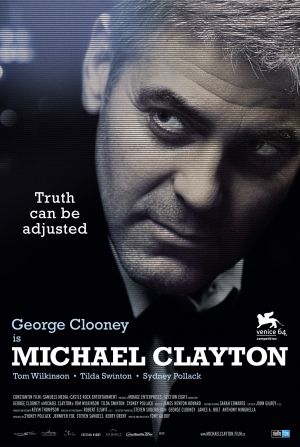
Michael Clayton

I could never be a lawyer. It’s too expensive, it takes too much studying, I’m not good at public speaking, and as Michael Clayton taught me, it’s too dangerous. If I want my car blown up, I’ll go to the demolition derby.

Not just an educational experience, Michael Clayton is a great movie, and a nominee for Oscar’s Finest Honor to boot. Atonement may have been groomed to win the award, but it’s a movie like Michael Clayton that you really want to see win it. It’s smart and unassuming, features grand performances, and is understated in a “little engine that could” way. We as Americans naturally root for the underdog, and Michael Clayton has a lot to root for.

It stars George Clooney in the title role, and he’s his usual spectacular self in it, but the reason you’re going to see the movie is Tom Wilkinson. And if it isn’t, it should be. To use an analogy from a college professor of mine, Wilkinson takes the top of your head off and throws it into outer space in this movie. He plays Arthur Edens, a top-notch lawyer at a top-notch firm who’s a little nutty… Alright, he’s totally freakin’ insane. He speaks the very first words of the movie, while the screen is still black, and it’s clear from the get-go that this is man who’s frighteningly bonkers. But he’s not bonkers in the off-the-wall, silly sort of way. Insanity is really easy for an actor to play badly, but to play it convincingly takes a real pedigree, which Wilkinson proves that he is. Seriously, if he doesn’t win Best Supporting Actor, I’m moving to Canada.

But let’s not forget George Clooney, who plays close to type, but plays it well. Michael is dark, brooding and jaded, which George does very well. His distance from his son, his weakness to addiction, and his lack of ambition all play to Clooney’s strengths, and I can’t actually imagine anyone better for this role. Tilda Swinton is very sympathetic, and plays her blood-sucking corporate juggernaut with complete humanness and vulnerability. Writer/director Tony Gilroy, while peripherally guilty of being within 500 yards of Armageddon (he did some work on the screenplay), does very well with this one. Despite that this is his first time in the director’s chair, he sets up some brilliant shots. On the same token, he has great actors to work with, and with dynamos like Clooney and Wilkinson, a large chuck of the work is done for him. The script, penned by Gilroy, reveals a lot of skill in the craft, with smart dialog and great pacing.

I can’t say if this deserves the Best Pic Oscar, as I’ve only seen one other film that got the nod. I’m hoping to see two more by the 24th. But I can confidently say that it deserves to be seen. Wilkinson is phenomenal in it, but the other elements that go into a Best Picture nod are there, too. It was a little hard to keep up with, but I managed to do it. It’s not flashy or overblown, but instead delivers a subtle and rewarding package that makes you glad you spent your $8.00 on it.

Iconic lines:
“Pretend it’s not just madness!”
“I am Shiva, the god of death.”
“Do I look like I’m negotiating?”

22 Rating: 14

Particle Man

Monday, February 04, 2008

Juno

Imagine being pregnant at 16. You might not imagine that situation to have many laughs or moments of levity. However, Juno, starring Ellen Page, proved to be the exception to this rule.
We are introduced to Juno as she guzzles Sunny Delight and waxes poetic about a chair in the front yard. We learn that she had sex with her "boyfriend” recently and suspects that she may be pregnant. She walks to the local convenience store where the clerk, played by Rainn Wilson, tell her that she should stop taking pregnancy tests because they are going show that she is pregnant. Juno then goes on to tell those in her life about the baby and deals with the decision of whether or not to abort the baby and the ramifications of that decision.
I was not expecting this movie to be funny. I had not seen many advertisements. I was told by a co-worker that it was funny, but our senses of humor tend to differ. However, the number of laugh out loud moments caught me totally by surprise, from Rainn Wilson’s one scene in the movie to Ellen Page and Michael Cera’s conversations to Allison Janney and her dog obsession I found myself laughing a whole lot.
One person I feel I must give kudos to is Jennifer Garner, who plays the prospective adoptive mother of Juno's baby. Her acting pleasantly surprised me. Her character is someone who is at first seen as extremely controlling but as the film continues you see deeper into her persona and begin to understand where that controlling demeanor stems from. While Jennifer Garner’s character seems to grow as the movie goes on, Jason Bateman, who plays her husband, seems to regress as the movie goes on. He starts out very likable but as you see his character more in the movie his sketchiness definitely comes out.
While I was impressed by those surprising portrayals, the one that blew me away was Ellen Page. Her character in this movie goes through a growing process that is atypical at the age of 16 but she portrays it in a very believable way. Most movies that have the characters going through situations that make them grow up, force their characters to grow up too soon. This is deftly avoided in this movie. I think Ellen Page definitely deserves the nomination for Best Actress. I was stunned by her portrayal of something so sensitive in a comedic way. She is an exquisite actress.
Immediately after the movie, I gave it a rating of 11. However, after thinking about the movie for this review that rating has significantly gone up to a 16. There was excellent acting and the plot was interesting and entertaining. In short this movie had all the ingredients of an excellent movie.

Tuesday, January 29, 2008

Cloverfield

Back in July, when Transformers came out, there was this really mysterious trailer in front of it. It had these kids at a party, and it was shot on handheld camera, kinda like The Blair Witch Project. Then there was all this noise and running around and OMG WHATS GOING ON THATS THE STATUE OF LIBERTYS HED IN THE STREETZ, and it was all very enigmatic. There was no title attached, just the date 01-18-08. There was bupkis about it on the internet, other than that it was a JJ Abrams Joint (Alias, Lost, MI3). People talked and talked about what it was. Was it Voltron? Was it H.P. Lovecraft, maybe Cthulhu (my personal hope, but no)? As time went on, the title of the movie was revealed as Cloverfield. The marketing for this film will have gone down as one of the great viral marketing campaigns, like The Blair Witch Project, or Snakes on a Plane. But while Cloverfield has borrowed Blair Witch's lo-fi aesthetic, it borrows just as much fizzle from the latter movie, in not quite living up to the hype it promised in early trailers.
The plot is Bourne Ultimatum-simple: some kids in NY are throwing a going-away party for Rob (Michael Stahl-David), and it's being filmed by Rob's brother Jason (Mike Vogel), and later Rob's friend Hud (T.J. Miller, who carries most of the film on his shoulders), who is crushing on Marlena (Lizzy Caplan, who REALLY NEEDS TO RETURN ZOOEY DESCHANEL'S DNA RIGHT NOW). Rob's "best friend" Beth (a very good Odette Yustman) comes to the party with man-friend in tow, drama ensues, and then the power goes out. When it returns, reports on the TV abound of a capsized oil tanker in the harbor......and then the Statue of Liberty's head rolls down the street, and it's all south from there.
The entire film is shot on handheld camera, which works very well for it. I liked the street level feel and how it worked in the giant monster genre. I liked the unavoidable allusions to 9/11, and I felt that they added weight to the film. Unfortunately, the story is so paper-weight that it wouldn't hold up to repeated viewings. There is a lot of fat in the form of a too-long intro before the action happens, which isn't good for a 75-minute movie. Gojira (the name of the movie is Gojira, not Godzilla....I don't want to hear about American edits with an added Raymond Burr........) was a great film because it tied fears about nuclear technology and the psychic residue leftover from WWII together, and made what would have been a mere popcorn film into something else. Cloverfield is pretty much popcorn, and not much else. There is good stuff. The monster, and its spawn. One character has a death that can only be described as............colorful. The ruined city. The acting is pretty good, but I was surprised later on that the young woman playing Marlena was not the great ZD, but a carbon copy. Not since the great Skeet Ulrich/Johnny Depp heist have I seen such a blatant aping of an actor's style and look, and that's distracting.
This is a short review for a short film. While I enjoyed Cloverfield for what it was, I was left wanting a lot more, and not in a good way. Those of you prone to motion sickness would do well to stay the heck away from Cloverfield, since there is a lot of turbulence involved in the shaki-cam-ness. I give Cloverfield a 9 out of 22 on the 22 scale.

Monday, January 21, 2008

Atonement

Atonement won the Golden Globe for Best Drama a little over a week ago, and it seems a likely candidate to be nominated for an Oscar the morning after I post this, so I don't think I was wrong in having heightened expectations. And Atonement is indeed an awardsy movie: A sweeping drama about two lovers torn apart, first by a misunderstanding and then by the second world war. It's spectacularly shot with some impressive set pieces. It's got an haunting, evocative score. And it boasts some terrific performances. But something was missing.

Here, roughly, is the story: Cecilia Tallis (Keira Knightley) and Robbie Turner (James McAvoy) have grown up together; he is the son of her family's housekeeper. At the start of the movie their relationship is fairly siblingly, but their latent passion for one another is awoken after Robbie sees Cecilia dive into a fountain to retrieve part of a broken jug wearing naught but her underthings. Also witnessing the fountain-dive is Briony (Saoirse Ronan), Cecilia's 13-year-old younger sister and a fledgling writer. Briony isn't sure what to make of all this, but after intercepting a naughty letter from Robbie to Cecilia, Briony and her older cousin Lola (Juno Temple) determine that Robbie must be a sex maniac. Later that night, Briony catches a couple having sex in the bushes (clearly, this is not a good day for her). The male runs off, but the female, it turns out, is her cousin Lola. Lola claims ignorance as to who was on top of her, and Briony--believing Robbie to be a sex fiend--assumes the assailant must be him. When Briony gives this as her testimony, Robbie is sent to prison and later to fight with the British Army. Robbie and Cecilia are torn apart, and Briony is left to fight her guilt.

It's a good, gripping plot, and it's aided by capable direction from Joe Wright (who also directed 2005's Pride & Prejudice), stellar cinematography from Seamus McGarvey (World Trade Center, Sahara) and an absolutely top-notch original score by Dario Marianelli (V for Vendetta). So it's likely to win it's fair share of awards. Still, I was left underwhelmed.

Here's the problem: While Briony, Cecilia, and Robbie found themselves in some horribly heart-wrenching situations, this critic's heart was never properly wrenched. And I think it's because I never really got to know the characters. Briony we get to know the most, but all we get from her is a sense of precocious fussbudgety. Robbie we get a little less from: While we do get a sense of his struggle for acceptance (being of lower birth than Cecilia & co.), he's really just a generic lover-turned-fighter. And Cecilia is just a garden-variety tragic heroine.

I don't think this fault lies with the actors; Ronan, McAvoy, and Knightley all do commendable jobs. Their love, fear, and shame all feel real, but they feel like the love, fear, and shame of people who I don't really know. As Robbie staggered about in combat, I couldn't help but think: "This is rough and all, but why should I care more about you than any of the other soldiers here?"

I won't blame Ian McEwan either, who wrote the novel upon which this movie is based. I have not read the novel Atonement, but with all the acclaim it's gotten (Time book of the year, among other accolades) I can't imagine that the characters are as inscrutable on the page as they are on the screen.

If I have to assign blame, it'll be to screenwriter Christopher Hampton (The Quiet American, Mary Reilly). Hampton put all the pieces in place, but forgot to imbue them with a soul.

Atonement still manages to get a 10, so the character anonymity doesn't kill it. But for a movie that's aiming for Hollywood's highest honor, that anonymity might well be it's undoing.

Sunday, January 13, 2008

The Golden Compass

With the Harry Potter series, J.K. Rowling showed the world that kiddy-lit can be entertaining as well as deep and thought-provoking, and can appeal to adults just as much as children. Naturally, the greedy movie execs thought, "Kiddie fantasy is big right now, especially British kiddie fantasy." Following the "if it ain't broke, run it into the ground until it is" philosophy, movie-makers looked to Phillip Pullman and his His Dark Materials series in order to continue the trend. Thus the first movie, The Golden Compass, was born.

Poor intentions aside, The Golden Compass is a fun ride, and even a good story. It features performances that range from a little bland to downright skillful, and seems to promote the innocence of childhood, as well as denounce people who try to control others. Dakota Blue Richards does a splendid job as Lyra, the main character, an orphan girl of about 11 years. She lives at Jordan College in Oxford, England, and is taken care of, but generally forgotten. Richards carries the film with surprising aplomb considering that this is her very first film. Supporting performances include Nicole Kidman as Mrs. Coulter, a government official who takes Lyra under her wing, Daniel Craig as Lord Asriel, Lyra’s adventurous and somewhat distant uncle, the voice of Ian McKellan as Iorek Byrnison, a giant talking polar bear, and Sam Elliot as Lee Scoresby, a cowboy (complete with six-shooter and accent) who flies a zeppelin. Kidman is sweet/conniving enough as Mrs. Coulter, but is very lacking in depth most of the time. Craig plays a much softer version of Lord Asriel than in the books, and suffers from not enough screen time. The ice bear Iorek is pretty well done, but I can’t help thinking that Gollum was so much better every time he comes on the screen. And Elliot plays his part well, but the part itself is just slightly too clichéd.

The new and not-so-new ideas in this movie abound, including a person’s soul existing outside their body, called a dæmon. A person’s dæmon exists as an animal manifestation of that person, and the form it takes shares characteristics with the person. I don’t really understand Pullman’s choice of that term to describe it; I think he could have chosen something with less negative connotations. Also, there is the concept of the ice bears, a race of talking polar bears that live in the far north. They are basically just like people, and treated as such. Talking animals is a tried and true convention of fantasy stories, but it being bears is kinda new. Also, when ice bears fight each other, the results are pretty cool.

Then there are the religious and spiritual elements and controversies of the movie. The Magisterium, which Mrs. Coulter is a part of, is a combination of a state-sponsored church and a totalitarian government. It endeavors to control every part of a person’s life, to “tell them what to do,” as Mrs. Coulter puts it. The Magisterium, even in the movie, bears a striking resemblance to the Catholic church, and some have interpreted this as a direct attack on Christianity. Pullman, who is an outspoken atheist, has said himself that he is “trying to undermine the basis of Christian belief” with these books. IMHO, it’s not a very good idea to purposefully insult a large chunk of your potential readership. On the other hand, some Christian leaders see the Magisterium as an indictment of those who would use Christianity as a form of oppression and subjugation. After all, Jesus was into letting people know the best way to live, not making them do it.

The movie itself was pretty balanced between being a fantasy epic, a personality study, an action film, and a sci-fi piece, doing each with moderate amounts of success. The first third of the film, which takes place at Jordan College and in London, is very warm and inviting, but the scenes on the sea and in the frozen north are dark, and not very well-shot. Director Chris Weitz, who previously did About a Boy, doesn’t make his film stand out from the other children’s fantasy movies of the day, and handles a vast array of characters competently. A vast array there is, but many of the characters just appear and disappear, so they’re not very well-developed. But I left the theater looking forward to the next movie, which is due out in 2009, and that’s what you want with a series.

Iconic lines:
There aren't really any that stick out. Sorry, guys.

22 Rating: 9

Monday, December 24, 2007

Sweeney Todd

I love musicals but not Tim Burton. His movies tend to be too weird or strange for me. Therefore I had mixed feelings when I found out that Tim Burton was directing a musical. In order to stop this battle going on inside I decided to go see the movie to see once and for all if it was good or bad.
Sweeney Todd: The Demon Barber of Fleet Street is a classic musical that many Broadway aficionados have loved throughout the years. In the film, we are first introduced to Sweeney Todd after he has escaped from a wrongful imprisonment which he was sentenced to years ago by a corrupt judge whose motives were and are in no way pure. We see through a flashback that before his arrest he was a happy, upper-middle-class barber who loved his wife and baby daughter Joanna. However we are quickly brought back to the present to a changed man sailing back to his home and hopefully his wife and child. What happens next is full of interconnected stories that all lead to Sweeney Todd’s door while he delves deeper and deeper into his own madness.
I was surprised by my enjoyment of this movie. True it is a musical, which I love, but it is also a Tim Burton movie, which I am not such a big fan of. However, I was pleasantly surprised by my enjoyment of this movie. I think one of the strongest aspects of this film was casting. I thought the casting was extremely well done. Johnny Depp as Sweeney Todd steps away from Captain Jack Sparrow and convinces the audience that he is a haunted man who is looking for revenge, and--he can sing. Helena Bonham Carter is also an excellent fit for Sweeney’s equally disturbed partner, Mrs. Lovett. Although some may claim that her singing was not up to snuff I think that is a very unfair judgment. I would like to see those people sing in a cockney accent and see if they end up sounding like Charlotte Church. Alan Rickman turns in a disturbing performance as Judge Turpin, the judge who is responsible for Sweeney’s current lot in life. Timothy Spall, who some may recognize as Wormtail from the world of Harry Potter, gives us a spot-on performance as a corrupt man who only takes the commands of Judge Turpin. Overall, the casting job was great.
This was an extremely bloody movie. Since this is a tale of man who goes mad with thoughts of revenge, I don’t think anyone should expect it to be a lovely little stroll in the park. If you can’t stand blood this is not the film for you. I am not that squeamish when it comes to movie gore sometimes, so I was able to handle this movie. The amount of blood that was shown to be spilt still diminished it in my eyes somewhat, but not too much.
This was a good movie. The actors did an excellent job, Tim Burton did not seem to go too crazy as I feel he does with most of his movies, and it was faithful the story. I never thought I would give a Tim Burton movie anything higher than a 2, but I give Sweeney Todd a 13. I did have to subtract some points for the bloody violence, which was a bit gross, but necessary for the story.

Monday, December 10, 2007

Beowulf (In 3D!!!)

It just hasn't been the same for me since the winter of 2003. For the few years prior to that, we had been getting a steady diet of high-quality fantasy in the form for the Lord of the Rings trilogy, and the Harry Potter movies....well, sorta high quality in the case of the Columbus HPs. I began to equate fantasy at Christmastime the way some people equate stab wounds with trips to Spanish Harlem. At any rate, it seemed like every year after Sam couldn't carry the ring for him, but could carry Frodo was going to be a letdown. Part of this could be because Return of the King is one of the best movies ever made, but I digress. Enter Fantasy Contestant #1 of 2007, Beowulf. Is it a contender? The short answer is no, but despite my hatred of Robert Zemeckis, it came a hell of a lot closer than I ever would have given it credit for.
Zemeckis has always, to me, made films that are either good ideas that aren't quite classic (Back to the Future, Who Framed Roger Rabbit?, Cast Away), too cute for their own good (Forrest Gump), or something else (What Lies Beneath....I'll tell you what lies beneath.....the sound of Alfred Hitchcock turning in his grave. Ahem.) So it's the law of lowered expectations that helped me enjoy Beowulf with the proper frame of mind. It doesn't hurt that the film was written by Roger Avery (Pulp Fiction) and fantasy legend Neil Gaiman (DC/Vertigo's Sandman comics, American Gods). The basic story is thus: King Hrothgar (Anthony Hopkins) is plagued by the monster Grendel (Crispin Glover)'s constant attacking of his noisy mead hall. After a particularly brutal slaughter, the hall is closed and Hrothgar sends out for a hero. The call is answered by Beowulf (Ray Winstone), his right-hand man Wiglaf (a rock-solid Brendan Gleeson), and Beowulf's thanes. After being greeted by the king, insulted by the king's wormy advisor Unferth (John Malkovich), Beowulf attracts the attention of Grendel and Pwns him. But further violence occurs late the next night which raises questions. Is Grendel really dead? No, Hrothgar says, it was Grendel's mother. Beowulf goes into the hills into Grendel's cave to confront the monster, and makes a very foolish decision......
I could talk about differences between poem and film, but I've been typing for the last two hours, so no. I will say that I found Beowulf pretty darn enjoyable. I liked the performances a lot, and was impressed with Ray Winstone's commanding presence. I liked how even though he stretched the truth (a lot), Beowulf was still really badass. I liked the themes of being haunted by past decisions, and the how the past catches up with one. It's not terribly deep, but there's more to the film than pretty pictures.....though those pictures are pretty indeed. The motion capture CGI used for Beowulf has come a long, long way since The Polar Express, and there are some shots in the movie that are almost photorealistic. And the 3D?
I saw Beowulf twice: once in Digital 3D at the Loew's Boston Common, and once in 3D IMAX at the Jordan's Furniture in Natick. The picture was nice and clear at BC, and there was only minor blurring in certain 3D effects. I suspect that some of the imperfections result not from the technology, but what the human eye can process in the span of seconds. The glasses for the real 3D were comfortable, and covered my eyes completely. I was, however, disappointed by the IMAX experience. Bulky glasses were passed out that couldn't comfortably be pushed up one's nose so that the lens completely covers the eyes, and it takes some concentration to block out the frames of the glasses, and concentrate on the film. In addition, the Natick theater had a surprisingly small IMAX screen, and the lights in the aisle floors are too close to the ends, and anybody not sitting at least 5 seats in is going to get some pretty distracting glare. I had to lean to the right to compensate for this. The sound system at the IMAX is vastly superior to that of the Boston theater, with a massive subwoofer underneath the floor. The 3D is very immersive, and greatly enhances the viewing enjoyment. If I was watching, say, The Spitfire Grill, in 3D, it would probably get a higher rating than I would otherwise give it. I give Zemeckis a lot of credit for being at the forefront of exciting new technology that will be increasingly more common, I hope.
Overall, Beowulf is a very solid, but not amazing, film. There's lots of eye candy, solid performances, some decent uses of irony and foreshadowing in the story (Has this been THE dumbest year for movies or what?), and fun battle sequences. I would encourage you to see Beowulf in 3D, not 35mm, due to the immersive nature of the format. I give Beowulf an 9(14) out of 22 on the 22 scale (The number in parentheses is for 3D).

Totally Awesome Quotes:

Beowulf: "I am Ripper... Tearer... Slasher... Gouger. I am the Teeth in the Darkness, the Talons in the Night. Mine is Strength... and Lust... and Power! I AM BEOWULF!"

Grendel: (dying in his cave) "He wasth stho strong..........stho strong..."

Tuesday, December 04, 2007

Ocean's Thirteen

I was not particularly excited to see Ocean's Thirteen. I can sum up the reason for this in two words: Ocean's Twelve.

The Ocean's movies are fairly featherweight affairs, and any sudden jerk away from the charisma-fueled semi-camp really only reminds the audience that they're watching something substance-free. I know this will displease my colleague Particle Man, but the Julia Roberts-playing-someone-else-playing-Julia-Roberts gig was ill-advised. I can understand the whimsical intentions behind such a move, but the same logic that leads the characters to say, "Hey, doesn't Tess look like Julia Roberts?" should also lead them to say, "And don't I look like Brad Pitt?" That and an ending that rendered the rest of the movie irrelevant combined to make for one unhappy reviewer.

So it was with that mindset that I sat down for Ocean's Thirteen, completely ready to skewer it. To my surprise, however, (and, admittedly, chagrin), there wasn't much skewer-worthy here. There wasn't much praiseworthy, but at least there wasn't much skewer-worthy.

At this point, you should be aware what's going to happen: George Clooney, Brad Pitt, Matt Damon, Don Cheadle, Casey Affleck, Scott Caan, Shaobo Qin, Bernie Mac, and Carl Reiner get together to perform a heist. The odds seem completely stacked against them, but they pull it off anyway. The end.

There are a few specific differences in this film: The Ocean's gang teams up this time to steal stuff from Al Pacino, who's opening a new casino, and who screwed over Oceanite Elliott Gould in the process. Gould suffered a myocardial infarction as a result of the screw-over, so it's a revenge-job propelled by guilt over Gould's shaky health.

They do neat stuff en route to this goal, I guess, but it's all becoming pretty old hat by this point. In fact, the moments that stand out as great are the moments peripheral to the plot (Clooney and Pitt watching Oprah, for example).

But you know what you're getting from these movies at this point: a cavalcade of stars, some nifty stunts, a bit of inspired whimsy, and a fairly forgettable plot. And because Thirteen nimbly avoided the pitfalls that plagued Twelve, it comes out of the deal with a 5.

Monday, November 19, 2007

Cursed

About two years ago a close friend tricked me into seeing a scary movie. I hate seeing any kind of scary movie, so the trick was actually necessary to get me to the theater (my friend also paid for my ticket). I sat there ready to be the one wimp in the audience who screamed, jumped, and clung to her friend because I was sure everyone else was not such a coward as I was. Then Cursed began.
Let me set it up for you. Christina Ricci portrays a young woman who has become a caretaker for her younger brother after both of their parents died, and is dealing with a boyfriend who is being cold and distant at this time. One night they are involved in a car crash and attacked by some animal. After this attack they both figure they are fine and just try to move on with their lives. However, in the days that follow both of them start experiencing strange things that they can’t explain. The brother, after doing some research, realizes that a werewolf attacked them and the only way to save them is to kill the werewolf that infected them.
Actually, now that I have written that out the movie doesn’t even sound that scary. However, I have heard that Wes Craven is good at scaring people and, as he was the director of this movie, I thought I had just cause to be nervous. Yet soon after the film started my friend and I both realized that the scary thing about this movie was the fact that they actually thought it would be scary. It was funny in a very bad kind of way, but not scary. Sure there were parts that made you jump, but it did not scare you. They even had the typical scary movie things going, e.g. ominous music that crescendos at the point you are supposed to get scared, but I think they left out the part that was supposed to scare you.
One really scary thing was the horrible plot of the movie. I was scared that this script actually got optioned. I still have nightmares sometimes thinking that if they made that into a movie what is going to come next? Joshua Jackson, who plays the distant boyfriend, is described as having been a ladies man, until very recently. He shows up here and there in the movie but just gets through the scene other than acting in it. The plot was so contrived that it was ridiculous. Of course the werewolf is going to be someone who the brother and sister trusted and would never suspect in a million years. I mean that was just ridiculous and I actually felt insulted that there was NO ORIGINALITY in the plot. They must have thought that I was like a lot of moviegoers who doesn’t really think about what they are watching. Guess what? THEY WERE WRONG!!!!!!
One thing that usually angers me about going to see bad movies is the fact that I actually spent money to see it. However, in this case that did not happen, but I still ended up liking some bad movies that I paid to see more than this one.
Normally at this point in my review I would try to sum things up and give you my rating in a clever way. This movie does not deserve it. -16. Shame on Wes Craven! Yeah, that’s right you don’t even deserve a proper conclusion.

Monday, November 12, 2007

Boondock Saints

This review is fairly spoiler-ish, so be warned.

We live in a day and age that doesn’t deal very well with moral absolutes. In general, we are just concerned with ourselves, and all the things we have to do in order to preserve ourselves. This attitude means we don’t step on anyone’s toes, and don’t impede anyone else’s freedom, which is a good thing. However, some people are very irresponsible with that freedom, and choose to impede other people’s freedoms even though they themselves are not being bothered. The attitude of “none of my business” fosters that, unfortunately, and allows it to continue unchecked. So where do you draw the line between letting other people go on their own way and stepping in to say “that’s wrong”?

Boondock Saints deals with that question by presenting a fantastic situation, and carrying one viewpoint to an extreme. However, it pulls off a neat trick in that even carried to that extreme, it doesn’t seem wrong or off-the-mark.

The story involves two Irish twin brothers in South Boston, who through not-so-simple twists of fate, end up becoming symbols of justice and near-superheroes. Connor and Murphy MacManus (Sean Patrick Flannery and Norman Reedus) seem like something out of a comic book at the start of the film; dressed in identical blue jeans, black pea coats and sunglasses, praying side-by-side in Catholic mass. A little girl in their pew can’t help but stare at them. Then, despite the fact that the priest is speaking, they go up to the altar to kiss the feet of the statue of Jesus, as though they were clergy instead of lay persons. With the help of a package boy for the Italian mafia (David Della Rocco, whose character is actually named Rocco) who’s tired of being a peon for evil men, they embark on a crusade to rid Boston of its criminal element. They begin killing mobsters, assassins, and criminal lowlifes. More than that, they bring religion and faith into the equation, by proclaiming themselves to be the holy hammer of God.

At first glance, these guys seem like psychotic and dangerous freaks. The only thing worse than a psycho is a psycho who believes he has God on his side. However, a public outcry for the Saints to be apprehended and the killings to stop is nonexistent, since they are only preying on predators of the innocent. From a certain perspective, they are making the world safe for good, upstanding citizens. The fact of the matter, though, is that the “good upstanding citizen” group does not seem to include them. They live in illegal Irish housing in the worst part of town, work in a meat packing plant, drink, smoke, swear like sailors, and get in fights at the drop of a hat. But those superficial things don’t have any bearing on what makes a person truly good, as the Saints certainly are. “Unsavory” and “unholy” are definitely not the same thing. This is one of the major themes of the movie for me.

The Saints’ activities have not escaped the notice of the law, and they are being tracked by FBI agent Paul Smecker (Willem Dafoe). But even he gets frustrated with how working within the confines of the police system entails wading through miles of red tape and a slow crawl towards justice. He realizes that the Saints are hunting the bad guys, too, and decides to help their cause. On an unrelated note, Smecker is gay, but seems to reject everything about being gay except having sex with men.

About half-way through the film, we are introduced to Il Duce (Billy Connolly), a very efficient and brutal assassin. After initially hunting down the Saints to kill them, Il Duce joins their cause, and indeed becomes a Saint. The fact that there are always three Saints (first the brothers and Rocco, and then the brothers and Il Duce) is very significant. The obvious reference is the Trinity, being the Father, the Son, and the Holy Spirit. The invocation of the Trinity is the final part of the prayer the brothers say before killing someone. Continuing the Trinity theme, Il Duce can be seen as the Father (he is actually the originator of the prayer the Saints commonly recite), Rocco as the Son (his entire purpose in the film is to die), and the brothers as the Holy Spirit (they carry their philosophy and belief system into action).

Besides the numerous philosophical questions and issues the movie raises, it’s also a competent action film. It’s low budget, granted, but director Troy Duffy makes the most of what he’s got. The pacing is a little off, and the visual style is a little over-the-top in places, but the writing is top-notch, and Willem Dafoe brings oceans of depth and skill to his part. Boondock Saints is a dual-purpose movie, much like The Matrix and Jurassic Park, and it’s quickly becoming a cult classic.

Iconic Lines:
“The laws of God are higher than the laws of man.”
“Shut your fat mouth! I can’t buy a pack of smokes without running into 9 guys you f***ed!”
“What a fag.”

22 Rating: 14

Particle Man

Wednesday, November 07, 2007

The Warriors

There are cult movies, and then there are cult movies. Films that have been included as part of the cultural zeitgeist, and have stayed there. One such film is Walter Hill's 1979 classic The Warriors. The Warriors, which was (very loosely) adapted from a novel by Sol Yurick, is the story of The Warriors (of course), a gang from Coney Island. In the opening moments of the film, we see discussions among The Warriors of a summit they are attending at midnight, a summit called by Cyrus, the charismatic leader of the Grammercy Riffs. Interspersed with those scenes are other scenes of wonderfully colorful gangs going to the summit. Gangs dressed like mimes, pimps, etc. Each gang sends 9 unarmed representatives to Central Park. There, Cyrus delivers a speech about how there are SO MANY gang members, and so few police, and how they could own the city if they were to unite. However, Cyrus is shot by Luther (David Patrick Kelly, probably best known as T-Bird from The Crow), leader of the Rogues. Luther blames it on The Warriors, when he notices that one of them saw him commit the act, leaving The Warriors to try and make it all the way home to Coney Island.....with every gang in New York City looking for them.
I mentioned The Crow earlier, which is not just significant as a film that features David Patrick Kelly as a scenery-chewing heavy, but another film I love for some of the same reasons that I love The Warriors. For one thing, there are a lot of very competent performances from very obscure actors. The biggest "stars" in the film are probably Kelly and James Remar (Who? Yeah, exactly....). The fact that the performances make an impression is significant because they do so against such a strange, surreal version of New York, much like The Crow does with its ultraviolent, almost gothic Detroit. It should seem ridiculous that there is a gang that dresses up as baseball players with quasi KISS makeup, says nothing, and whales on people with baseball bats, but it works here. The film also has going for it a good length, good pacing, and great cinematography by Andrew Laszlo (Shogun, Newsies, First Blood).
As great as The Warriors is, it has several drawbacks. One is that the film flirts with violence against women a little too closely, though it doesn't cross that line. Another is is that it might seem aged to some, something that the "Directors Cut" DVD doesn't help. Though there are some good added scenes, there are ill-advised framing sequences made to look like comic-book panels to help the (very dumb, apparently) viewer understand the comic-book feel that the movie is supposed to have. Ummm, thanks. I really didn't get that from the KISS/baseball gang, or any of the other flamboyant gangs in the film, for that matter. I saw this on the big screen at midnight at the Coolidge Corner Theater in Brookline a few months ago, and they projected the DVD, instead of showing an actual film print of it. Booooooooo.
All the above bitching aside, The Warriors is a really fun film. The strange feel of the film has kept it from aging too much, and I'm sure it feels very much the same way now that it did back in 1979. I give the Warriors a 16 out of 22 on the 22 scale.

Memorable Lines:

Mercy: "Yeah, that's right, Warriors. Just keep walkin'. Real tough muthas, ain't ya? You guys don't show me much. Why don't you dickheads just walk all the way back home, huh?"

Ajax: "I'll shove that bat up your @$$ and turn you into a popsicle."

Sully, Leader of The Orphans: "You see what you get, Warriors? You see what you get when you mess with the Orphans?"

Luther: "Waaaarrrrrriiiorsss, come out to pla-ay!"