Thursday, May 03, 2007

Hot Fuzz (Stormy Pinkness)

Hot Fuzz was a different sort of experience for me. After seeing it in the theaters I was impressed by the movie, but not to an overwhelming extent. However, as I continued to think about the movie, my opinion of it improved. But first, let’s look at what Hot Fuzz is.
Nicholas Angel is a top cop in London. He does everything he can to make sure every lawbreaker pays the price. While he is excellent at his job, his excellence reflects badly on the other officers in London. So, in an effort to make themselves look better, they give Nick a promotion that reassigns him to a quiet little village, Sandford, where the greatest problem seems to be a MIA swan. Nicholas also gets stuck with a new partner who really is not quite on top of his game. After a few fatal accidents happen in the town, Nicholas becomes convinced that these were not accidents, but murders.
Obviously, Hot Fuzz is a dark comedy. Or at least that’s how it was billed when I went to see it. Also, it’s British, which can take some getting used to. I thought that was my problem: Sometimes I find British comedy funny and sometimes I don’t. So this was the reason in my mind that I was bored for the first part of the movie. However, I think what it came down to was the fact that I wanted to see some shooting and some action and didn’t want to sit through the exposition to set up the action. Now that I am in a different mood, and thinking back on the movie, it was not boring at all.
I have been thinking about this movie for two weeks, which is a good accomplishment for the movie, or really anything that can hold my attention span longer than a minute. I have also been thinking of how to try to describe this film and the only word I can think of is “ridiculous.” While this trait is not always a good thing, in this case it was. This movie was ridiculously entertaining and enlightening. It taught you that things are not always as they appear, and in a hilarious way, of course. All of the actors were great, from the sinister shop owner played by Timothy Dalton, to the bumbling sidekick portrayed by Nick Frost.
Immediately after I saw this movie I was asked to give it a rating. At the time, I gave it a 12. However, after further thought, I think I need to bump its rating up to a 15. It was funny and entertaining and, once again, delightfully ridiculous.

Tuesday, May 01, 2007

Babette's Feast (a guest review by Number Three)

I’m a sucker for a good foreign film. And one such reason is because a surprising number of foreign films serve as the primary influence for several Hollywood offerings. It’s always a surprise though when I accidentally discover a hidden movie that just so happens to be a great influence on some popular American movie that we’ve all seen.

So here’s what Babette’s Feast is about. Let’s play a little game and see if you can guess what popular movie was influenced by it.


An unlikely person stumbles upon a happy, if overly dispassionate town and changes their pattern of thought to accept and enjoy the pleasures of this world instead of denying them through the use of food.


Have you figured it out yet? You’re right, it’s Chocolat. Now let me just say that I liked Chocolat and I don’t mind that it ripped off Babette’s Feast. They are both good movies and they are both set in very different times and places, but boy are they alike when you consider the basic aspects of the story and message.


The only problem with foreign films, though, is that they often feel a bit foreign. That is to say, I am a product of
Hollywood, and so while I greatly appreciate foreign films, there will always be some element of the culture that just doesn’t fully translate into my full and utter enjoyment. Thus, Chocolat is a bit easier to watch for an American I think, but I wouldn’t hesitate to recommend Babette’s Feast anyway, because it will serve as an intriguing education on film influence and it will also delight you and make you very hungry for a good French restaurant afterwards.

Here’s the basic storyline: There is a somewhat remote and fairly provincial Danish village on the seacoast that is quite happy. They are all very good and very dedicated Papists…and that’s important. Two nice young ladies live a life of service beside their pastor father and give up the prospect of marriage so that they might dedicate themselves to the service of the village. They find contentment and joy in their service, but there is probably a tinge of regret too. Fast forward many, many years. Papa is dead and the village tarries on, doing their best to live up to the pastor’s preaching and exhortations about living the good Christian life. Along comes Babette, a French woman who has some connection to an earlier and rather amusing character. She has been forced to flee
France over the turmoil of the times and finds a home with the now two old ladies who never married.

She serves humbly for over a decade and one day learns that she has won 10,000 francs from a lottery ticket that a friend back home had renewed for her every year. To show her appreciation she makes a feast for the village, who because of their philosophy, somehow think it would be un-Christian to enjoy it. Oh but the food is good! Babette teaches them a little something about enjoying the things of this earth through her food. Here the viewer can probably fine-tune the message to their tastes, pun intended. I would say, excess is not good, but neither is trying not to find joy in the things that are meant to bring us joy. Well, the movie is a joy to watch, especially with a fine
Bordeaux and a lovely meal in hand.

Number Three’s Score:
Mouthspeak (impact of dialog): +10
Watchfeel (impact of visuals): +16

Mouthfeel (overall watchability): +14

Number Three

Monday, April 16, 2007

Snatch

Some movies bring you up to a higher level of understanding. Some movies touch your soul with the depth of their characters, ideas, or visual acrobatics. And some movies make you think really hard and examine yourself in a way you didn’t before. Snatch falls into none of these categories; it just makes you laugh.

Here’s the condition, though: it can’t make everyone laugh. There are some folks who will find the particular brand of comedy in Snatch to be completely unappealing. To really appreciate it, you need to forget all of your morals, hang-ups, and sensitivities for two hours. Make no mistake; Snatch doesn’t have a single redeeming character in it. That’s not the point. The point is simply to entertain you through presenting a wide array of characters that are so ridiculous, so over-the-top, and so not like real people that you can only laugh at their antics. And once you realize that fact, I think you’ll find that this is one of the funniest movies ever.

The plot of Snatch centers around two simultaneous stories. The first is of a stolen 86-karet diamond, and all the people trying to get their hands on it. The second is of an unlicensed boxing promoter (and his partner) and his debt to an unscrupulous gangster. The fact that it’s a British film, and that all the major characters in it are British (save two, an American and an Uzbekistani), really adds to the other-worldly-ness and catharsis of the comedy.

The plot is started rolling by Franky Four Fingers (Benicio Del Toro), when he holds up a Jewish precious stone storehouse and steals a diamond the size of a fist. A Russian named Boris the Blade (aka Boris the Bullet Dodger) recruits Vinny and Sol, two black jewelers, to steal the diamond for him. They prove to be blazingly incompetent, but through sheer luck, they end up with the diamond. At the same time, the American whom Franky stole the diamond for, Cousin Avi (Dennis Farina), comes to London to get the diamond from Franky, who doesn’t have it because Vinny and Sol stole it, who in turn gave it to Boris. Avi hires Bullet-Tooth Tony (Vinnie Jones) to track down Boris. Add to this a dog that likes to swallow non-edible objects and the fun just never stops. When Avi comes back to the states and a customs officer asks him if he has anything to declare, he responds, “yeah, don’t go to England!” Confused yet? That’s just one plot thread.

The other involves boxing promoter\penny arcade manager Turkish (Jason Statham), who has a fight coming up for boxing manager and gangster Brick Top (Alan Ford). Brick Top is not burdened by any type of morality, feeds men he has killed to pigs, and gets his jollies off of torturing dogs (in Britain, the only man worse than a pedophile is one who tortures dogs). Turkish sends his partner Tommy to buy a caravan (trailer mobile home) for him off a fast-talking gypsy named Mickey (Brad Pitt). Mickey cheats him, then offers to settle the debt by fighting with Gorgeous George (the man Tommy brought with him to see Mickey, and the boxer in Turkish’s upcoming fight). To Tommy’s surprise and dismay, Gorgeous George loses (and is hospitalized). Turkish decides to solve his dilemma of having lost Gorgeous by replacing him with Mickey, and agrees to buy Mickey’s mother a caravan if he will do the fight. Brick Top reluctantly agrees, but insists Mickey take a fall in the fourth round. Mickey, however, knocks his opponent out in the first round, screwing Brick Top. Deciding he wants to use Mickey again in the fight that will make back the money he lost, Brick Top motivates Mickey through dastardly means, but Mickey screws him again, and has a surprise in store for him. Turkish and Tommy are caught in the middle of all this, and through ridiculous circumstance, receive a windfall at the very end of the movie. If you’re still not confused, I’m very impressed. And don’t worry; the stories are connected in various places.

The acting is pretty good, but the focus is not on the acting. Standing out is Brad Pitt. He’s the most famous face in Snatch, but he doesn’t have the spotlight at all. His performance is insanely good, especially his accent-work (hint: I don’t mean British). The cinematography is pretty stylish and sharp, and the dialogue is among the smartest and most quick-witted out there. And if you have even a hint of Anglophile in you, this movie will send you into a sputtering incoherence of joy.

Obviously, Snatch is about very bad people and what happens to them. In an existential twist, what happens to them isn’t ruled by any over-riding morality, but instead by random chance. Sometimes it’s good, sometimes it’s bad, and sometimes it’s neither. The fact that the people involved in the story are people we don’t care about at all is one of the strengths of the movie, actually. Things come at them from left field, and some of them are deliciously goofy and unbelievable. Some results are bad, yes, but the characters never really get their comeuppance (except the ones who die). That fact can be viewed as tragic and unjust from one point of view, or hysterical from another. Personally, I choose the latter, and to really appreciate this movie, I think you have to.

Iconic lines (or exchanges):
“Never underestimate the predictability of stupidity.”

Turkish: “We’ve lost Gorgeous George.”
Brick Top: “You’re gonna have to repeat that.”
Turkish: “We’ve lost Gorgeous George.”
Brick Top: “Well, where’d you lose him? It’s not like he’s a set of f***ing car keys.”

“Find my friend a nice Jewish doctor!”

22 Rating: 18

Particle Man

Saturday, April 14, 2007

Grindhouse

Greetings, TMBC-keteers! I was hoping to get this review of Grindhouse written and up on Friday, but you know how life is. Better late than never, right? And for those of you who were wondering why the latest joint from Quentin Tarantino and Robert Rodriguez turned in such a mediocre performance at the box-office this weeked, I'm going to shed some light on that, but, not in the way you expect.
As you've all read or heard, I'm sure, Grindhouse is a loving tribute to the low-rent type of cinema that you would see in the inner city, if at all. The bread and butter of the genre were various exploitation films, horror flicks, spaghetti westerns, etc. Robert Rodriguez's portion of the double feature, Planet Terror, is a mash-up of every zombie movie and R-rated action movie you've ever seen. Tarantino's portion, Death Proof, is an odd mix of car movie, slasher film, and women's lib riff. Both films have been artificially aged, with added crackles and print damage, and with "missing reels" at "inopportune" moments. Plus, there are fake trailers from the likes of Rob Zombie, Edgar Wright, and Eli Roth!
I should note that I saw Grindhouse in the best possible circumstances: in a crowded theater, two days before the official release date, on a Wednesday evening. While there were a few jokes that went over the heads of the crowd, they were pretty tuned in, for the most part.
Planet Terror revolves around a zombifying virus that has origins too bizarre to recount (and spoil...) here. Pulled together to combat this menace are El Wray (Freddy Rodriguez), a diminutive bad-ass with mysterious origins, Cherry (Rose McGowan), a former stripper who gets her leg gnawed off by the zombies, which turns out to be their mistake....Doctor Block (Marley Shelton), an anesthesiologist who becomes more and more unhinged throughout the film. Also appearing are Michael Biehn as the hard-assed sheriff, Tom Savini as the eventually doomed sheriff's assistant, Josh Brolin as Doctor Block's sinister husband, etc. PT is extremely well cast with actors who understand the material, and treat it with the appropriate performances (or lack thereof). It functioned as less of a parody for me, and more of a kick-ass, WAY over-the-top horror-comedy in the vein of Evil Dead II or Return of the Living Dead. Of the two features, PT is vastly superior to DP, and an extremely worthy follow-up to Sin City for Rodriguez.
Death Proof is the story of Stuntman Mike (Kurt Russell), a psychotic movie stuntman who stalks and murders young women with his special "death-proof" car. It's tough for me to go into this section without using heavy spoilage, but I have to say that I was disappointed. I thought that Kill Bill Vol 2 was the best film QT had ever done, and DP was a mostly slow, EXTREMELY talky piece that was mostly a homage to the old grindhouse films tangentially. All the elements are there, but DP is like a QT film disguised as a grindhouse film. There is some stunning stuntwork from Kiwi stuntwoman and former Xena double Zoe Bell (playing herself in a great debut performance), and a long car chase towards the end of the film that more or less makes up for the talking, talking, and more talking. DP is definitely the My Dinner With Andre of the grindhouse set.
And the fake trailers? Glorious. Completely glorious. So glorious, I can't spoil them for you. Oddly enough, the only real nudity in the film is in two of the trailers. I will say this, though: Grindhouse gets a point shaved off of this review for not including the transcendant Hobo With a Shotgun trailer with it. You can YouTube HWAS, and I recommend you do.
What's the bad? There really isn't much bad that I found with GH, but the running time of 3 hours and 11 minutes definitely explains a thing or two about it's poor box-office performance. I would consider that a plus though, as the film is supposed to be a double-feature. That, and it might confuse people as to whether it's supposed to be funny, scary, or both. For those more sensitive audience members, most of PT, and bits of DP are insanely gory. I don't even want to contemplate how many times the damn thing went before the Puritanical MPAA. Consider yourself warned. But, if you were going to see it anyway, you're probably aware of that.
If it seems like I don't have a lot to say about Grindhouse......I don't. But you shouldn't consider that a bad thing. It delivers exactly what it promises to, with some breakout performances from Freddy Hernandez and Zoe Bell, and lots of solid performances from older actors, like Kurt Russell's creepily hilarious Stuntman Mike. I would give Death Proof a 10 and Planet Terror a 16. Add a few points from the fake trailers, and Grindhouse gets a solid 16 out of 22. I hope to see you at the "grindhouse," but I probably won't if you fall in step with the rest of America, which seems to consider Ice Cube and 3D Disney better entertainment. Boo, America.........

Wednesday, March 28, 2007

300 (Particle Man)

Previously, Frank Miller gave us Sin City, an experience so amped-up and over-exaggerated that, while it doesn’t really hold water from an objective standpoint, was one wild ride while it was being viewed. Now we have 300, also from the deranged and ingenious mind of Frank Miller. Miller actually had little to do with the movie, unlike Sin City, where Robert Rodriguez gave him a co-director credit even though he never once manned a camera. But the Miller-ness is still intact, and 300 simply oozes style and drama.

Director Zack Snyder, whose only previous feature film was the 2004 remake of Dawn of the Dead (I didn’t see it myself, but I hear it was pretty terrifying), creates a story that’s hammy, over-dramatic, and one-dimensional, exactly like it should be. This is a comic book, people. If you’re looking for realism, watch C-SPAN.

It’s clear that Snyder understands the source material, because he evokes the right mood from the very first frame. It’s over the top, yes, but that’s definitely not a problem. In fact, I would have more of a problem with the movie if it were subtle and under-handed. Subtle it is not, but it’s very smart and self-aware. It knows it’s based on a graphic novel, and expects you to as well. Likewise, it expects you to check your pre-conceived notions about what a “normal” movie should look like at the door. The visual style is very stark and in-your-face, but also beautiful in its own way.

Now for the plot. Historically based (kinda…), 300 tells the story of the Battle of Thermopylae, in 480 BC. The Persian army was marching across the land, plowing over everyone who didn’t bow the knee. Sparta, and its King Leonidas (Gerard Butler), were definitely not ones to bow the knee to anyone. When Persia sends an emissary to tell Leonidas what’s what, he quickly gets a vision of just who he’s dealing with, but not long before he dies a horrible death. The Persian army of millions is on its way when 300 Spartans, lead by King Leonidas himself, block their path at a critical point. It’s a narrow passage through the mountains, such that the insurmountable numbers of the enemy become meaningless.

Meanwhile, Gorgo (Lena Headey), Queen of Sparta, is left to rally support for her king, and faces some political intrigue at home. The relationship between Gorgo and Leonidus is fascinating. As strong, courageous, and unflinching as Leonidus is, Gorgo matches him in every area. She gives him good counsel when he needs it, and believes in him and what he stands for, because she stands for that herself. Even so, she’s not butch or man-like, though her most attractive (non-physical) features are male in nature. Really, she every man’s dream: a masculine person in a smokin’ hot female body. She’s a woman of incredible beauty and grace, and is even a little vulnerable. In the midst of that, however, she’s strong and solid, unyielding to her cause. The most memorable moment in the film is when Leonidas and Gorgo see each other for the last time, and no words are spoken to one from the other. Yet volumes are said with just their exchanged looks.

LOTR fans will get a treat by seeing David Wenham again, as a one-eyed soldier with a gift for words and spinning tales. Other than that (and the king and queen), however, there are no stand-out performances. Xerxes (Rodrigo Santoro) is just as he should be, exotic and other-worldly. A Quasimodo-like character (Andrew Tiernan) is really just a catalyst for the plot moving forward, and I feel that more could have been done with his character if the actor had made some different choices. The one over-the-top element to the movie that really distracted me from the experience was the inordinate amount of super-dramatic pauses it had. By the fourth time it had one, I was just saying, “that’ll do, pig, that’ll do.”

300 generally duplicates the experience of Sin City and every other comic book movie worth its salt, in that I bought into it during its runtime. That element is essential to comic book movies; it has to have the ability to make you suspend your disbelief enough to enjoy it. 300 succeeds most of the time, though it sometimes lets its stylization run away with it. Even so, it’s a very fun ride, which is what any ridiculously stylized movie should be.

Iconic lines:
“Spartans! Enjoy your breakfast, for tonight we dine in hell!"

22 Rating: 13

Particle Man

Monday, March 26, 2007

300 (Dr. Worm)

There's nothing subtle about 300. Look at the poster to the left here. See how it features a chiseled guy screaming in the rain? See how the title kind of looks like it was created by a blood splatter? See how there's a lightning bolt in the background, just for awesomeness sake? This poster tells you pretty much everything you need to know about 300. It's chock full of chiseled guys, blood, and--yes--awesomeness.

It's also the first movie of 2007 to make an imprint on the greater public consciousness, and for that, it deserves a deeper look.

The story of this film is rather simple: 300 Spartan soldiers must fight off a million-strong Persian horde. So it's your classic underdog story. But it's also the story of the Spartans defending their way of life against the Persians. So it's a classic "fight for your motherland" story. And in 300, the Spartans say all the right things about freedom and all men being created equal (in a bit of a stretch of historical accuracy), while the Persians are characterized as trembling in fear before their god-king Xerxes. So it's also a classic good vs. evil story.

These plot lines are developed, in large part, at the expense of nuance. But, honestly, that doesn't really matter. This is not a nuance movie. This is an adrenaline movie. This is a drums-pounding-electric-guitar-grinding-guys-yelling-and-killing movie. There's not a whole lot of room for nuance in the plot.

Fortunately, there's plenty of nuance in the visuals, which are stunning. The entire film has a marbleish feel to it, heightening the sense that these mythic heroes are ancient Greek statues come to life. And director Zack Snyder makes some really interesting choices with the fight scenes. At a couple points, he alternated between slowing down and then speeding up the action as the Greeks mowed through Persian after Persian--I found this to be a particularly effective technique (in fact the technique, and the movie in general, reminded me a bit of the video game Dynasty Warriors).

And like video games, 300 seems like it will appeal predominantly to male audiences. I don't want to generalize, but war movies with gratuitous battle sequences have historically been appreciated more by males than by females. Also, the main character, King Leonidas, is certainly a man's man; he's the kind of guy who'd sooner die than genuflect to another man--a character trait that sets the plot of the movie in action. Furthermore, there's only one one meaningful female character in the film, and not only is she admired mainly for her male characteristics (and hotness), she also bears the unfortunate name of Queen Gorgo. Other than her, it's pretty much all beefcake ... so, on second thought, maybe this film will appeal to females after all.

One person who should appeal to everyone is Gerard Butler, who plays King Leonidas. Butler's performance is strong and stable, and he's just thoughtful enough that you don't write off Leonidas as an arrogant jerk whose aversion to diplomacy brings his country to war. I will say, however, I was a bit confused as to why Leonidas and several of the other Spartans had Scottish accents. Maybe they were going for the Braveheart synergy effect (and in fact, one could certainly appreciate 300 as a poor man's Braveheart). Alongside Butler, Lena Heady does a competent job as Queen Gordo, Dominic West doesn't stretch but doesn't fail as the corrupt statesman Theron, and David Wenham is rather enjoyable as the silver-tongued soldier (and narrator) Dilios.

It should also be noted that this movie has attracted some attention for its perceived political messages. Iranians, for one, were incensed at how their ancestors (the Persians) are depicted. And several have noted that George W. Bush probably isn't disappointed to see such a positive portrayal of a leader who brings his country to war--despite objections--because he believes it's the right thing. (One writer went so far as to say the president "is going to blow a load in his pants when he sees this movie.") These are all interesting discussions, but they're out of place in a movie review. So check out our sister blog, I Should Be Allowed to Think, which was created just for topics like these.

All things considered, 300 is an enjoyable, visually arresting film that's a bit short on depth. That's good enough to earn it a 10.

Monday, March 19, 2007

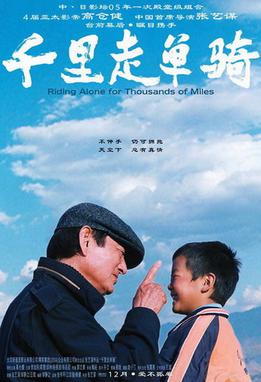
Riding Alone for Thousands of Miles (a guest review by Number Three)

Zhang Yimou (pronounced Jong Yeemo) is officially my favorite foreign director to date. His masterpieces include Raise the Red Lantern, Hero, House of Flying Daggers, and Curse of the Golden Flower. Now we have Riding Alone for Thousands of Miles, which is by no means a masterpiece, but certainly aspires to the greatness I have come to expect from Yimou. Riding is not like his martial arts movies, which most Americans think of when they hear Yimou’s name. Rather, it is more like his stupendous efforts To Live and The Road Home, which show off his ability to craft a story with both human drama and visual beauty.

Riding
follows Gou-ichi Takata on a multi-tiered journey of discovery of self, family, and humanity. One thing that strikes me as particularly unique with Riding is that it is a story primarily in China from a Chinese director, but the lead role is the legendary Japanese Actor Takakura Ken. In fact, Takakura is the only actor in this movie. Nobody else had ever been on screen for a movie before, which is how Yimou wanted it. After all, a story about the common people must be played by common people. It is done with tremendous success here. I didn’t even know there was only one seasoned actor in this movie until I learned otherwise from the special features. I’ve seen enough Hollywood actors unsuccessfully play the common man to no avail. Very few can because none of them are common. There is a sort of swagger in the Brad Pitts and George Clooneys and Renee Zellwegers of our acting set that they just can’t shake.

Well, Takakura Ken shakes the swagger and the rest of the actors never had it to begin with. This movie is a delight from the first frame to the very end. As I said, Riding follows Gou-ichi Takata, who lives in a Japanese fishing village far off from his son. When he learns that his son who’s back in Tokyo is ailing, he goes to visit, only to learn that they had grown further apart than he realized. His son refuses to even see him on his hospital bed. Thus begins a journey when his son’s wife passes along a video tape made by the son that reveals the son’s unfinished passion that he will now never be able to complete. Gou-ichi then sees an opportunity to win his way back to his son’s heart. This takes him to China to seek out what his son was unable to finish.

His quest meets obstacle after obstacle, and Gou-ichi’s persistence in and of itself is an astounding thing to behold, but what is yet more astounding is that his journey's purpose becomes multi-tiered as his focus extends beyond himself to those suffering around him. It is hard to describe the complexity of emotion and drama so skillfully shown, but this film was no doubt a great challenge for actor and director alike. There are moments of sadness and moments of levity, and amidst all of the emotion is the gorgeous backdrop of the majestic Yunnan province of China.

If you’re in the mood for a drama and willing to expand your horizons to another culture, give Riding Alone for Thousands of Miles a chance. There is a quality here that Hollywood often misses.

Number Three’s Score:
Mouthspeak (impact of dialog): +16
Watchfeel (impact of visuals): +18
Mouthfeel (overall watchability): +17


Number Three

Wednesday, March 14, 2007

Because I Said So

Initial Reaction: It's over!! There is a God!!

I, like many of you, have seen a number of movies that I've appreciated to varying degrees. There have been films that I have loved and defended passionately. There are ones that I greatly enjoy, but wouldn't label them as "great movies." Then there are those on the other end: films I've hated because of the ideology they push or because of gratuitous violence. I've felt "meh" about many movies, not impressed but glad to have some kind of distraction in front of me. Then there are those that are just painful to watch.

Because I Said So falls into the last category. I'll be honest, I initially had reservations about seeing it; my tolerance for rom coms and chick flicks has been lessening lately. But I was having a fun night with a friend, and sometimes those movies are cute when you watch them with fellow females. I should've listened to my gut.

From the very opening scene I felt uncomfortable. It was more like watching actors improvise a movie than watching an actual movie. When the movie began, I was bombarded by numerous characters, situations, and lines being spoken quickly and at the same time. Not to mention some subpar cinematography (which says a lot--I seldom notice that sort of thing). I got the distinct feeling as I watched that the actors themselves hated this movie. And that's a bad sign.

Anyway, we are introduced right away to the Wilder family, which includes mother Daphne, and daughters Maggie, Mae, and Milly. Thankfully the older two are already married, but mother Daphne can't help but get way too caught up in her daughter Milly's life. She wants to see her happily married to a very specific sort of man, but Milly has decided instead to throw herself into her career as a chef.

The humor in Because I Said So was more of an annoyance to me than any kind of comic relief. I just wanted them to stop doing funny things. Unfortunately, the humor usually centered around Diane Keaton's character Daphne, and Diane Keaton was horrendous in this film. Annoying, superficial, hyperactive, unappealing and loud, her screen presence was like fingernails on a chalkboard. Since she was intended as the most comic character, this really destroyed any potential that Because I Said So had as a comedy. So let the record show that the "com" from its genre "rom com" is officially absent. I mean, when the running joke is when the "funniest" character walks onto a chaotic scene carrying a huge cake that she spent hours on (and you can guess what happens next), eyes are going to roll.

As for the rest of the characters, Mandy Moore was pretty watchable, but played one of the two characters she always tends to play: the sweet girl. This is fine, but before long her saccharine smile started to make me feel nauseous. One of her love interests (Gabriel Macht) is pretty decent, while the other (Tom Everett Scott) seems to be made of cardboard.

Milly's sisters, played by Lauren Graham (part of the reason I bothered with this movie in the first place) and Piper Perabo have significantly more success with the comedy of the film, but aren't given much to work with and unfortunately are hugely overshadowed by Moore and Keaton.

So, the plot: Milly is single and wanting a man. Mom wants to help, so she goes online, posts a personal ad, and interviews the suitors herself. Most of these have zero potential anyway (surprise: the scene includes a long line of unattractive/unpolished men trying to impress mom... unfortunately, the most funny scene), but at the end of the day, Prince Charming shows up. I'm not even going to give his name. That's how much I care. Anyway, mom decides he is good enough and he makes plans to happen to meet Milly. In the meantime, there's a musician in the room observing this process. He goes and talks to mom to see what she's up to and she explains it to him. He, of course, decides he'll give the daughter a go as well, takes one of her business cards, and leaves.

The long and short of it is that Milly starts dating both men. Mom pushes the one she chose (while not giving away the fact that she chose him in the first place) but Milly seems to prefer the other guy. It's the standard "who is right for me?" problem. There's conflict, there's sweetness, there's baking. In the end, in one of my least favorite scenes from the movie (there are so many to choose from), (SPOILER) she tells off the "wrong" guy because of such reasons as: "You liked what my mother wanted me to wear" and "I just ruined my souffle." Obviously, people, there isn't much here. It's a ridiculous scene that's supposed to be the emotional climax and the main thrust of the "romance" in the film. And so, let the record show that the "rom" part of "rom com" is also absent. Oy.

There were no lines that were memorable, so I'll give you the worst scene instead: Mom asks Milly what an orgasm feels like. Enough said.

Rating: -15

Poorly shot, disappointing in the acting department, painfully unoriginal, and a flop of a comedy, Because I Said So does not have high heights to reach. It achieved a whopping 6% (Rotten) on Rottentomatoes.com. While watching it I felt genuinely uncomfortable because it was so bad. The last scene is a beautiful wedding, and we're supposed to all feel really happy. The movie actually succeeded in making me happy here, if only because I knew it was the end and I didn't have to watch it anymore.

Monday, March 12, 2007

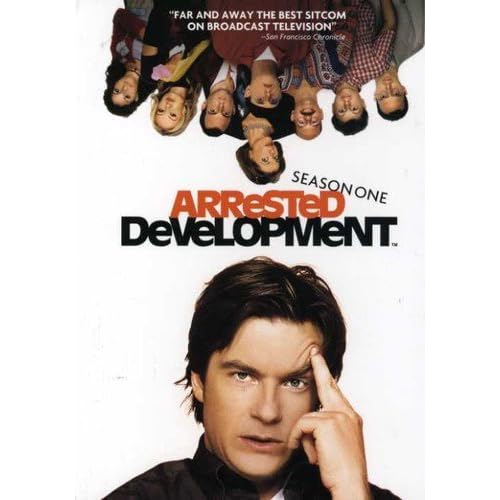
Arrested Development - Season 1

As a TV watcher, I must fit into the category of “non-typical.” Granted, my favorite show is one of the most popular on television right now, 24. But my other favorites have all been cancelled after a none-too-long run. Freaks and Geeks was ignored and then unceremoniously dumped. Firefly was shown scathing disrespect and then discontinued despite overwhelming responses from its small number of fans. The best-fairing of the lot was Arrested Development, which managed to last two entire seasons, but just couldn’t make it all the way through the third. And like my other favorites, I caught onto Arrested Development only after the rest of the world did.

Arrested Development is the chronicle of Michael Bluth (Jason Bateman), high-ranking official in the Bluth Corporation, a construction firm. He is the “normal” one in a family of slackers and spoiled rich people. The family includes his father George (Jeffrey Tambor) who is president of the Bluth Corporation; Lucille (Jessica Walter), his possessive, wine-swilling, neurotic, and conniving mother; Lindsey (Portia de Rossi), his materialistic twin sister; Gob, (actually GOB, an acronym for George Oscar Bluth, played by Will Arnett), his conceited, vindictive, overly-dramatic magician of an older brother; Buster (Tony Hale), his timid and ultra-weird mama’s-boy of a younger brother; Tobias (the fearless David Cross), his ambiguously gay psychiatrist-turned-actor brother-in-law; George Michael (Michael Cera), his studious, confidence-impaired teenage son; and finally Maeby (Alia Shawkat), his disaffected, habitually naughty teenage niece. Don’t worry about keeping all the characters straight; that will come with time.

At the beginning of the first season, Michael is gearing up for what he thinks will be a big promotion at his father’s retirement party on the company yacht. In reality, his father gets arrested (hence the name of the series) and spends the rest of the season in prison. Michael then, as the only responsible (and arguably sane) member of the family, has to save the company from going under. He and George Michael, along with Lindsay, Tobias, and Maeby, move into a model home built by the Bluth Corporation. Lucille and Buster (who is more like a lapdog than an actual son) remain in their luxurious apartment, Lucille throwing money away as if the company were not crashing to the ground.

Michael, now the president, rides his bike to work every morning, and the only car the family has is one of those trucks with the stairs on top meant to be driven up to planes on the tarmac. Due to the ridiculous nature and outlandish behavior of his family members, Michael’s stress and load of responsibility are incredibly high. Gob is constantly cheating on his sweet Latino girlfriend; Lindsay is having trouble with her husband Tobias’s career choice, not to mention his unconscious homosexual tendencies; George Michael has a secret crush on his cousin Maeby, which may not be (but probably is) wrong; Buster, in rebellion from his overbearing mother, begins dating an older woman, who is oddly named Lucille; and as much work as Michael is doing to keep this family together, his mother Lucille seems to be stymieing his efforts at every turn. Yet even through the almost unending tough times, Michael’s family never fractures (despite his father being in jail), and because of that, never splinters into them not speaking to each other. Michael and his son basically have the mindset of “if we don’t take care of these incredibly inept people, who will?”

Honestly, this is one of the best shows ever to be on television. It is consistently funny throughout, features fantastic performances, is hilariously irreverent, and is incredibly sharp and quick-witted. It surpasses the great Seinfeld for TV comedies, because the situations are not just ridiculous and convoluted for the sake of being so, as the ones in Seinfeld so often were. Sometimes the characters say things that are so unbelievably politically incorrect that there is no recourse but to burst out laughing. Also, Arrested Development has a really good theme to it, though it’s buried underneath layers of caricature and hyperbole. It’s that family is the only thing you can truly count on. But Arrested Development is even more interesting than just that, because it takes that theme and then attempts to dismantle it with every single episode, but to no avail. Try as it may, it simply cannot overcome its own optimism.

The season ends much the same way as it started, with a seeming tragedy becoming a source of comedy. It’s sad that this show never really found its audience, but in retrospect, that was kind of inevitable. The brand of humor is very particular, and only certain people will be able to appreciate it. The show was kind of meant for DVD, too, because it really rewards multiple viewings. There are always new things to be picked up when one watches it again. Not too many people actually like it, as can be seen from the fact that it was cancelled, but I am proud to call Arrested Development one of my favorite TV series.

Iconic lines (or exchanges):
“Illusions, Michael. Tricks are something a whore does for money… or candy!”

Lucille: “Did that Mexican girlfriend of yours kick you out?”
Gob: “She’s not that Mexican, mom. She’s my Mexican. And anyway, she’s Columbian or something.”

“Annyong!”

22 Rating: 18

Particle Man

Friday, March 09, 2007

Daredevil/Ghost Rider

Since I’ve been writing reviews so sporadically, I thought that I’d take this opportunity to give our dear readers two, TWO reviews for the price of one! Today I’ll be looking at Mark Steven Johnson’s Ghost Rider, which is currently burning up the box office, and his previous comic book adaptation, Daredevil.

Daredevil was created by Stan Lee and Bill Everett early in the “Marvel Age” of comics. Trial Lawyer Matthew Murdock was blinded at an early age by an accident involving radioactive chemicals (what other kind is there?), which granted him a “radar sense” and dramatically increased his other four senses. Trained by the ninja master Stick, he defends Hell’s Kitchen as Daredevil, The Man Without Fear!
To be polite about it, Johnson’s 2003 film of Daredevil is quite an abortion. Johnson professes to be a big comic book fan, but this movie is plagued by a weak script, numerous character inconsistencies and weak motivations, and quite possibly the worst casting ever unleashed on a Hollywood film. The film begins with a wounded Daredevil, and moves to Daredevil’s origin (tweaked, and not for the better…..more on that later), and then moves back to the present day to explain why he was slumped against the cross on top of a church, bleeding everywhere. Matt Murdock (Ben Affleck….ewwww) and his partner Foggy Nelson (Jon Favreau, in the only good performance in the film) defend the poor and downtrodden in New York. A chance encounter in a coffee shop introduces Matt to Elektra Natchios (Jenifer Garner), daughter of a wealthy businessman in partnership with Wilson Fisk, the “Kingpin” of crime (Michael Clarke Duncan). Natchios wants out of the crime business, and the Kingpin sics assassin Bullseye (Colin Farrell) after her. Daredevil gets caught in the middle, is blamed for the murder of Daddy Natchios by Elektra, and wackiness ensues.
Batman Begins, Superman Returns, and Spider Man 2 have shown us that you can great films out of comic superheroes without taking all sorts of liberties with origins, motivations, etc. But Johnson gives us no evidence that he even really read a Daredevil comic before. First of all, his origin is tampered with so that Murdock suffers his accident by pure chance, instead of his saving an old man in the comics, a selfless act. Also, it is implied that his fighting skills are gained from his radar sense, which “makes the city his playground.” Riiiigghhhtttt. As anybody who’s studied boxing or other martial arts knows, that comes from lots and lots of hard work, not from knowing how to get from Point A to Point B. Second of all, there’s a scene early in the film where Daredevil tracks an acquitted (guilty) rapist, beats the snot out of him, and drops him in front of an oncoming train. This is a marked deviation not only from the character, but the character type. Could you get behind Spider-Man if he dropped a crook off of the Empire State Building? Or Superman if he blew up the head of a bank robber with his heat vision? This same principle applies to fans of the comics, who have seen Daredevil try and stop The Punisher from arbitrarily executing criminals time and time again. Third, he doubts himself throughout the entire film. Not only is this a characteristic the uber-confident Matt Murdock does not possess, it makes Daredevil come across as a whiny loser in the film. Whiny Loser + Blind Man Jumping Off Of Buildings = Does Not Resemble Our Earth Logic.
The casting for Daredevil? Must have been done by a blind man. I had the same problem with all four principals, in that I didn’t believe, or buy a single performance. Ben Affleck is simply the wrong choice for Daredevil. He’s really tall and stuff, sure. But he’s not much of an actor. He cannot convey intensity to save his life, which was vital to this film. A better choice would have been Matt Damon, Guy Pearce, or Ed Norton. Jennifer Garner was an unimpressive choice for Elektra, as she looks about as Greek as Condoleeza Rice. Again, not much of an acto….she can’t do dark or evil to save her life, and that hurts the role. There was a lot of controversy over the casting of Michael Clarke Duncan as the Kingpin, since the Kingpin was very, very white, and…..well, you know the rest. Michael Clarke Duncan is a good actor, and nobody really can convey massiveness onscreen like he can, but that’s not enough. We have a Kingpin who seems to favor brute force over Machievellian manipulation and striking out at his enemies through connections and with influence. As it stands, Duncan turns in a performance as subtle as a cement truck driving through a shopping mall. But perhaps the worst performance of all comes from Colin Farrell, playing the “Lucky Charms” version of cold-blooded assassin Bullseye. As played by Farrell, Bullseye is a manic, cartoonish, extremely goofy assassin, who kills at the drop of a hat, in plain view of people, which again……cement truck in a shopping mall. Even more ridiculous than his demeanor is his “costume”, which consists of a bullseye carved in his forehead, and a jacket that looks like it was leftover from a Meatloaf video. In the comics, Bullseye is like the Hannibal Lecter of the Marvel Universe: Approach with caution. The only reason that one would need to do that to the Bullseye of the film is because he’s liable to annoy you to death.
The nu-metal soundtrack that permeates the score of Daredevil hurts, and ages the film by degrees. Using pop music can be tricky, and in a superhero movie, a traditional orchestral score is best. The cinematography is ok, nothing to write home about. The other big bone I have with the film is that when you have a subject like Daredevil or Batman, a world class fighter, the fight choreography needs to not suck. And please, no CGI to “enhance” the fights.
So what did I like about Daredevil? Well, it was better than Hulk. Jon Favreau was pretty amusing. One thing that Mark Steven Johnson seems to do very, very well is insert scenes which illustrate smart, real-world principles. Take the scene in Daredevil where he returns from patrol. He takes his uniform off to reveal a map of scars, burns, bullet holes, stab wounds, etc. He pops Vicodin in the shower, and painfully pulls a tooth knocked loose out. There aren’t a lot of scenes like that in superhero movies, and more thought like that put into the script would have improved Daredevil substantially.
I can’t give Daredevil anything higher than a -6 out of 22 on the 22 scale, unless we’re talking about the extended, R-rated cut of Daredevil. That cut, which has slightly more depth to the story, gets a -2. Now, how does Ghost Rider stack up?

Ghost Rider is the story of Johnny Blaze, a motorcycle stunt driver who makes a very foolish decision in an attempt to save a loved one, and pays a price for it. Way, way back in Marvel Spotlight #5, Blaze finds out that his foster father Crash Simpson has cancer, and reasons that “there’s only one person that can help me now…….SATAN!” He whips out the Satanic Bible, makes a pentagram on the floor, puts a goat’s skull in it, and summons the devil for a deal that OF COURSE won’t bite him in the ass in any way, shape, or form. He is “cursed” with the power of the Ghost Rider, which he uses to fight evil. While having a cult following, Ghost Rider is for the most part a really cool visual without a ton of depth. The most current Ghost Rider series, written by Daniel Way, is aiming to correct this with a sharp focus on Ghost Rider vs. Lucifer, in a way that’s never been done before. But to be fair to MSJ, GR is nowhere near as developed a character as Daredevil.
The plot of Ghost Rider is a rehash of the origin: Johnny Blaze’s father Barton is diagnosed with cancer, and the young Blaze makes a “deal” with Mephistopheles (Peter Fonda) to save him. Said deal ironically backfires, separating Balze from his girlfriend Roxanne in the process. Blaze hits the road, and we fast forward into present time. The eccentric Johnny Blaze (Nicholas Cage) is a major star on the cycling circuit. He “drinks” jelly beans out of a martini glass, and regards Karen Carpenter with reverence in a pre-show ritual. His assistant Mack (Donal Logue) worries about his increasingly dangerous jumps, and his obsession with the occult. Blaze often asks people “if they believe in second chances.” He runs into Roxanne (Eva Mendes), now a TV reporter, and gets her to agree to have dinner with him. But that night, Lucifer comes calling, Blaze turns into Ghost Rider “the devil’s bounty hunter” for the first time, and is contracted with capturing his son Blackheart (a truly awful Wes Bentley), and wackiness enuses.
For the most part, I enjoyed Ghost Rider. After Daredevil, I definitely wasn’t expecting Shakespeare from MSJ. The movie is well shot, and for the most part, fun to look at. There’s a fairly striking bullet-time shot about halfway in, and the production design is pretty competent. I was actually pleasantly surprised at the creepy ambiance that is present in a lot of the film…..this wasn’t something I thought MSJ would be able to pull off. For better or for worse, the movie is pretty faithful to the source material, which should please hardcore fans of the comic. I mentioned real-world details in the DD review, and one that is rendered nicely is the aftermath of Blaze’s first uncontrolled motorcycle ride through the city on Ghost Rider’s hell-cycle. What do you think a city street should look like after a supernaturally-powered motorcycle goes tearing through it at about 200 mph, on fire? Yeah, it looks a lot like that.
Nicholas Cage’s performance both helps and hurts this movie. Given the odd feel of the film and the source material, there are few actors with Cage’s grasp of the odd that could do justice to it. When Cage pulls this off, as he does in films like Wild at Heart, Leaving Las Vegas, and Dead Fall, the results are very satisfying. When he doesn’t pull it off in a film (Vampire’s Kiss comes to mind…..), he falls flat on his face. What he manages here is something between the two. The very attractive Eva Mendes turns in a workmanlike performance that is adequate. The same can be said for Donal Logue. Peter Fonda as Mephistopheles and Sam Elliot as the mysterious caretaker are really the only actors who understand the material, and act accordingly. Wes Bentley hands us a campy performance that should result in the revocation of his SAG card.
Ghost Rider shares faults with it’s source material: style over substance. The big problem I had with the film is a real lack of dramatic tension. You not only get the impression that Johnny Blaze was mostly tricked into making the deal, but that he never even made up his mind when his signature was “acquired.” This departure from the original origin takes credence away from the idea that he is seeking redemption. Another aspect that adds to this is how powerful Ghost Rider is……every time he fights one of Blackheart’s minions, they get a lump or two in before he completely kicks their asses in. The villains needed to be a much more prominent threat. And while the visual effects were competent, even good, the main character simply didn’t look quite real enough. I’m sure that a skull on fire isn’t easy to render, even with today’s technology, but GR needed to look every bit as good as Gollum, for example. That, and while a lot of the film was legitimately funny, the script needed a once-over to reduce the amount of cheese in the recipe.
All in all, I got what I expected from Ghost Rider: Two hours of simple, escapist entertainment. It is an improvement over Daredevil, but not by much. I give Ghost Rider a 5 out of 22 on the 22 scale, and fear for Garth Ennis’s beloved DC/Vertigo series Preacher, which will be coming to HBO courtesy of MSJ. Gulp.

Tuesday, March 06, 2007

For Your Consideration

I love Christopher Guest.

For those of you saying, "Who?": Please go rent This is Spinal Tap, Waiting for Guffman, Best in Show, and A Mighty Wind. In that order. Honestly, you won't be sorry.

For the rest, this review is for you.

You're wondering, how does this film stack up with the rest of Guest's work as a writer/director? (I include Tap, though Rob Reiner directed that.) Well, it's pretty darn good. Bearing in mind that this is my first viewing, and that Guest films get better with repeat viewings, I'd put Consideration ahead of A Mighty Wind and almost even with Best in Show, though still significantly behind Guffman and Tap.

Consideration is a significant departure for Guest, primarily because that it's not a mockumentary. It does still include plenty of interviews, but in this case the interviewers are characters in the film as well. The non-mockumentary style is a bit of a shock at first, but it doesn't take long to get used to.

In nearly all other ways, however, the film is vintage Guest. It's fueled by an enormous ensemble cast--larger than previous movies. So large, in fact, that even the core actors are on screen for no more than thirty minutes in total. And like all other Guest movies, it features mediocre people reaching for an elusive taste at greatness.

In the case of For Your Consideration, it's a group of people working on a low-budget, narrow-audience film called Home for Purim. The actors in the film are all either past their prime or never had a prime, and the crew are not without their own endearing quirks. But the best way to take this movie apart is by handing out...

Cast Report Cards
First, for the old guard (appeared in Guffman or Tap):
-Catherine O'Hara, as Marilyn Hack, is solid as the lead and mother figure of Home for Purim and the first to get Oscar buzz. She's brilliant at the beginning but gets a bit hammy toward the end. B+
-Harry Shearer doesn't particularly stand out as Victor Allan Miller, the father in Purim, but his quiet competence keeps the film nicely grounded. A-
-Parker Posey is stellar as usual, this time as Callie Webb, the daughter in Purim. She goes a bit over the top in one scene, but overall she does a wonderful job inviting the audience to share in her emotion. A-
-Christopher Guest, himself, puts in perhaps his worst performance to date as Jay Berman, the director. He's amusing in his brief screen time, but this is the least-believable Guest character I've seen. He gets a C.
-Eugene Levy brilliantly handles a role he's perfectly suited for, that of Victor Allan Miller's unscrupulous agent. Solid A.
-Bob Balaban and Michael McKean are decent in a smallish role as Purim's writers, Philip Koontz and Lane Iverson. The two are individually excellent, but don't have much chemistry together, so a B apiece here.
-Don Lake and Michael Hitchcock are sublime as Siskel/Ebert/Roper send-ups: Ben Lilly and David van Zyverden, two critics who can never agree. The scene where they weigh in on Purim made me laugh harder than any other scene in the movie. A+
-Fred Willard does his usual clueless ham schtick, here as Chuck Porter, co-host of a "Entertainment Tonight"-type show. He's good, but he doesn't steal the movie the way he did in Best in Show and A Mighty Wind. So, largely because of the high standards he's set, he only gets a B.

And the new guard (Best in Show and later):
-Willard's co-host Cindy Martin is played by Jane Lynch, who is excellent. It's hard to carve out space next to Willard, but Lynch does so beautifully and believably. So A-.
-Jennifer Coolidge is hilarious in every scene she's in as Whitney Taylor Brown, the producer. She's probably the one actor who consistently outfunnies everyone she acts with in this film: A+.
-Ed Begley Jr. is relatively unrecognizable as flamboyant make-up artist Sandy Lane. It's rather different sort of role for him, but he pulls it off with aplomb: A.
-Christopher Moynihan is perfectly average as Brian Chubb, the son in Purim. He does nothing to distinguish himself but also nothing to embarrass himself in one of the film's larger roles, so h gets a B.
-John Michael Higgins turns in a confident and comical performance as publicist Corey Taft: A-.
-Rachael Harris' performance is notably competent as Mary Pat Hooligan, Parker Posey's girlfriend in Purim: A-.

Some new folks--all of whom you might recognize from television--turn up as well.
Ricky Gervais (David Brendt in the British "The Office") rocks as studio exec Martin Gibb (A), completely outshining his co-exec, Guest regular Larry Miller (B-).
From the American version of "The Office," Jim (aka John Krasinski) pops up superbriefly as an actor in a competing film--too briefly to warrant a grade, in fact.
Other faces you might recognize include Sandra Oh (Dr. Cristina Yang in "Grey's Anatomy") and Richard Kind (Mark from "Mad About You"), who help out the film as a marketing team.

All together, it's a charming little comedy that merits at least one viewing, if not more. It's a solid B+, and on the 22 scale, it's a 10.

Monday, February 26, 2007

Heavyweights (a guest review by Number Three)

This review is dedicated with love to my number two, Particle Man, who insisted that I write a review for a movie I don’t like for once…actually, for twice (I also loathed The Departed). The fact is I rarely waste my time watching movies unless I’m pretty sure I’ll like them. There are a few exceptions. In the case of The Departed, it was purely for educational purposes. In the case of Heavyweights, it was because someone from the youth group we lead suggested we watch it with the group. Needless to say, I think we’ll skip it.

So, you already know I don’t like the movie. But just how bad did I think it was? Well, let’s just say it was Dodgeball: A True Underdog Story bad (without the constant, unfunny “sexual humor”). So, now you know whether or not you’ll like Heavyweights, because the same thing that made one movie bad was the same thing that made the other bad: Ben Stiller. Now, don’t get me wrong, I loved Meet the Parents. It was probably the funniest movie I saw the year that it came out. The problem, though, is that when Ben Stiller isn’t playing the loveable, slightly Magoo underdog, he’s playing a character so bizarre, absurd, stupid, gratingly annoying, unreal, mean, vitriolic, and loathsome, that there’s simply no way for me to get into the movie he disgraces his presence with. Examples of such roles are the aforementioned Dodgeball, along with the irritating rotgut that is Zoolander. And again his sour abrasion is on display in Heavyweights.

Now, technically this is not a Ben Stiller movie. He barely shows up in the credits, yet, whether intentional or not, he is a dominant role with quite a bit of screen time. The basic plot is this: Nicholas (David Goldman) is a chubby young boy and his parents send him to fat camp. He is reluctant at first, but realizes it will be fun, so off he goes. During the first general session at fat camp, the friendly, fun owners announce that someone else is taking over the camp. It turns out that that Tony Perkins (Ben Stiller) is the guy. Whereas the old owners didn’t really push the kiddies at all to lose weight, Perkins is basically a slave driver. He is obsessed and delusional, and in an effort to sell his own name and image, he intends to knock many a pound off the chubbies.

And thus the “comedy” begins. He pushes the kiddies to the point of child abuse (something I guess we’re supposed to laugh at). Once they’ve had enough, it becomes a battle for the camp as some of the old camp counselors work with the kiddies to try to take down Perkins and his crew of buffed-up Scandinavians. Nicholas, his band of veteran fat camp friends, and the seasoned counselors all work together to bring justice to the unjust. That’s pretty much the only admirable part of the movie. This mission encourages and justifies a vengeful retaliation from the kiddies that really doesn’t make them much better than Perkins. Let me qualify…it doesn’t make them morally better. Certainly every one of the child characters and the old counselors are vastly more watchable than Ben Stiller’s character. Oh, by the way, some kids from the cooler camps across the way also cause problems for the chubbies, and I guess we’re supposed to laugh at that too.

Sorry, Stiller. The way to comedy isn’t to create an unbelievable character that goes over the top with “funny ridiculousness.” Rather, the truly funny movies are successful because they involve real characters in funny situations. These situations can border on impossibility as long as they don’t cross over. For example, Meet the Parents is brilliantly funny. The situations are right on the edge of believable. You play a character that we can identify with and care about; not so in Heavyweights. You cross the line of a believable character. On top of that, you are gratingly mean. Thus, this movie is completely unfunny, and when it did manage to pull a laugh out of me, it was a guilty laugh. Try again, Stiller. Take a look at Adam Sandler for some education in comedy.

Number Three’s Score:
Mouthspeak (impact of dialog): -18
Watchfeel (impact of visuals): -12
Mouthfeel (overall watchability): -15


Number Three

Saturday, February 24, 2007

TMBC's Oscar Predictions

The following are They Might Be Critics' predictions for who will win the 2006 Oscars in each of the following categories. Mind you, this isn't who we think should win, this is who we think will win. The critic who predicts the most categories correctly wins a cookie. And the eternal adulation of all the other critics. If you think you can beat us, submit your own predictions for a chance at eternal adulation and a free cookie (after $5.95 shipping and handling).

Best Supporting Actor
Dr. Worm's pick: Alan Arkin - Little Miss Sunshine
Particle Man's pick: Eddie Murphy - Dreamgirls
Stormy Pinkness' pick: Eddie Murphy - Dreamgirls
Wicked Little Critta's pick: Mark Wahlberg - The Departed
Your Racist Friend's pick: Alan Arkin - Little Miss Sunshine
Actual category winner: Alan Arkin - Little Miss Sunshine

Best Supporting Actress
Dr. Worm's pick: Jennifer Hudson - Dreamgirls
Particle Man's pick: Abigail Breslin - Little Miss Sunshine
Stormy Pinkness' pick: Jennifer Hudson - Dreamgirls
Wicked Little Critta's pick: Jennifer Hudson - Dreamgirls
Your Racist Friend's pick: Abigail Breslin - Little Miss Sunshine
Actual category winner: Jennifer Hudson - Dreamgirls

Best Actor
Dr. Worm's pick: Forest Whitaker - The Last King of Scotland
Particle Man's pick: Forest Whitaker - The Last King of Scotland
Stormy Pinkness' pick: Forest Whitaker - The Last King of Scotland
Wicked Little Critta's pick: Will Smith - The Pursuit of Happyness
Your Racist Friend's pick: Forest Whitaker - The Last King of Scotland
Actual category winner: Forest Whitaker - The Last King of Scotland

Best Actress
Dr. Worm's pick: Helen Mirren - The Queen
Particle Man's pick: Helen Mirren - The Queen
Stormy Pinkness' pick: Helen Mirren - The Queen
Wicked Little Critta's pick: Helen Mirren - The Queen
Your Racist Friend's pick: Helen Mirren - The Queen
Actual category winner: Helen Mirren - The Queen

Best Documentary Feature
Dr. Worm's pick: An Inconvenient Truth
Particle Man's pick: An Inconvenient Truth
Stormy Pinkness' pick: An Inconvenient Truth
Wicked Little Critta's pick: An Inconvenient Truth
Your Racist Friend's pick: An Inconvenient Truth
Actual category winner: An Inconvenient Truth

Best Animated Film
Dr. Worm's pick: Cars
Particle Man's pick: Cars
Stormy Pinkness' pick: Cars
Wicked Little Critta's pick: Cars
Your Racist Friend's pick: Happy Feet
Actual category winner: Happy Feet

Best Adapted Screenplay
Dr. Worm's pick: The Departed
Particle Man's pick: The Departed
Stormy Pinkness' pick: Borat: Cultural Learnings of America for Make Benefit Glorious Nation of Kazakhstan
Wicked Little Critta's pick: The Departed
Your Racist Friend's pick: The Departed
Actual category winner: The Departed

Best Original Screenplay
Dr. Worm's pick: Little Miss Sunshine
Particle Man's pick: Letters from Iwo Jima
Stormy Pinkness' pick: Letters from Iwo Jima
Wicked Little Critta's pick: The Queen
Your Racist Friend's pick: Pan's Labyrinth
Actual category winner: Little Miss Sunshine

Best Directing
Dr. Worm's pick: Martin Scorsese - The Departed
Particle Man's pick: Martin Scorsese - The Departed
Stormy Pinkness' pick: Clint Eastwood - Letters from Iwo Jima
Wicked Little Critta's pick: Clint Eastwood - Letters from Iwo Jima
Your Racist Friend's pick: Martin Scorsese - The Departed
Actual category winner: Martin Scorsese - The Departed

Best Picture
Dr. Worm's pick: The Departed
Particle Man's pick: The Queen
Stormy Pinkness' pick: The Queen
Wicked Little Critta's pick: The Queen
Your Racist Friend's pick: The Departed
Actual category winner: The Departed

Categories predicted correctly:
Dr. Worm: 9
Your Racist Friend: 8
Particle Man: 5
Stormy Pinkness: 4
Wicked Little Critta: 4

Babel (Oscar Round-Up)

Some have compared Babel to last year's Oscar winner Crash, and that's not a bad place to start. Both films jump back and forth among a number of loosely connected story lines. Both films cover very different people coming from very different backgrounds. Both films make white people feel bad.

But while Crash packed a more severe emotional wallop, Babel is probably technically a bit better. The different story lines don't seem quite as forced together, the cinematography is a bit more daring, and Babel manages to be even more relevant than Crash.

I know that last claim will need some explaining, but let me first give you an overview of the plot, which contains four distinct but connected elements occurring on three different continents. The first centers around two sons in a Moroccan goatherding family who get in trouble for shooting at a tour bus (thinking that they were too far away to hit it). The second concerns Brad Pitt and Cate Blanchett (the only really recognizable actors in the film); Blanchett is hit by the bullet fired by the Moroccan boys and Pitt must scramble to find her medical help in this third-world country. The third focuses on Pitt and Blanchett's two young children and their Mexican caretaker Amelia. Unable to find someone to watch the children for her on the day of her son's wedding, Amelia decides to bring the children to Mexico with her for the occasion and, predictably, trouble ensues. The fourth plot line is the most tenuously connected: It involves a deaf-mute Japanese girl named Chieko whose father sold a gun to a Moroccan who sold it to his friend who gave it to his son who shot Cate Blanchett with it.

If this is confusing, I apologize. I promise it's easier to follow when you're actually watching the movie.

Rather than confusing you further by trying to continue explaining the mildly convoluted plot, I'm going to attempt to substantiate the my claim: that Babel is more relevant than Crash. Don't get me wrong; I'm not saying that racism is irrelevant. I'm just saying that racism was also relevant ten years ago, and twenty years ago, and forty years ago. Babel, however, is a more perfect time capsule, brilliantly capturing what life was like in 2006.

So what's life like in 2006? Well, as Babel points out, different parts of the world live in very different ways. Without being too showy about it, Babel unmistakeably demonstrates how different Americans live--not just compared to poor, rural Moroccans, but even compared to our neighbors to the south. It's a totally different world, and, to be quite honest, you can't blame the rest of the world for resenting us for it. There's a great moment in Babel where a helicopter flies in to the dingy Moroccan village where Cate Blanchett is being cared for to airlift her to a hospital. The villagers, who have clearly never seen a helicopter, all come out of their homes to gawk at the scene unfolding before them. But behind the pure curiosity in each of their eyes, you can also feel a question burning: "Would you do this for me if I were dying?"

Now, you may rightly point out that Western entitlement isn't exactly much newer than racism, and you're right, but I'm not done yet. Another subtheme of this movie is the fear of terrorism. After Cate Blanchett gets shot, the news media back home gets all riled up, hesitating not at all to call her bullet wound an act of terrorism--even though, if you'll remember, it was just the product of the curiosity of a couple young Moroccan boys. But if you heard that an American tourist got shot while in a tour bus in some dusty Muslim country, you'd instantly assume terrorism as well. So you can understand the reaction of the authorities, even as the boot of justice comes down far too hard on those poor boys. That Babel manages to evoke all these feelings at once is one of its greatest strengths.

If I had to point out flaws: Well, the whole Chieko subplot. It's not a bad little story, it's just that it doesn't really fit with the rest of the film. Sure, if you believe the point of this movie is the difficulty in overcoming language barriers--as some critics (and the movie's title) might have you believe--then yes, it makes sense to include a subplot about a deaf-mute Japanese girl struggling to communicate. But that's really not the point of the movie. It's a bit of a recurring theme, sure, but it's not the point.

I might also point out that, with a bit more focused editing, it would be easy enough to trim 10-15 minutes off of this two-hour-and-twenty-two-minute film. But I don't want to come down too hard on it. The greater point is that this is a monumentally relevant, strikingly poignant, and even unabashedly uncomfortable movie that's well-worth a rental. Does it deserve a Best Picture award? That's borderline, but it's certainly no shame that it was nominated.

I managed to see all five Best Picture nominees this year, so I'm happy to unveil to you my 22-scale rankings for not only Babel, but the other four nominees as well. I'll award Babel a 14, which ties it with The Queen and puts it comfortably ahead of The Departed (11) and Little Miss Sunshine (10). But if I could cast a vote with the rest of the Academy, I'd have to cast my ballot for Letters from Iwo Jima, which just edges the rest of the competition with a 15.