Thursday, February 22, 2007

Letters from Iwo Jima (Oscar Round-Up)

Bravo to Clint Eastwood for making this film. It is a powerful account of the battle at Iwo Jima, Japan in World War II. As a sister movie to his other World War II film, Flags of Our Fathers, Eastwood made Letters from Iwo Jima to give audiences a much more accurate and all-encompassing view of this time period than any one movie could do.

Eastwood took a unique approach to Letters from Iwo Jima. Most war films push a specific ideology that exists on one side, depicting those who represent the enemy as bad, evil, or wrong, while glorifying the actions and words of the "good guys." Eastwood stays away from these things, and in so doing creates a "big picture" movie that tells a tragic story beautifully while simultaneously exposing us to the ugliness of war.

The main character we follow is Saigo, played by Kazunari Ninomiya, a soldier at the bottom of the ladder who ends up in some very difficult situations, but bears it all in the hopes of seeing his family again. The movie begins with the Japanese forces getting ready for the impending battle, doing the backbreaking job of digging beach trenches--which one of them on a dry note refers to as "their own graves." Soon General Tadamichi Kuribayashi arrives, played by Ken Watanabe. Kuribayashi has been sent to command the forces at Iwo Jima, and as soon as he arrives he starts shaking things up. His approach to the battle is entirely different from those around him; for example, he stops the digging on the beaches and instead tells the soldiers to begin digging tunnels. Kuribayashi realized the number of lives that would be sacrificed in those trenches and knew that if they didn't fight more defensively, their slim odds would become even worse. He also strongly believed that his men should be treated humanely and kindly, a sentiment not shared by the leadership under his command.

The beginning of the film helps us to identify with the Japanese soldiers. As the title indicates, we become privy to a number of the letters that were written by the soldiers on this island before and during the battle. At different times and with different characters, we catch a glimpse into their lives, meet their loved ones, and hear their deepest desires and regrets. We hear their hopes, their despair, and the daily musings any other person would have called unimportant. Screenwriter Paul Haggis based these letters on authentic letters that were found on the island in 2005. These scenes add a beautiful, gentle side to an otherwise tragic and sobering film.

I remember distinctly the bitter moment when the battle begins and we see the Americans descending upon the beach. I felt a true conflict within me, seeing my own people arrive to kill and defeat the people I had been getting to know through the film. And as soldiers fell on both sides, I was reminded that for every man there is a mother, a father, a wife. There is an entire story. Through this, Eastwood does away with the "us and them" mentality: the "good guy versus bad guy" idea that is the norm with war movies, and movies in general.

Now, there is "good" and "bad" illustrated in Letters, but it is not limited to one side. There are very specific moments in the film where one sees ugliness as well as beauty from both Japanese and American soldiers. We are confronted with individuals, not faceless enemies or agendas, and we are given this look at the individuals through their letters.

Eastwood shows us not only the conflict that existed between America and Japan, but also that which existed within the Japanese forces, as a new ideology works against an old one. This old ideology fostered fear of the unknown, brainwashing, and suicide. This "battle within the ranks" tore the Japanses apart from the inside, and we are able to see the conflict at numerous levels of command.

I cannot pretend to know what working on this film must have been like for all involved. The direction and screenplay were incredible, and the acting was top-notch. Ken Watanabe is one of my personal favorites; he draws us in and keeps the strength and emotion of his character very well-balanced. Ninomiya effortlessly provides us with a main character who acts as a channel through which we can experience the movie. He mirrors our own reactions to the terror and tragedy of war from beginning to end, and empowers us to hope against the odds that all will be well.

Rating: 17

Letters from Iwo Jima is a story about the Japanese, their culture, the individuals who fought and lost their lives, and this bloody battle. As most people know, it is a very sad story, but we're provided with enough glimmers of hope to not feel completely destroyed at the end. It is a masterpiece which pays a wonderful tribute to both sides, while at the same time reminding us to remain humble.

Wednesday, February 21, 2007

The Queen (Oscar Round-Up)

When I was little, I, probably along with every other little girl in the world, dreamed of being royalty. Although my parents claimed that I acted like I was, that didn’t change the fact that I wasn’t royal. As I got older I felt a sense of envy for royalty; they had all that money and power just because they were born into it. They never worked hard for it. Now, however, while I still do feel somewhat envious, I’m also very relieved that I don’t have to live up to the expectations that blue bloods do. This feeling definitely hit home when I saw The Queen.

The Queen tells the story of the way the British Royal Family dealt with the death of Princess Diana. When the death of Diana is announced to the Royal Family, the Queen decides that they will mourn privately for their ex-daughter-in-law. However, this causes a great uproar among the British people, who, because of their love for Diana, believe the Royal Family should show some outward sign of mourning. In the middle of all this is Tony Blair, the newly elected prime minister, who must save the Queen from her own ways in order to preserve the monarchy in the public eye.

Although I love history, I didn't expect to enjoy this movie that much. It did get nominated for an Oscar, however, so I decided to go see it. From the moment the movie started I saw how wrong I was. I was completely drawn into this film. It didn't feel like I was just watching a story unfold, it felt like I was involved in the story (which, for a nonfiction movie, is a bit of a miracle).

The acting in this movie was near-perfect. While I was not very familiar with Helen Mirren before this movie, I was aware that she had recently completed a role as Elizabeth I and now was playing Elizabeth II. Most people thought that this was quite an accomplishment, but I decided to see if she could act before jumping on that bandwagon. Let me tell you, she can act. She looked like the Queen; she conveyed this reserved and powerful manner that made me believe she was Queen Elizabeth II; and she showed brilliantly how she was conflicted between being the sovereign of her country, a mother, and a grandmother to two boys who just lost their mother.

Another great performance in this film was turned in by Michael Sheen as Tony Blair. Not only did he look like the Prime Minister, but he lets us see the human side to these foreign political figures we all see on the news. Sheen did an excellent job of showing that the main conflict of the movie also existed within Tony Blair: he clearly understood the disappointment with the Royal Family's apparent lack of remorse as well as he understood the Queen's need to be private and reserved--and was frequently explaining one point of view to those who held the other. Such internal conflict requires excellent acting, and Sheen hit this dead on.

Sheen and Mirren were the standout performances of the film, but other actors pulled their weight as well. Alex Jennings did a good job of portraying Prince Charles, although I think everyone wishes Prince Charles looked more like Alex Jennings. One character that annoyed me, however, was Prince Phillip, the husband of Queen Elizabeth II, played by James Cromwell. He seemed to always want to run things, and there were several times where I wanted to point out to him that he had no power, his wife was in charge.

If you're wondering whether The Queen is worthy of the Best Picture Oscar, it is. It had wonderful acting. The story was unexpectedly compelling and drew you in. And there was a stroke of symbolism within the movie that enhanced the film with multiple interpretations. It is a great movie and has the whole package, which earns it a 16.


-Stormy Pinkness

Tuesday, February 20, 2007

Little Miss Sunshine (Oscar Round-Up)

Imagine, if you will, 6 people who are as different from each other as Pepsi is from ice cream, but have one thing in common: they are all related to one another. With some that connection is rather tenuous, either because of marriage or dislike, but the fact remains that they’re all family, and there is no getting around that, much as they sometimes wish. Little Miss Sunshine is a film about the unbreakable connection of family, and about the way that even though you may fight with them, scorn them, and do things simply to piss them off, you will always be there for them in their time of need, just as they would be for you.

Gone are the days of Ward and June Cleaver, and family dynamics are no longer simple. Actually, they were never simple; shows like Leave It to Beaver just desperately wanted you to think so. Now we have broken homes, homes with additional members, and even parental units that exist of two members of the same sex. Just as regular households have become rarer, functional families have become rarer, too (though the relation of the two is very debatable). Little Miss Sunshine demonstrates that, and also demonstrates that even though things are frustratingly complicated now, they don’t have to be bad.

Little Miss Sunshine deserves to be a Best Picture nominee for a number of reasons. First and foremost is the splendid way in which it shows the familial bond, its good and bad parts. It does this through caricature, and that fits in with the tone and plot of the film. It’s technically called a comedy, and it is ridiculously funny. But the contrivances and conventions of comedy are strangely missing, and even stranger, it’s not really a problem. There are plenty of laughs, but there are also moments of stark seriousness, and that mixture catches us off-guard. Sometimes it works, sometimes not.

Second are the fantastic performances in it. Of the six main characters, only Toni Collette is just so-so, and the rest are amazing. Steve Carell plays against type with his depressed college professor, without a hint of hyperbole or heavy-handedness. He’s a quickly rising star, and I haven’t seen him in a bad role yet. Greg Kinnear elicits hatred and bile as the father of the family. I don’t feel even an ounce of sympathy for him as his plans come crashing down, but I don’t think I’m supposed to. I feel much more connected to Alan Arkin’s character, the smack-sniffing grandpa. He’s foul-mouthed, hedonistic, and doesn’t care what anyone else thinks, but he demonstrates first the “family is all you’ve got” theme. Paul Dano uses one of an actor’s greatest tools in the first half of the movie to fantastic effect. After all, “no voice” can be a voice.

That leaves Abigail Breslin, who is nominated on her own for Best Supporting Actress. She really earns her nod, as she plays her character as a brilliant bright spot amidst the grungy dirt of the rest of the family. She could have easily given in to the grimness of the rest of her family, but she instead has a sunny disposition even in the face of tragedy, and Breslin has us rooting for her at the very start of the film. Even though she’s obviously physically imperfect, she was the most “pretty” of all the beauty pageant contestants.

Sadly, I don’t really think this will win Best Picture. As good as this movie made me feel when it was over, it’s hurt by the fact that what it has to say is not all that important, at least compared to the other nominees. But it does have a positive message, and great performances to boot; a film worthy of the label “Best Picture nominee.”

Iconic lines:
“Welcome to hell.”
“I’m madly in love with you! And it’s not because of your brains or your personality.”
“Again with the f***in’ chicken!”

22 Rating: 15

Particle Man

The Departed (Oscar Round-Up)

Before I say anything else, I want it noted for the record that I think Goodfellas is the most overrated mob movie I've ever seen. And that Martin Scorsese is just as inconsistent as any classic filmmaker. Having said all of that, Scorsese turns in his most consistent work in years with The Departed. And while solid, The Departed doesn't quite ascend to sit aside other great Boston movies like Good Will Hunting or Mystic River, but it's sitting directly behind them.
Scorsese's latest police and thieves epic, a remake of the Hong Kong film Internal Affairs (and its sequels, in a way), tells the story of two young men in the state police, Billy Costigan (Leonardo DiCaprio) and Colin Sullivan (Matt Damon). Billy grew up in a fractured family with mob connections, and Colin under the watchful eye of Whitey Bulger analogue Frank Costello (Jack Nicholson, in his finest performance since Batman). Colin works his way up the ranks of the state police, while using his position to keep Frank one step ahead of the police. Billy is persuaded to use his family history and violent background to infiltrate Frank's gang in an attempt to bring him down for once and for all. And from there, wackiness ensues.
Now let's stop and talk about the performances. Performace-wise, The Departed is the movie I've been waiting for all year, in that the performances don't simply serve the film. Based on his work here, I think I can finally consider DiCaprio a solid actor. He doesn't do anything flashy here, but he has done his homework. He gives us a Billy Costigan who has no problem beating the crap out of a couple of goombas from Providence with a comic book rack for shaking down a Pakistani store owner, but visibly flinches while Frank brandishes a severed hand and talks about John Lennon. Matt Damon turns in a solid performance as Colin Sullivan, who we see slightly recoiling from time to time, from the choices he's made, and the position he finds himself in. Jack Nicholson is one of those actors I watch all the time, and think "He could be doing better work," the other being Gene Hackman. But here he completely shines as the malevolent Frank Costello, stealing every scene he's in without even coming close to overacting (Paying attention, Al Pacino?). Vera Farmiga is serviceable as the psychologist who is caught between Colin's easy charm and Billy's raw nature. Martin Sheen turns in a subtle, unpretentious performance as Captain Queenan, one of two links to the outside world for Costigan. The other, Sergeant Dignam, is played by Mark Wahlberg, who is making himself more and more invaluable with each passing year. The foul-mouthed (slightly more so than he would be in reality, unlike practically all of the other characters in the film) Dignam serves as an unlikely voice of reason, and seems to have stolen Robert DeNiro's terrible haircut from Scorsese's earlier King Of Comedy. Ray Winstone shows up as Mr. French, Costello's right-hand man, unrecognizable under his skeezy beard. I must give special mention to Alec Baldwin, as SPI Captain Ellerby. Baldwin squeezes maximum impact out of the relatively few scenes he's in as the sweaty, boorish Ellerby. Baldwin is also the actor who has the most accurate Boston accent, save natives Damon and Wahlberg.
One department that helps the film a lot here is the music. Scorsese tones down the overall density of classic rock songs, and uses several effective selections, most of them from the Rolling Stones' seminal Exile on Main Street. The score was also very effective, sort of an urban version of spaghetti western guitars, performed by the prestigious likes of Sharon Isbin and G.E. Smith, under the masterful ear of Howard Shore, late of the LOTR trilogy, Dark City, Silence of the Lambs, and many other classic film scores in recent times. Scorsese reunites with Goodfellas/Last Temptation cinematographer Michael Ballhaus, who gives us an attractive yet realistic Boston, and gives the film a nice feel somewhere in between Altman and Anderson, which is right where Marty S is supposed to be. William Monahan is the film's secret weapon, giving us whip-smart, blink-and-you'll-miss-it dialogue, which contributes greatly to the film's excellent pacing. And I have to step in here and defend the film's language...like many Scorsese films, the "excessive" language is cited as a bone of contention for some. Yes, there is a lot of swearing in The Departed, but it is accurate. If you listen to 99% of Bostonians conversing outside of polite company, they talk pretty much EXACTLY like the characters in The Departed, Dignam excepted. People also talk about the violence, but I have three things to say about it: One, children and those who don't have the stomach for lots of gore shouldn't be watching films by Scorsese, Miike, Tarantino, or any other director who is somewhat infamous for violent content. That's like me saying that I went to see the Barney movie and was put off by excessive hugging. Two, in a movie about cops and the South Boston Irish mob, people are going to get shot in the face at point blank range. A lot. It's what's called content that is appropriate to the material. Thirdly, even aforementioned face-shootings in the movies don't seem like much when you've been exposed to real world violence. It's brutal, ugly, and virtually impossible to capture on celluloid...not that it should be. I don't want to make a reductionist statement to the effect that people who haven't seen stabbing and shooting victims, or have seen or been in serious (read: one person is trying to maim or kill the other person) fights aren't qualified to comment on violence, but I will say that a large section of the puzzle is missing for them.
The Departed suffers a bit from what I feel is excessive character death, and by missing plenty of opportunities to dig deeper into what makes the characters tick, adding more substance to the film. It is what separates The Departed from other great crime films like the first two Godfather films, Double Indemnity, and Se7en. Having said that, Scorsese has distinguished himself with a admirable showing that hasn't escaped notice. The Departed is currently number 74 in the IMDB Top 250 movies of all time, and holds a very impressive 93% on rottentomatoes.com. I give The Departed a rock-solid 13 out of 22 on the 22 scale.

24 Watch: James Badge Dale, who played Jack's Season 3 partner Chase Edmunds, turns up here as a state cop.

This review was fueled by Exile on Main Street by The Rolling Stones (duh).

Friday, February 09, 2007

Indiana Jones and the Last Crusade

What could be better than a rip-roaring, action-packed, good vs. evil adventure across three continents? One that includes Indiana Jones!

The third installment in the Indy trilogy is by far the best one, as it contains themes and conflicts the level of which are simply not found in the first two. Don’t get me wrong, the first two are great, especially Raiders of the Lost Ark. As great as they were, though, they’re really just fun action stories that appeal to the 8 year-old in all of us, instead of just blowing stuff up and wowing us with CGI like today’s action movies do. Indiana Jones and the Last Crusade is that as well, and so much more. The quest for the Holy Grail is a great starting point for so many engaging stories, this one being the chief of them (tied with Monty Python). The reason for that is that there can be any number of “holy grails.” Anything that a hero strives for, and that at times seems unattainable, is a holy grail. That can be anything from the tangible (like the Grail itself) to the intangible (like an actual relationship with one’s father).

The Last Crusade was released in 1989, a time when special effects were not the thing they are today. In modern times, digital photography and advanced post-production make virtually anything possible. Back in ’89, filmmakers had to use a little more ingenuity to make things happen. The Last Crusade had basically everything going for it, because it had a genius of a director in Spielberg, and a master of special effects (and nothing else…) in George Lucas. Besides having production values that gave it the space to stretch out, it was amazingly cast as well. Harrison Ford plays one of the only roles that fits him like a glove, as he had proven with the first two films. Trumping him is Sean Connery, who injects comedy and light-heartedness as well as a strong sense of dignity to his aging archeological professor.

Like I said, this movie has overarching themes that bring it out of the realm of simple good storytelling, the realm the previous two movies exist in. The father-son struggle is very strong throughout, but in typical Spielberg-ian style, it transforms from a struggle to an appreciation and admiration, and maybe even a love. But what really makes this movie great is the optimism of it, another element of it being a Spielberg film. The character of Indiana Jones is a real, genuine hero, stereotypical and iconic in the best way. When he beats the bad guys, you cheer. When he’s in danger, you flinch. When it looks like he’s about to fail, you get filled with a sense of dread. Those things are a part of good storytelling, and are the result of creating a character that the audience can believe in and root for 100%. In order to create that kind of character, the filmmakers have sacrificed some realism and believability, but I think it’s more than a fair trade. In a way, the ridiculousness and un-reality of some situations only make them more enjoyable. Of course Indy’s hat comes back to him after he almost falls off a cliff. Of course the tank veers to the right at the last second. Of course Indy and his dad don’t get killed or severely maimed when they crash the plane. It’s not a surprise, and it’s sort of expected. If it weren’t there, we’d be disappointed.

The original genesis of the Indiana Jones character was an idea in George Lucas’s head, one he generated around the same time he had created the Star Wars universe. It was based around 1930s serial adventure stories, ones where plucky heroes would find riches, glory, and pieces of tail on escapade after exotic escapade. Three films later, Indy has become one of the most enduring and immortal characters ever put on film, and a part of the childhood of many members of my generation. Whispers of a fourth film exist, but it’s been almost 20 years since The Last Crusade, and you now have an entirely new demographic to appeal to, and Indy isn’t quite as big a star to them. Never mind the fact that as the Indy trilogy is 20 years older, so is Harrison Ford. I don’t think the whip and fedora will fit him the same way anymore. We’ll see, though.

Iconic lines:
“X marks the spot!”
“He chose… poorly.”
“You call this archeology?”

22 Rating: 16

Particle Man

Tuesday, February 06, 2007

Classics Rocked: Life Is Beautiful

The reputation: Much-hyped-at-the-time 1998 film about a man who attempts to protect his son from the horrors of the death camp they are in.

Why it's not as good as you think: Uhhhhh, it's not good at all. I can see why some people thought this movie was touching and a good idea, but it was completely misguided. First of all, it's a "comedy" about the Holocaust. I don't think that this is an idea that is completely out of bounds if done properly, but I didn't laugh once during Life Is Beautiful. Strike One.
For those who haven't experienced the horror of this overpraised trainwreck, let me save you the trouble: Italian Jew Guido (Roberto Benigni) arrives in small village, and woos beautiful Dora by being somehow less of an @$$ than her fiance, and by using cheap parlor tricks to mesmerize her into ignoring his obvious looks, and lack of personality. Benigni's aggravating "love-child of Pee Wee Herman and a Marx Brother" persona is Strike Two. Benigni's wife Nicoletta Braschi's performance as Dora is the film's sole saving grace, and keeps it from being COMPLETELY toxic to children and other living things. Fast forward a few years later. The Holocaust is in "full effect," and Guido, Dora and young son Joshua are tossed in a concentration camp. In an effort to shield Joshua from the horror that surrounds them, Guido tells him that the camp is a "hiding game," and that the winner gets a tank. (Ok....I have to give credit where it's due, again. That concept is so sick, it's ****ing hilarious.) Despite the fact that THEY ARE IN A CONCENTRATION CAMP AND PEOPLE ARE CRYING AND BEING MISERABLE AND GETTING SHOT AND GASSED AND DYING all around them, Joshua buys it. This is where the film REALLY loses me.....I just can't but the fact that nobody around tries to offer the kid up to the guards in an attempt to save their own butt: human beings are far too selfish. I can believe a man can fly, and toss planets around, but this is beyond the wildest sci-fi. Strike Three, yerrrrrr out. Anyway, Guido is shot by guards, and Joshua is reunited with his mother as American forces arrive to save the day. How bittersweet. Eeeeeechchhhh.

I refuse to believe that this film won an Oscar. I think that there was a wormhole ala Donnie Darko, and our section of the Academy Award was switched with the corresponding part of the ceremony from Bizarro World, and none of our quantum scientists caught the gaffe. Arrrgh. Me love Life is Beautiful. Me say hello now!

Dr.Worm's Response: Really? The story of a man trying to protect his son from the horrors of the Holocaust--even losing his life in the process--doesn't do it for you? Not at all moved by the noble concept of self-sacrifice? Well, to each his own, I guess.
But was there a line in there about Guido having a "lack of personality"? I'm trying to wrap my mind around that one, and I'm having trouble. Guido oozed personality. His personality jumped off the screen. You might not have liked his personality--though I have no idea why, the Academy and I found him perfectly winsome--but there's no way you can say he lacks personality. It's like saying Shaquille O'Neal isn't tall.
And you didn't laugh once? Not even at lines like "I don't like Visigoths. Tomorrow, we'll get sign: 'No Spiders or Visigoths Allowed'"? And you found Guido annoying? Even as he's saying, "I want to make love to you--not just once, but over and over again! But I'll never tell you that. I'd have to be crazy to tell you. I'd even make love to you now." See, your strikes one and two were both home runs for me. I'll grant that it's a little tough to believe that Joshua never catches on about the game, but I think the film is self-aware enough to know that, too. So I'll call that a foul ball.
I find it difficult to believe that you were unmoved by such a charming, captivating, and good-hearted film. Perhaps, while you watched it, you were sitting on a tack, being pestered by mosquitoes, and battling a case of mumps. That's the only way this savaging makes any sense to me.

Wednesday, January 31, 2007

Classics Rocked: A Clockwork Orange

A Clockwork Orange
The reputation: Stanley Kubrick-directed film about a violent teenager in a future dystopia who gets behavioral conditioning so that he gets sick at the thought of harming anyone is highly acclaimed, and makes a muddled comment about free will.
Why it's not as good as you think: With Kubrick, everything is different, and less movie-like. Sometimes that's a good thing, but considering his penchant for graphic violence and nudity, it's most often bad. A Clockwork Orange is a very violent story, both in sexual and non-sexual ways, so that combined with Kubrick's general tone makes for a very intense film. And it's the bad kind of intensity here, the kind that makes you want to run and hide. The sets and costumes are supposed to be strange and disturbing, but come across as either comical, low-budget, or both. If you know anything about the novel that it's based on, you know it's divided into three parts, seven chapters each, for a total of 21 chapters. Well, in Kubrick's film, the last chapter and its events are cut out, and in this case, that's critical. Because of that, Kubrick's movie ends in darkness and evil, while Burgess's novel ends in hope. With the novel, we got to make up our own visuals, but when it's on film, Kubrick made up the visuals for us. Also, I'm sorry, but I just don't care for Kubrick's visual style. The choices he makes about camera angles is cool, but his sets and costumes are a joke. The white fedora, suspenders, cane, and exaggerated crotch may be iconic, but they just come off looking silly. Kubrick's genius my butt.

Your Racist Friend's retort:
I guess that's all well and good, Particle Man, but there are a number of things you're ignoring about this film. Like Kubrick's unprecedented use of music in the soundtrack, specifically established, well-known classical works. Then there's Malcolm McDowell's great performance? Kubrick said he probably wouldn't have made the film if Mcdowell wasn't available! The movie was nominated for several Academy Awards, including Best Picture, but then again, so was Titanic. And you talk about the violent subject matter, but it's extremely toned down from the book. Also, despite the missing 21st chapter, the indictment of the system, and how it makes young men like Alex DeLarge is very clear and intact. I stumbled across the insanely out of print DVD of this film in Newbury Comics a few months ago, intending to hock it on Ebay. But when I sat down and watched it, I decided it was too good a film for me to do that.

Monday, January 29, 2007

Classics Rocked: E.T.

In the hundred-odd years of movie history, certain films have been praised so effusively or so frequently that expressing a negative view of them is nearly unthinkable. Well, as critics, we pride ourselves on not following the crowd, and we're here to tell you why a few of your favorite movies suck. This week, Dr. Worm will rip E.T., Particle Man will bash A Clockwork Orange, and Your Racist Friend will slam Life is Beautiful. But just so your soul isn't completely crushed, each panning will get a brief retort from critics who believe these movies deserve their classic status.

E.T.
The reputation: A critically acclaimed and well-loved classic about a cute little boy, a cute little alien, and a journey back home.
Why it's not as good as you think: The thing with Steven Spielberg is that he never wants to leave his audience with any doubt about how they should be feeling at a given moment. He's got that trait working at full throttle in E.T., which features a darling little boy interacting with an adorable, big-eyed, glowy-hearted alien. Some of it works, but much of it is just ridiculous and laughable, like the climactic (read: campy) scene in which people clad in space suits break into Elliott's house through the doors AND the windows. Other moments fail the schmaltz test as well, such as poor Elliott--child of divorced parents--finding his absent father's shirt in the garage and remarking plaintively to his brother, "Dad's shirt ... remember when he used to take us out to the ball games?" And when it looks like poor E.T. has finally bit the dust, what brings him back to life? No, not the ceaseless workings of highly-skilled doctors, but Elliott's love. In other words, if this movie were a cookie, and you ate it, it would give you diabetes.

Particle Man's retort: Have you no heart, Dr. Worm? This movie has a lot going for it, not the least of which is a childlike view about things. In E.T., the world is a simple place of bike rides and trick-or-treating. E.T. is the ultimate child; he has rudimentary verbal skills, doesn't understand things outside his own world, and has the courage to be who he really is because he doesn't know how to do anything else. And the fact that Elliott cared so much for E.T., enough to bring him back from the grave, is a testament to the all-reaching power of love, and how it can break through all boundaries. I find it hard to believe that such a sentiment cannot pierce your heart even a little.

Friday, January 26, 2007

Rent

“How do you measure a year?” I’m pretty sure that, by now, almost everyone has heard of this lyric, which is in the song “Seasons of Love” from the Broadway show Rent. But don’t worry if you still have no idea what I’m talking about, because it’s no longer necessary to go to the theater to see the show (it’s still a good idea though). That’s right, ladies and gentlemen, you can now watch Rent from the comfort of your own home.
Some people may still be asking what Rent is, besides just being a musical. Well, I’ll tell you. Rent is the story of a close group of friends who live in New York City. Almost all of the main characters are poor artists, willingly suffering from lack of funds in order to stay true to their art. The story begins on Christmas Eve and ends the following Christmas Eve, which leads them to ponder how one year can be measured. Throughout this year the friends have to deal with many changes in their lives, some good, some bad. Some have found true love, others are trying to just make sense of their lives. Some are dealing with AIDS and drug addiction. And through all of these things, they all look to each other as a supportive family.
First, allow me to say that I absolutely love the idea of Broadway musicals as films—mainly because I would love to see all of them, but if I had to go to a theater to see all of them then I’d never have any money. For this reason, I never saw Rent on the stage. I knew the soundtrack by heart, but I could never attach any visual elements to it until I saw this film about a year ago.
The film? It was good. I enjoyed it. However, it was nothing as spectacular as I expected Rent to be. The acting was solid and everyone had great voices—Idina Menzel, in particular, gave a standout performance as Maureen—but this musical had been built up in my mind for so long that I think it was inevitable that I was let down a bit.
For me, the music was more interesting than the film, I think because everything seemed so emotional when they were singing, but some of that emotion was lost when they were just speaking. I’m not suggesting they should have sung the whole time, but there seemed to be quite a disconnect between the sung and spoken portions.
I had been told that Rent was the BEST musical ever, which I did not completely agree with. It was good, but nothing completely outstanding. Overall, I would give the movie a 12. I thoroughly enjoyed the music, but enjoyed the dialogue a little less. Although I did learn how to measure a year.

Wednesday, January 24, 2007

Fight Club

In case the title is no indication, Fight Club is a "guy" movie. Sorry for the support for stereotypes, but I can't put it any other way. And despite being a gal myself, I can see what appeals. It's a cool idea to think about fighting for the sport of it, getting out frustrations, building your toughness in a situation where you aren't judged for wont of it.

Fight Club starts off on a very funny, dry note. The main character, who serves as the narrator, is played by Edward Norton, and he is engaging enough to keep us interested in his sad, dull life. He is trying to fix a problem of his: insomnia. He can't sleep for days on end, and he's desperate. A doctor gives him little help, and in response to his pleas to end his suffering, tells him to go visit the local support group for men with testicular cancer to see what real suffering is.

Willing to try anything, he goes, and finds it very therapeutic. He was free, accepted, and encouraged to express emotion. And even better, he started sleeping. So begins the addiction. He starts attending as many support groups as possible, whether they apply to his specific situation or not (mostly not). It seems as though he's found the cure, until someone catches on to his scheme. Her name is Marla, and she's a fraudulent group attender as well. Suddenly his freedom is stifled, and he starts the downward spiral all over again.

And then, he meets Tyler (Brad Pitt). Pitt's character is quite a unique personality, and his free, uncaring attitude towards life attracts Norton. Their lives quickly become intertwined, and after an evening of fighting each other for the heck of it, Fight Club is born.

Now, this is the part of the movie that appeals to most guys. The idea that he could get together with a group of men to practice fighting for the sport of it--almost for the therapy of it. Fighting overtakes their lives, and causes them to see everything differently. They begin sizing people up and thinking about who they could pummel if they got the chance. They go through each day in anticipation for the next fight. Norton is satisfied again.

Then it all goes spiraling out of control, and in the process, it lost me. The first part is very different from the second, and as a viewer I didn't feel as though it worked. Fight Club keeps growing, and those who attend are faithful in their membership. It's a secret society, but inevitably, rumors start. They begin vandalizing public property and terrorizing innocent people. They do have a purpose, and that purpose is to set people free to truly experience life by letting go of things that don't matter. A great idea in theory, but in practice things get more and more sketchy. It all gets very unreal, and it quickly becomes clear that no one knows where the line is, or whether or not it has been crossed. Pitt and Norton become almost dictators to this group, and before long things start to get really ugly. Norton starts to get uncomfortable with everything going on, understandably, and then: the twist. I'm left with half of a movie with great potential.

**SPOILER**

I had actually heard what the twist was a long time before seeing the movie, but as the film unfolded, it seemed less and less possible to me, so I forgot about it. But it still came: we learn that Norton and Tyler are actually the same person. And as I sat there watching, I thought (as I frequently say), "seriously?" I mean, I guess they made it work, but to me it was like one of those kids' toys where you have to put the star-shaped block in the star-shaped hole. It won't fit in the square hole. Director David Fincher hammered it into the square hole.

My biggest question is, why did the film go in this direction? The main guy losing his mind is decent material, but it was totally out of the blue. And...seemingly without greater purpose. We get a very subtle sense throughout the movie that there's more to Tyler than meets the eye, but nothing in the way of identifying him as the other personality of the narrator. Sure, in hindsight you can look back and say "Oooh, I can see why she said that..." but there was no light bulb moment. I guess it was more of an explosion moment.

At first, I thought Fight Club had something to say, a character to redeem, or something. It was headed in good direction. The problem is, in the end, the filmmakers allowed the crazy plot twist to take over and drown out the real point. They, like Tyler, suffered from split personality. Unfortunately, the insane side won.

**END SPOILER**

Rating: 4

What the heck was the second half about?? There were some decently funny parts, involving his boss and where he lives. Norton and Pitt were also great personalities to play these roles. But it started off funny, surprising, intriguing, and purposeful. It ended disturbing, crazy, mutilated, and pointless. Fight Club began as a fresh film, but turned faster than milk on a hot day.

Thursday, January 18, 2007

Rocky Balboa

All throughout the month of December, there was only one movie in wide release that I was looking forward to, and that movie was Rocky Balboa. Myself, and one of my co-workers. Everybody in our department thought we were crazy. After all, Sylvester Stallone's last starring vehicle to gross over $100 million was Rocky IV, 21 years ago. His name has not been concurrent with box-office draw in this decade, or the last. It took several long years to get a studio to back this, the final installment of Rocky Balboa's story, and they would only give him about $20 million. So was their investment justified? After all, the franchise has been artistically bankrupt since the first installment.....right?
I say, wrong. Though the fifth film remains unwatchable, and I find the second and fourth films just ok, the third is a great guilty pleasure of mine. It would have been a shame for the series to end on the note that Rocky V set, and Stallone ably recovers with Rocky Balboa, the strongest film in the series since the classic first installment.
The events of the newest film take place several years after the events of the fifth film, which isn't referenced or brought up in any way. Adrian has been dead from cancer for several years, and Rocky runs a restaurant named after her, posing for pictures and telling stories for patrons. The opening sequence has him visiting her grave, talking to her as if she was still alive. Paulie (Burt Young) is still working at the meat packing plant, and Rocky's son (an underwhelming Milo Ventimiglia) works at some financial-type job as a worker bee, uncomfortable in the shadow of his celebrity father. Rocky goes on an annual tour of the city with Paulie, remembering his early courtship of Adrian, and she appears in flashback, as if she was a ghost. Weighed down by the poor way in which he treated his sister, a guilty Paulie urges Rocky to forget the past, which then visits Rocky in two ways. The first occurs when Rocky ducks into a neighborhood dive for a beer and a memory, and the bartender is "Little Marie" from the neighborhood (Geraldine Martin), whom he walked home in the first film, and admonished against hanging out with bad crowds and smoking, to no avail ("Screw you, creepo!"). Marie is now grown up, a single mother, and Rocky becomes a close friend. The second is a computerized fight run on ESPN that pits Rocky in his prime against current milk-fed heavyweight champ, Mason "The Line" Dixon (Antonio Tarver), and claims Rocky as the clear winner. This gets Rocky thinking, and an exhibition match is set up, as Rocky goes into the ring for one...... last...... time........ (Actually, the third "last time" since the second film.....I think. Don't quote me on that.)
Rocky Balboa has several things going for it. One is one of the best film scores of all time. Another is one of the most root-for-able characters in the history of film. Stallone performs his triple duty of star, director, and writer quite nicely. The script is a bit monologue heavy, but there are some nice touches in there, like Rocky's local celebrity and how that is handled. There are strong performances from Stallone, Young, and Geraldine Martin, who practically steals the film with her big eyes and tentative portrayal of Marie. The DP should be commended, as this is easily the most artfully shot of the Rocky films, with an apparent variety of techniques and cameras used.
Now for the bad news: I was hoping that this would be a great film, but it's merely pretty good, and here's why. First of all, Tarver isn't a very strong personality, and is a very underwhelming opponent for Rocky, despite the fact that he's 30 years younger. His character also (of course) undertrains for the fight. Shades of the Braddock/Baer fight in Cinderella Man, I think. Ventimiglia also turns in a snoozer of a "performance" as Rocky's son. I don't think all of this is his fault, as the role seemed a bit underwritten to me. Also, the story has dramatic weight, but I don't think that there's enough of it to give it the emotional impact that it should have had. I didn't feel like the stakes were as high as they were in, say, Rocky III or IV. Also, two other minor nitpicks I have that hurt the film a bit: Duke's (Tony Burton) part should have been bigger, and the training sequence needed to be more kickass.
Overall, I liked Rocky Balboa. If you're a fan of the series, you'll like it a lot. If you're not, you might find yourself pleasantly surprised. I give Rocky Balboa a 10 out of 22 on the 22 scale.

Monday, January 15, 2007

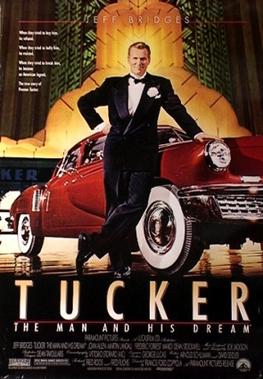
Tucker: The Man and His Dream (a guest review by Number Three)

Tucker: The Man and His Dream is one of those rare films that is so delightful, expertly crafted, and flawlessly acted that it makes me gag at the inferior quality of most (not all) movies that come out of Hollypoop these days. This film sounded like a real toss-up when I saw it in our local library. The front cover looked like some awful burp of a schmaltzy sheen, and I almost passed it up for Eternal Sunshine of the Spotless Mind. Looking closer at the team of actors/director was much too compelling, though…so I got both movies. I’m glad I did!

Forget the lame title. And please, please don’t fall victim to your first impressions. This plays like a corny 50’s period drama at the start, but it quickly transforms into an impeccable show of filmmaking that transcends its own context. There is fine acting here…probably the best character piece I’ve seen from Jeff Bridges, easily rivaling his work in Fearless, The Fisher King, and Arlington Road. And there is near perfect directing here from Francis Ford Coppola as in his less known Gardens of Stone and successful Grisham adaptation The Rainmaker. This film not only transported me, but it also managed to make me feel the same emotions toward the same people at the same intensity as the protagonist did. This is hard to do as successfully and thoroughly as Coppola/Bridges do here.

Tucker (Bridges) is a dreamer/inventor. His vision for greatness and his love and enthusiasm for his family (wife Joan Allen along with some kiddies including a very young Christian Slater) seem to uniquely spill over into each other. There was a question in my mind throughout the film as to whether his vision would ever squash his family or his family would ever squash his vision. He didn’t walk the line - he straddled it - with both feet firmly planted in his vision and his family. It was precarious. There were moments when I wondered if the family was about to lose Tucker to his vision, but the next scene would quickly assure me that Tucker’s quixotic nature was well-leashed by his own sense of duty. Then there were moments when I wondered if the vision was about to lose Tucker to his family, but the next scene would quickly assure me that the family’s investment in Tucker’s vision was almost as intense as Tucker’s.

The basic story is this: Tucker wants to invent a great and superior car that far surpasses the quality of the “Big Three” cars. He wants to make money, no question about it, but deep down he’s more interested in making something great. Tucker wants to make a great car, and his bold, adventurous nature sends him on a quest to do just that. Along the way he must contend with financial backing, politics, and the Big Three’s powerful opposition. But each obstacle was simply an excuse for Tucker to demonstrate his resolve. He pressed on, often using great wit and charm to make it through each hurdle. In trying to classify his personality, think Howard Hughes meets Tom Bombadil. And by the way, Tucker does meet Howard Hughes, which had me cracking up as my wife (who doesn’t know Hughes) wondered if I had had too much Rioja. Hey, there’s even a bit of courtroom drama! And in the end, it’s not about competing financially with the Big Three; it’s about competing with their customer’s sense of quality. What makes Tucker’s car great isn’t whether or not it sells, but whether or not the people think it’s great. Well, I think the car is great, and so is the movie!

Number Three’s Score:
Mouthspeak (impact of dialog): +19
Watchfeel (impact of visuals): +21
Mouthfeel (overall watchability): +20


Number Three

Friday, January 12, 2007

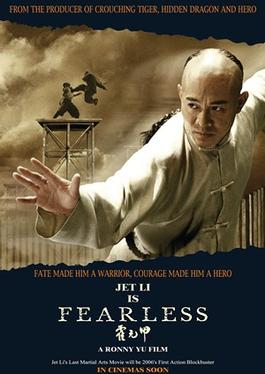
Fearless

I don’t like martial arts movies. The concept of people fighting each other (especially when they don’t absolutely have to) is pretty foreign to me. The Asian culture is fascinating to me, but the societal fabric of martial arts seems strange and unfathomable to my near-pacifist eyes. Thusly, I don’t like martial arts movies. However, I submit to you this: Fearless is not a martial arts movie. It’s a movie with martial arts in it.

Fearless tells the true story of one Huo Yuanjia (played by Jet Li), founder of the Jin Wu Sports Federation. He grew up in a fairly traditional Chinese home, with a domineering (but also just and upright) father, and a gentle (but also submissive) mother. He was a brash, headstrong child, but he got his butt royally kicked by a slightly older boy. He then vowed that as he continued to fight, he would never again let anyone beat him. He became exceedingly egotistical as he matured, but his fighting prowess was second to none. A dangerous rivalry and a personal tragedy would eventually break him out of it.

This was a pretty tough sell for me, but I eventually bought it. The point where Yuanjia has reached his lowest depth is really where the story started to have meaning for me. This was also the point where we meet Moon (Li Sun), who becomes Yuanjia’s love interest. Moon is a woman who, besides being exceptionally beautiful, is even more capable and self-sufficient than Yuanjia himself, though in a totally different way. Moon is a blind woman, but a happy, content, and peaceful woman. Even though she’s blind (or perhaps because of it), she sees something in Yuanjia that no one else sees. She shows him that no matter how awful circumstances get, life is still worth living. She gives him the resolve to go on and make things right.

Here’s the real weirdness for me, and the reason I find martial arts movies to be too far outside my ken to appreciate. Ancient Chinese culture is built on fighting, but as a competition that matches skill against skill. So people who have no grudge or animosity between them whatsoever will fight. For me, fighting is something I don’t do, don’t want to do, and hope that I never have to do. While I can appreciate the high amount of skill required and the level of artistry involved (it really is called martial arts for a reason), but the idea at the very base of it is something I don’t like: fighting. So for me, a martial arts movie would need to emphasize the human elements of the story and have a really engaging plotline, because a lot of the fighting is completely lost of me. Fearless definitely did that. The beginning was pretty doubtful, and the fact that the entire movie was in Chinese was kind of off-putting, but it really developed into a compelling story with characters I could get behind.

The presence of Moon helped matters quite a bit, and was probably the lynchpin for me. The injection of a female influence made the movie not just about martial arts, and Li Sun is incredibly appealing. I was outvoted to watch this movie at a recent gathering of friends, but I’m glad I was. It took a while, but overall Jet Li turned in a performance that I could really believe in. And the moment at the end where Moon finally sees Yuanjia with her eyes really touched my heart. That’s right! My heart was touched by a martial arts movie! And that’s why I profess that Fearless is really a movie with martial arts in it.

Iconic lines:
“Cry when you are sad. When the tears are gone, life will move on."

22 rating: 7

Particle Man

Our first hate mail!

Hello happy movie viewers!

As most of you know, we enjoy dissecting films on this blog. As a result, we're changing the world, one reader at a time! Keep up the good work!

"I can't be friends with you guys anymore. I was watching TV last night and American Beauty was on TNT… even though I hated that movie when I first saw it (you know me and deep movies ) I started watching it… and… I…. I liked it. And I understood it and started analyzing it, damn it!! I never do that! Do you know what this means?!?!?! That stupid review website of yours has ruined me!! All my life I have worked so hard to be a shallow, self-centered and empty shell, watching only action and scary movies…. And now you have robbed me of that. I've started thinking and I hate thinking!! So now I have to find some new shallow and self-centered people like me to be my friends."

-JBod

Monday, January 08, 2007

Talladega Nights: The Ballad of Ricky Bobby

"How could this possibly be bad?" was my reaction when I first caught wind of Talladega Nights. "It's Will Ferrell making fun of southern people!"
And, just as I suspected, Will Ferrell making fun of southern people is, indeed, quite funny. It's a slam dunk, right? Will Ferrell is the brightest light to come out of Saturday Night Live in a while, and southern people are notoriously easy to make fun of.
And yet, I'm underwhelmed.
Talladega Nights starts out well enough. After some background scenes showing Ricky Bobby's birth, a fateful day in his childhood, and his first stint as a driver, we get to the real meat of the story: Ricky Bobby ruling the road in NASCAR, and all of the comedy that comes along with that. The comedy culminates in a series of ads, in which Ricky Bobby hawks a Jackhawk 9000 hunting knife ("Available at Wal-Mart"), Maypax: the offical tampon of NASCAR ("When you work on your mysterious lady-part stuff, you should have the right tools too"), and Big Red ("I'm Ricky Bobby. If you don't chew Big Red gum, then f*** you.") That's followed by a five minute long scene comprised mainly of Ricky Bobby saying a very awkward grace, which is funny enough, but it marks the moment where the filmmakers start to lay off the humor accelerator and try to tell a story.
You see, Ricky Bobby's NASCAR dominance is threatened when Jean Girard (Sacha Baron Cohen) joins the circuit. Girard is gay and French--in other words, the antithesis of the American South--and his arrival seems as though it's about to start a perfect rivalry: American impudence, bigotry, and xenophobia vs. flamboyant French immodesty.
Unfortunately, this rivalry--and the satire it promises--never really has a chance to develop, because in Girard's and Ricky Bobby's first race together, Ricky Bobby wipes out.
Now, up to this point, we've seen roughly 40 minutes of movie, and it's all been pretty solid. But the next 50 minutes or so--between the crash and Ricky Bobby's inevitable comeback--drag just a bit. It's basically 50 minutes of Ricky Bobby rehab, and while parts of it are indeed amusing, I found myself losing interest.
Unfortunately, this disinterest sours the triumphant ending just a bit. See, it's during that 50 minutes--in which Ricky Bobby hits his lowest before picking himself up again--that we realize that we really don't care all that much about him. We're interested, sure, and we're happy for him when he wins in the end. But we don't really care.
And that, unfortunately, is the element that keeps a funny movie from being an excellent movie. It's a common problem for those who have cut their teeth in sketch comedy: When you're used a 5-minute character arc, it's hard to get used to into a 2-hour character arc. When you only have 5 minutes, it pays to start with a burst of energy and to make your characters simple. When you have two hours, however, the same strategy doesn't always work.
But that's only a complaint about the movie taken as a whole. Taken piecemeal, there's much that's very funny about it. I'd say 15 to 20 laugh-out-loud moments total, with 2 or 3 of those being solid belly laughs. Much of the credit there goes to a really top-notch cast. Ferrell and Baron Cohen both do well, but the acting honors in this movie really belong to John C. Reilly as Ricky Bobby's best bud Cal Naughton Jr. Reilly manages to be just as funny as Ferrell without ever seeming to overact. There's a long list of talented actors in Talladega Nights: Jane Swift as Ricky Bobby's mother, Michael Clarke Duncan as his pit crew chief, Gary Cole as his father, Molly Shannon as his boss' wife, Amy Adams as his secretary-turned-girlfriend. Even some of the relative unknowns turn in solid performances, such as Houston Tumlin and Grayson Russell as his sons, Walker and Texas Ranger, respectively.
Yeah, it's certainly a funny movie filled with funny people, which I suppose is what you pay for. But the lack of cohesiveness and proper pacing means Talladega Nights places no higher than a 7.

Disclaimer: I watched the unrated DVD version, which is 14 minutes longer than the theatrical version. It might be that the aforementioned pacing issues weren't a problem in the theatrical version, but as the DVD only allows me to watch the longer, unrated version, I guess I'll never know.

Saturday, December 23, 2006

A Charlie Brown Christmas

Out of all the TMBC critics, it was probably easiest for me to figure out which classic Christmas movie I was reviewing. After all, a casual glance around my apartment and the various Snoopy dolls, Peanuts action figures and books littered amongst everything else reveals a casual obsession with all things Peanuts. So, it only makes sense for me to review the way-ahead-of-it's-time, still-relevant, still-heartwarming A Charlie Brown Christmas.....which was almost never made.
The familiar plot revolves mostly around Charlie Brown and his disillusion with the holiday season, which has become completely commercialized, and has distorted the true meaning of Christmas. To add to his holiday burden, he is picked to direct the Christmas pageant. Ignoring bossy Lucy's wishes for a large aluminum tree, he picks a small, pathetic tree that gets him laughed at by all the other kids.....except for Linus, who answers Charlie Brown's request for insight into the true meaning of Christmas with his iconic reading from Luke. When he is at the depths of his depair, having collapsed the tree with a single ornament from Snoopy's prize-winning decoration of his doghouse, Charlie Brown is joined by the other kids, whom Linus helped realize that they were too hard on Charlie Brown, and who promptly prop up and fix the pathetic tree with more decorations from Snoopy's doghouse. The special ends with the gang singing "Hark, The Herald Angels Sing."
Wait, that's all there is to the story? The above recounting and some little sketches comprise all of A Charlie Brown Christmas , which prompted shock and awe from studio executives upon it's proposal. First of all, the score was jazz. Jazz in a children's cartoon. Second of all, there was no laugh track. That was completely unthinkable at the time for a cartoon. Thirdly, with the exception of the boy voicing Charlie Brown and a few others, the voice actors were novices. Most of them couldn't even comprehend their lines, and read them off phonetically. This led to the familiar off-kilter phrasing rhythm in Peanuts cartoons from then on. Finally, the religious undertones in the special made execs squirm. Charles Schultz held the line on this point, with the rationale that "if we don't tell people what the true meaning of Christmas is, who will?" When screened for executives, they thought it was going to be a disaster, a total flop. Taking all the elements above, and adding the rushed, choppy animation, it seemed that A Charlie Brown Christmas was over before it began. But it aired, became a critical and ratings hit, and the rest is history.
One of the reasons the special is so good is that Shultz's vision is intact. Character depiction is accurate (Snoopy and Lucy are grade A jerks, all the way....), and the special has an organic feel unmatched by the later Peanuts christmas special. It's not hard to see why it's the second-longest running TV Xmas special, beaten only by Rudolph the Red-Nosed Reindeer, which debuted a year earlier. I give this enduring classic a 17, and wish you all a Merry Christmas!

Memorable Lines:

"Pig-Pen, you're the only person I know who can raise a cloud of dust in a snowstorm!"

"Get the biggest aluminum tree you can find, Charlie Brown, maybe painted pink."

"Rats. Nobody sent me a Christmas card today. I almost wish there weren't a holiday season. I know nobody likes me. Why do we have to have a holiday season to emphasize it?"

Friday, December 22, 2006

Miracle on 34th St.

As much as I respect his opinion, I must disagree with Dr. Worm. Nobody does it better than the Muppets, you say? Au contraire, Mahatma. “Does it best” is covered by James Stewert, but Jimmy had his day in the sun with Wicked Little Critta’s review of It’s a Wonderful Life, so I’ll leave that alone. Doing it second best is Edmund Gwenn, as the saintly Kris Kringle in Miracle on 34th St. Turn in your beards and hats, Salvation Army; this guy blows all you fake Santas away.

Miracle on 34th St. is the very first movie I remember seeing when I was a kid, and is probably the actual first movie I ever saw. My first memory of it was when I was 5 years old, watching it with my 9-year-old sister on Thanksgiving night. There were probably earlier incidents of me watching it, but they are lost to the mists of time. But every year at Thanksgiving (the official start of the Christmas season in my mind), my sister and I watch this movie. Needless to say, this is a yearly tradition that has only been broken by events such as marriage and terrible illness.

The story starts off with a man strolling down the Manhattan streets on Thanksgiving morning, an old man with a long white beard (Edmund Gwenn). He comes to where the Macy’s Thanksgiving Day Parade is gearing up for to get going, and sees Macy’s Santa Claus having some trouble with the whip. When the man goes to help him, he notices that Santa is drunk, and the man is outraged. Finding the organizer of the parade, Doris (Maureen O’Hara), he is asked by her to stand in for Santa, to which he reluctantly agrees. The next day, he’s hired as the regular Santa for the toy department of Macy’s, the one where the kids line up to sit on his knee and tell him what they want for Christmas. Wackiness ensues when it’s revealed that he thinks he’s the real Santa Claus. His name, by the way, is Kris Kringle. When asked what is real name is, he matter-of-factly states, “that is my real name.” What’s more, he starts telling the parents of the kids he sees to shop at stores other than Macy’s. Mr. Macy loves it, because many customers have expressed gratitude to Macy’s for putting good-will ahead of commercialism. But a devious amateur psychologist plots to have Kris institutionalized for his “delusion,” but he turns to his lawyer roommate, Fred Gaily (John Payne), to get him out of the nuthouse. Fred takes a very unorthodox stance for Kris’s defense, however: he tries to legally prove that Kris is in fact Santa Claus. Also, there is Doris’s level-headed daughter, Susan (Natalie Wood), who doesn’t believe in Santa Claus. Kris opens up a world for her that she didn’t even know existed.

The main feature of this film is that you don’t know if Kris is actually Santa Claus, or if he’s just deluded. Not even at the end do you really have a definitive answer. Everything in the movie could just be coincidence, and Kris could just be an unaware catalyst to huge events. Maybe there really is no Santa Claus, as all the adults in the movie save Kris believe. On the other hand, maybe there is, and everything that Kris was saying was true. It could go either way. The great thing about this movie is its ambiguity. It doesn’t try to make you believe one thing or another; it allows you the space to make up your own mind.

My mother suggests that a belief in Santa Claus is essential to children, because it is that same belief that allows us to believe in God. Belief in something that we can’t see and have no evidence of is a very important trait, and if children can learn it early on, all the better. There is not a shred of evidence in Miracle on 34th St. that Kris really is Santa Claus, and never does the movie say definitively whether it’s one way or the other. So it’s up to you, the viewer, to decide; not only for the purposes of watching the movie, but in real life, too. Is there, or is there not, a Santa Claus?

Well?

Iconic lines:
“Christmas isn’t just a day; it’s a frame of mind.”
“Faith is believing in something when common sense tells you not to.”
“HELLOOOOOOOOOOOOO?????????"

22 Rating: 16

Particle Man

Thursday, December 21, 2006

It's a Wonderful Life

Initial reaction: "Life really IS wonderful."
I can't begin to express my happiness in reviewing one of my favorite movies of all time. It's a Wonderful Life spans approximately 30 years in the life of its main character, George Bailey. The film opens in an involving and touching way, carrying the audience through George's hometown of Bedford Falls to overhear numerous prayers being offered up to God on George's behalf. Something has gone terribly wrong in George Bailey's life, and we witness his loved ones, young and old, expressing their concern for him. Who is this man that everyone cares about so much? What's going on?
The prayers in a mumbled chorus travel up to heaven where God and his angels decide an intervention is warranted. This scene is charming. Granted, it consists of pulsating stars and constellations discussing George's problem as though it has just come on the daily news, but it doesn't have to be convincing or cool-looking. That's not the point at all. The point is to show us that the prayers are heard, and help is on the way.
They appoint a second-class angel, Clarence Oddbody, to help George. Most other angels earn their wings by completing missions, but poor Clarence hasn't done this yet, and, as he puts it, "...it's been over 200 years and people are starting to talk." With the promise that if he helps George he will receive his wings, he then gets a view into the life of George Bailey.
George is a wonderful, likeable, all-American guy. As you can imagine, director Frank Capra's choice of James Stewart for this role was probably the best he ever made. He was brought up by kind-hearted, hardworking parents who raised him and his younger brother, Harry, in Bedford Falls. George's father, Peter Bailey, runs the Bailey Brothers Building and Loan which basically allows him to grant loans to the more underprivileged members of the community so they can buy decent homes for their families. A noble pursuit, and he's clearly not in it for the money. George admires his dad, but from the time he's young he itches to get out of the stifling Bedford Falls, see the world, and become a famous architect, designing skyscrapers, air fields, etc. High hopes.
But of course, George is unlucky. George's father dies right before George is supposed to leave for college, and, as a result, his family's beloved business is threatened by the town tycoon, Mr. Potter. George realizes he must give up his dream to save his father's. He ends up living a life of sacrifice. Whether it be family, friends, or just well-meaning citizens down on their luck, George comes through for them. He still has a small, burning flame within him that gives him hope that someday he'll do something really big. But in reality, he ends up just helping people in their average, ordinary lives as he carries on in his own.
Things go fairly well for George. At least, he can't complain too much. He has a beautiful wife, four adorable kids, a decent house, and some high-quality family and friends. But it's hard to get through life without at least one big shocker. George's comes when an $8,000 deposit for the Building and Loan is misplaced en route to the bank. It's the beginning of the worst day of George's life. He faces bankruptcy and prison, and suddenly all of the sacrifices he's made all of his life compile into the realization that he's nothing: he's worth more dead than alive.
Enter Clarence Oddbody, AS2 (Angel Second Class). Clarence intervenes, and when George shares his realization to Clarence in a drunken stupor, Clarence allows George to see what life would be like if he'd never been born.
George stumbles around his hometown, or what he thought was his hometown, and receives shock upon shock of how different things are. I won't give too much away, but his night is filled with eye-opening situations and heartbreaking realizations. He is nearly crazed with confusion and grief, and it's quite a ride for the audience as well.
As affecting as the film is in these respects, it's incredibly heartwarming. Since most of the people in the world that would potentially watch the film are average people, most of us can identify with George's situation. Potential overlooked, opportunities lost. But the joy of it comes with the fact that we all contribute to this world. Each of us has an effect on those around us, some much more than we realize. The final scenes of the movie are some of the happiest I've ever seen. And it's not a superficial kind of happy. It's deeper, the kind that fills your soul and makes living seem that much more worthwhile.
This is a role that James Stewart was born to play. Donna Reed, who plays his wife, Mary, is beautiful, sweet, and sincere. She seems to embody the heart of the film. Also notable are Lionel Barrymore as Mr. Potter, Henry Travers as Clarence, and Thomas Mitchell as Uncle Billy. But to be honest, the entire cast was exceptional. They all contributed fantastically to the plot.

Rating: 18

It's a Wonderful Life is a beautiful movie that warms the heart and guides its audience into a joyful Christmas spirit. It's well-done and meaningful with an excellent cast. For me, it's just not Christmas without hearing the story of George Bailey.

Wednesday, December 20, 2006

White Christmas

Do you have that nice warm fuzzy feeling? If you do then you must be watching Irving Berlin’s White Christmas.
White Christmas was released in 1954 and stars Bing Crosby, Danny Kaye, Rosemary Clooney and Vera-Ellen. Set in the years following World War II, it tells the story of two old army acquaintances who team up in show business and become successful Broadway producers. In fact, Bob Wallace (Crosby) and Phil Davis (Kaye) are so wrapped up in their careers that they never can find time to meet any women and settle down. But after receiving a tip from an old army buddy, they go to see the Haynes sisters’ act. After the act, Betty Haynes (Clooney) and Judy Haynes (Ellen) meet the great Wallace and Davis and no one’s life is ever the same.
After a very brief period of excitement and confusion, all four end up in a snowless Vermont, just weeks before Christmas. They arrive at the Pine Tree Inn, where the Haynes sisters are scheduled to perform for the holidays. Wallace and Davis soon learn that this inn is owned by their former commanding officer, General Tom Waverly. After learning of the “Old Man’s” troubles, they team up with the girls to give him the greatest Christmas present ever.
I love this movie. It’s tied (with The Muppet Christmas Carol) for the title of my favorite Christmas movie. I love musicals (and I’ve been in quite a few), so this movie naturally speaks to me. Everything about it is wonderful. The songs are magnificent and so are the singers (though Ms. Ellen did not actually sing for the film). Whether they are singing of the fun they will have in snowy Vermont or the cruel nature of the thing we call love, I cannot recall a single musical moment I didn’t enjoy.
This production also contains awesome dancing! The dancing is so great that I can even forget the fact that Ms. Ellen was not able to vocally perform. (I can also forget my extreme jealousy of her and her size -1 waist, but I digress). The movie is filled with such energetic dancing that you can’t help but watch and wish you could do that too.
But my favorite part of the movie is the characters, from Bob Wallace to Gen. Waverly’s nosy maid. They aren’t in the least bit fake; at no point did I look at the film and think, “Gee, those people are acting well.” Instead, I thought, “Wow, those people really care about the general.” That’s extremely rare to find in a movie. I may just be jaded, but I can’t fully express how refreshing it was to not see one person overact.
I would like to get one thing off my chest, however. I know there are some out there who don’t feel that this movie qualifies as a Christmas movie. While I respect everyone’s right to their own opinion, in this case they are wrong. The Christmas season is defined by the selflessness and the generosity that the spirit of giving engenders in everyone. This is clearly shown in White Christmas. Wallace and Davis have so much admiration for their former commanding officer that they incur the cost of bringing their entire show up to Vermont to attract business, and also arrange an amazing surprise for the general in the process. After all, Christmas is the time when we think of those we care about and what would make them happy instead of ourselves. OK, my rant is done now. Back to the review.
As I said before, I love this movie. I have only good memories of sitting with my dad and watching it at Christmastime, both of us singing along. While that fact probably increases my love of the movie, it would still be a great movie even without that. That’s definitely an honor: to be able to take away all good memories associated with a film and still end up loving it, simply because it’s a great film. This shows the caliber of film that White Christmas is and why it deserves a 22. That’s right! I gave a movie a 22! I would like to thank Santa for bringing me such a wonderful Christmas present every year.

PLEASE NOTE: Today, 7/10/08, I was having a conversation with our own Dr. Worm about whether our ratings are based on enjoyment of the film or if it is good or not. With this conversation in mind I would like to give a slight amendment to this post. While I definitely enjoyed this movie to the 22 level, I feel I must give it a second rating for the goodness of the film. White Christmas receives a very respectable 10 in that area.

Now if Particle Man doesn’t mind, I’m going to borrow his iconic lines segment.

Iconic Lines:
Phil: My dear partner, when what’s left of you gets to what’s left to be gotten, what’s left won’t be worth getting, whatever it is you got left.

General Waverly: I got along very well in the army with out you.
Emma (the maid): It took 15,000 men to take my place!

Tuesday, December 19, 2006

A Muppet Family Christmas & The Muppet Christmas Carol

Nobody does it better.

Sure, that song was technically written for the James Bond film The Spy Who Loved Me, but only because that film came out two years before the first full-length Muppet movie: The Muppet Movie. If you were to ask Carly Simon today, I'd bet she'd agree that the Muppets, indeed, do it better.

Take A Muppet Family Christmas, for example. First airing in 1987, this made-for-TV special only needs an hour to beat the pants off of rival Christmas specials. You want laughs? It's got that. Observe, for example, the Muppet newscaster being showered with barometers after reading the line, "Barometers are falling everywhere." You want songs? It's got both original (the excellent "Pass It On" with Kermit, Robin, and the Fraggles) and traditional (a Muppet medley of about ten different Christmas songs closes out the film). You want a warmed heart? Observe Big Bird completely reroute the Swedish Chef's attempt to cook him (as the biggest Christmas turkey ever) with some kind words and a thoughtful gift. Their subsequent duet--"Chestnuts Roasting on an Open Fire"--will make you both hoot with laughter and mist up with sentimentality. It's Big Bird and the Swedish Chef--a guy in a bird suit and a puppet--and somehow they manage a more touching scene than umpteen other Christmas movies do.

The plot is incidental, but here it is anyway: Fozzie brings the entire Muppet gang back to his mom's place for Christmas, inadvertently ruining not only her vacation plans but also those of Fraggle Rock's Doc (a human), who had rented her house in the hopes of having a quiet Christmas to himself. As chaos ensues at Mrs. Bear's house, Kermit anxiously awaits the arrival of the tardy Miss Piggy, who seems to be caught in a blizzard.

But the plot really is incidental. You watch this because it makes you laugh, because it makes you cry, because it warms the cockles of your heart--and because it's the only Muppet movie to feature characters from all four of the major Muppet franchises: The Muppet Show, Sesame Street, Muppet Babies, and Fraggle Rock.

But believe it or not, this masterpiece of Christmas theater is outdone by a later film: The Muppet Christmas Carol, first viewable in movie theaters in December of 1992.

The Muppet Christmas Carol was the first Muppet movie after the death of Muppets creator Jim Henson in 1990, but it doesn't miss a beat. Directed by Jim's son Brian, it maintains all the charm of Jim's productions while including subtle hints toward the directions Brian would eventually take the Muppet franchise, such as the more prominent role of Rizzo the Rat.

The Muppet Christmas Carol faithfully follows the plot of Charles Dickens' A Christmas Carol. Michael Caine plays Ebenezer Scrooge (unfortunately for Sam the Eagle, as this was a role Sam was born to play). Caine is the only human in a prominent role; the rest of the cast is filled out by Kermit as Bob Cratchit, Miss Piggy as Mrs. Cratchit, Robin as Tiny Tim, Statler and Waldorf as Jacob Marley (who, to accommodate the pair, is split into brothers Jacob and Robert Marley), and Gonzo--turning in his finest performance--portrays Charles Dickens, the narrator.

The plot is precisely the plot you expect. Scrooge is a jerk until he's visited by the ghosts of Marley and the past/present/future, after which he's the nicest fellow you can imagine. To their credit, the Muppets don't do much to update this classic plot.

So why is The Muppet Christmas Carol such a triumph? Well, there's the inimitable Muppet charm and humor, which is a big part of it. There are several excellent songs, notably "One More Sleep 'Til Christmas" and "It Feels Like Christmas." But above and beyond this, the Muppets are all perfectly cast for the parts they play: Kermit, unassuming and hard-working, is the quintessential Bob Cratchit. Robin, the one Muppet consistently guilty of too much sentimentality, is heart-warming and sympathetic as the sickly Tiny Tim. And, as previously mentioned, Gonzo turns out a surprisingly good performance as a know-it-all Charles Dickens.

In fact, the hands-down worst scene of this film--Scrooge's old girlfriend singing "When Love is Gone" to the 20-year-old Ebenezer--also happens to be the one scene where no Muppets are present. When Muppets reappear at the close of this scene, it's a welcome respite.

There are plenty of good Christmas movies, as the rest of TMBC will point out later this week, but you simply cannot go wrong with A Muppet Family Christmas or The Muppet Christmas Carol, which come in, respectively, as an 11 and a 13.

It's a Wonderful Muppet Family White Christmas on 34th Street, Charlie Brown!

Greetings, TMBC fans!
In anticipation of the wonderful Christmas holiday, we are celebrating with a tribute to our favorite Christmas movies! This Tuesday through Saturday, December 19th through 23rd, each member of TMBC will review his or her most beloved Christmas film. Assuming everything goes as planned. ;)
Enjoy the reviews, and Merry Christmas to all!