Friday, November 10, 2006

Borat:Cultural Learnings of America for Make Benefit Glorious Nation of Kazakhstan

Hi all! Your Racist Friend has returned with a review of a film about a real "racist friend." I'm of course talking about Borat Sagdiyev, of the number one film in the country, Borat. Borat is the story of Borat Sagdiyev (Sascha Baron Cohen), a TV reporter from Kazakhstan. Borat likes swimming, table tennis, disco dancing, degrading women, and hating on Jews and gypsies. The film is a mockumentary of Borat's journey to America with his producer Azamat, to make a documentary for benefit of Kazakhstan. Whence there, he sees Pamela Anderson on a rerun of Baywatch, falls in love with her, and decides to travel to California to make her his bride. Needless to say, wackiness ensues.
There has been a lot of hype surrounding Borat, and it has only grown with the opening of the film. After a stunning opening weekend where the film netted over 26 million dollars in a mere 837 screens, FOX is expanding the opening to 2,500 screens. A lot of people are saying that Borat is one of the funniest movies they've ever seen, and I say this: Believe the hype. Borat is at least the funniest movie I've seen since South Park: Bigger, Longer, Uncut. I attended a 5:00 screening last Monday, and the theater was very full despite the oddball time. The audience (myself included) laughed uproariously, and very frequently. There was more funny material than in 95% of most comedies, and it came a lot faster. Cohen and his collaborators have created an inspired mix that borrows from Peter Sellers, Jackass, Monty Python, and Charlie Chaplin, among others. We've seen Borat before on Cohen's very funny It's Da Ali G Show, Innit?, but Cohen has more opportunity for the impish Borat to run amok across America. The specific language choices and odd angles at which Cohen launches jokes is no small boon to the humor in the film. Like Rocky Marciano punching his opponents in the arms to drop their guard, the things that come out of Borat's mouth are odd and hilarious.
Much has been made of the Borat character's anti-Semitism, with the debate originating with the infamous "Throw The Jew Down The Well" segment from Ali G. The Anti-Defamation League and other Jewish organizations have argued that some people don't have the perception to realize that Cohen is making fun of those "sentiments." First off, Borat is portrayed by a man named SASCHA BARON COHEN. If that's not a Jewish name, I've never heard one. Second of all, Borat's attitude against Jewish people is far from subtle. It crosses beyond simple prejudice and ignorance, and crosses into superstitious nonsense that any adult of at least average intelligence should be able to see right through. And therein lies the secret theme of Borat: intolerance sucks, and so does ignorance. I feel that this film won't be well received in red states, since Cohen doesn't pull any punches. Consider the scene in which Borat is told by the manager of a rodeo that he looks "too much like a terrorist," and would benefit from shaving off his mustache, since it would make him able to "pass as an I-talian." Also, Borat is a buffoon, like Beavis and Butthead. The key thing is that even though Borat is hopelessly anti-semitic, misogynist, and homophobic, his naive nature prevents the character from going "too far," and alienating the audience.
Some scenes to watch for include:
-Borat visits a "humor specialist" in New York.
-Borat shows just how clumsy he can be......in an antique shop.
-Borat stops for the night in a bed and breakfast........run by an elderly Jewish couple.
-Azamat commits an unspeakable act, ands a sequence ensues that rivals the infamous "Mr. Creosote" sketch from Monty Python's The Meaning of Life in terms of hilarity and shock value.
In closing, I would like to say that I found Borat much funnier than so-called "comedy classics" like Modern Times or Life Is Beautiful (THAT movie will be getting a special drubbing on this site from me very, very soon). Borat is a hilarious film, and more fun than anything I've seen all year. I give Borat:Cultural Learnings of America for Make Benefit Glorious Nation of Kazakhstan a 20 out of 22 on the 22 scale....and it earned every point.

Memorable Quotes:

Driver's Ed Teacher-"In America, a woman can choose whom she has sex with."
Borat-"WHAAAATTT?????"

Borat-"What's up, vanilla face?"

Azamat-"We should go back to New York. At least there are no Jews there."

Borat-"This is Orkin, the town rapist! Naughty, naughty!"

Wednesday, November 08, 2006

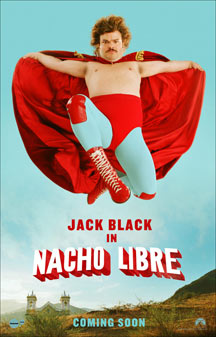
Nacho Libre

Nacho Libre is pretty much the movie you expect it to be. Do you expect a fun, light-hearted romp with plenty of Jack Black antics? Then that's what you'll get. Do you expect a stupid, puerile movie with more fart jokes than substance? Then that's what you'll get. Do you expect an epic, Oscar-worthy period piece about two Mexican lovers separated by space and time? Then you're probably seriously misled.

Jack Black plays the titular Nacho--short for Ignacio--and, as it's a PG movie, he's seriously toned down. He's still Jack, but with about one-third the caffeine. His character, Nacho, is a priest/monk/friar at a monastery in Nowheresville, Mexico. It's clear early on that he's at the bottom of the monk pecking order, as he's forced to take on the tasks no one else wants, like--as he says--"cooking duty, and dead guy duty." It's also clear early on that he's not totally into his priestly duties; instead, he longs to become a professional wrestler. This is a problem, of course, because wrestling is considered a sin.

Nevertheless, when Nacho learns of a wrestling opportunity where the winner takes home 200 pesos, he decides to try it out--incognito. He enlists the help of a local street rat named Esqueleto (Héctor Jiménez, who is hilariously hideous in his role), and the two form a tag team. They lose consistently, of course, but still get paid because audiences come to see them. So Nacho continues to lead his double life--humble priest by day, terrible wrestler by night--even while trying to win the favor of Sister Encarnación (Ana de la Reguera), a smoking-hot nun (really!).

This leads down a familiar path as our hero is eventually found out, hits his lowest of lows, but bounces back for his final triumph, in which he spectacularly defeats the top wrestler in the region and simultaneously convinces his order--particularly Sister Encarnación--that wrestling doesn't have to be sinful.

"That's all well and good," you say, "but is it funny?" Yeah, it is. It's not hilarious, but it's amusing enough. Jack Black and Héctor Jiménez are each delightfully hapless in their own special way, and the movie definitely trades on the fact that you're not supposed to take it even remotely seriously.

But, here's the thing: it's PG. That's not a bad thing in and of itself, but it gives you a hint as to what audiences it's being directed at: primarily males between the ages of 9 and 12. If you're one of those people, by all means, run out and rent this movie. If you're anyone else, well, it's a harmless use of 90 minutes, so I wouldn't say you should necessarily avoid it. But unless you're a Jack Black worshiper who needs to see each and every one of his works, Nacho Libre is a movie you could probably take a pass on.

Here's how the rating calculus for this movie works: it starts out at a -5. Now, on your own, rate Jack Black from -22 to 22, and then add that number to the -5. Personally, I rate Jack about an 11, so I'd give this movie a 6. If you think Jack's a 22, you'd probably give the movie a 17; if you think he's a -10, you'd probably give it a -15. In any case, you can use this formula to decide whether Nacho Libre is worth a rental for you.

Tuesday, November 07, 2006

House of Flying Daggers

I finally got a chance to see this movie after about two years of meaning to see it. It was always there in the back of my mind, but certain things (including watching movies with people who didn't want to see it as much as I did) kept it from happening. Luckily, I found and bought an inexpensive copy to solve that problem.
And it was worth it. The movie is enchanting, and officially on my list of "movies I could watch once a week for the rest of my life." I'd never seen a Yimou Zhang film before, but having seen Crouching Tiger, Hidden Dragon a number of times, I had mostly accurate expectations. Both movies have superb art, drama, depth, and combat going for them. For the average viewer, House of Flying Daggers requires a bit of adjustment of expectations, as Chinese films tend to be more fantastic and cartoon-y with their fighting sequences. However, if this doesn't put you off, it's quite a treat. Thankfully, I was ready for this aspect of the film and enjoyed it immensely.
In short, House of Flying Daggers is a feast for the eyes. Each scene is a work of art. Zhang integrates color, combat, and nature to create a vivid backdrop for a beautiful story of love, drama, and loss.
Zhang moderates the fantastic elements of this film quite well. The fighting sequences, while creative and engaging, complement the plot and don't distract from the rest of the movie. Each of the main characters gets the screen time they deserve, and are given great depth and character development. Ziyi Zhang, who plays Mei, makes the movie as convincing as it is. In my opinion, she's greatly improved since Crouching Tiger, which was nothing to sneeze at, either. Also noteworthy are Takeshi Kaneshiro as Jin, and Andy Lau as Leo. All three bring the story together seamlessly. Plus, Takeshi Kaneshiro is pretty darn attractive.
The first viewing is the best. It keeps you on your toes for the most part, and creatively delivers an engaging plot with characters we care about. There are some surprises, which are complicated, but don't alienate the audience at all. Personally, I loved the story. It rings so true on a number of different levels, and I think most people could identify with at least part of it. It's right up my alley: dramatic and even sorrowful, yet hopeful that humans have great potential for good, and for love.
**POTENTIAL SPOILER** (if you're one of those people who effortlessly figures out a movie within the first 20-30 minutes)
My problem with the movie is the fact that the surprises at the end render a significant piece of the first part of the movie pretty much pointless. While I watched it for the first time, I was so intrigued and impressed by the turns that the story made and how well it seemed to pull them off. Upon further reflection, however, (and a second watch) the beginning of the film is far less cool than originally thought. In my opinion, a movie should build upon itself and form a unified whole. In this case, an attempt to keep us guessing worked, but also forced the film to contradict itself a bit.

Rating: 15

This is definitely my kind of movie: graceful yet fatal martial arts, incredible characters with the right amount of depth, beautiful images and scenes that push us to the edge of reason, and a dramatic story that doesn't condescend to the audience and has a good message. In the end, my issues with the plot can easily be pushed aside for these qualities.

Saturday, November 04, 2006

Marie Antoinette

“She did not say that! There is no evidence that she did!”

This is my typical reaction when people bring up Marie Antoinette’s infamous line: “Let them eat cake.” Throughout history there have been many general misconceptions about the wife of King Louis XVI. Fortunately, Sofia Coppola decided to show people the Marie that historians know, basing her movie on the book Marie Antoinette by Antonia Fraser.

The movie begins with a very young Marie waking up and saying goodbye to her parents, Francis I and Maria Theresa of Austria. They had chosen to marry her off to the grandson of King Louis XV, Louis-Auguste. The movie follows her from her entrance into the French Court as the Dauphine of France (the heir apparent or princess) to her tumultuous end after the peasants rebelled against the reign of her and her husband.

Since receiving my bachelor’s degree in history in 2004, I have become very critical of so-called “historical” movies. And when I first heard that Kirsten Dunst would be playing the famous queen, I was extremely skeptical.. But Kirsten won me over. Although I know she is much older, she really did have me believing that she was a scared 14-year-old who was being married off to a stranger to ensure an alliance between two countries. She also seemed to grew as her character did, going from scared and confused to reckless and carefree to becoming a mother and accepting the responsibility that came with it, even if people in her court did not want her to.

Jason Schwartzman gave another fine performance as Louis XVI. He had already impressed me in Shopgirl, but he solidified my estimation of him with this performance. He showed the composure of a king but also some of the same lack of confidence that his wife shared, since they were both kinda thrown into the center ring at a young age—he was only 15 when he was married and only 20 when he ascended to the throne.

Most of the film was shot on location at Versailles, the grand palace of the royal family. The costumes as well seemed very appropriate for the time period. The film is backed by a soundtrack of both classical and modern music (much like in A Knight’s Tale, although with wildly more impressive results). Again, I thought this would be a major stumbling block to my enjoyment of the movie, but it ended up only enhancing it.

Although I did have some problems with some minor historical inaccuracies throughout the film, there was only one major flaw that I saw: The roles played by Molly Shannon and Shirley Henderson seemed completely inconsequential to me. I’m sure that they were part of the royal family—they seemed to be given some prominence, but the film never explains who they are. They seem just to be older gossips who talk about everyone, including Marie, acting completely nice to people’s faces while cutting them down behind their back. Versailles was way over its quota for that two-facedness.

Overall, the movie impressed me. I really enjoyed it and I always love seeing correct history being brought to the movie screen. It is definitely a movie I intend to buy when it is released, not out of any obligation to my chosen field of study, but because it showed what I love about history: It’s about the people who are involved and how they deal with and cause the situations that occur in their lives and around the world. I would give this movie a 12. Way to go Sofia! Although I liked Lost in Translation, this movie is MUCH more up my alley.

Wednesday, November 01, 2006

I ♥ Huckabees

I ♥ Huckabees is a deeply philosophical movie filled with probing… questions about the… nature of existence and… how everything is… connected and… what was I saying, again? Eh, it probably doesn’t matter anyway.

This film is nuts. I don’t just mean the characters in it, or the circumstances they find themselves in, or even the ideas behind it; I mean the actual movie. It’s totally froot loops insane. From the very start, I got that it would be a zany ride, and I definitely wasn’t disappointed. It asks a few very important questions, and the characters make some deep claims, but it’s a comedy. And because of the nature of the comedy presented, you wonder if it actually is asking them.

The movie has a somewhat wide cast of characters. First up is Albert (Jason Schwartzmann), an environmental activist/bad poet who is simultaneously self-righteous and self-loathing. He goes to two “existential detectives” (whatever they are), a married couple named Bernard (Dustin Hoffman) and Vivian (Lily Tomlin). Under his pro-bono employ, they observe him in every aspect of his life, taking feverish notes. At the same time, they are “investigating” Tommy (Mark Wahlberg), a firefighter who goes to fire scenes on a bicycle because he’s concerned about fuel emissions. He becomes Albert’s “other,” someone else under investigation by Bernard and Vivian. “Others” are meant to help each other through a difficult time. What Albert hires them for is ridiculous, and doesn’t have much bearing on the rest of the plot. He asks them to please stay out of his work life, a request which they of course ignore, and they discover that his environmental corporation is being taken over from the inside out by a kind of hyper-capitalist uber-Walmart named Huckabees. The architect of this friendly-but-hostile takeover is Brad (Jude Law), who’s in a relationship with Huckabees model and spokesbabe Dawn (Naomi Watts). We pretty much have polar opposites in Albert and Brad; indeed, this seems to be a movie about opposites (or perhaps complements), as Albert and Tommy fit into that category, as well. The Bernard/Vivian team and a competing psychiatrist named Caterine (Isabelle Huppert), with their opposite philosophies about the interconnectedness of everything, seem to fit into it as well, as does Dawn with herself (figure that one out, I dare ya!).

A few things in that explanation needed further explanation, and I purposely left them unexplained, since that’s what the movie does, too. It doesn’t bother itself with trivial details since that’s not what the movie is really about. A lot of the dialogue could double for a Philosophy 101 class, but it’s always connected to a particular character and what they’re dealing with. At the same time, it’s a kooky, zany ride that checks reality at the door and asks you to as well, and also has the ability to laugh at itself. It’s a movie about the struggle between the abstract and the concrete, conservatism and liberalism, and nature and technology, but it’s also about the complete ridiculousness of all those things. It points out the stupidity of philosophers while it simultaneously philosophizes in and of itself. More importantly, it does that in a way that doesn’t seem forced, half-assed, or condescending.

The actors in it are pretty good, but I especially enjoyed Mark Wahlberg and Naomi Watts. Wahlberg was at once hysterical, tragic, and uncompromising. Given this performance and some others in recent years (The Departed, Three Kings, The Perfect Storm, Boogie Nights), I really think he could pull off any role he sets his mind to with incredible ease. Watts was vapid, spoiled, child-like, wishy-washy, and precisely right for her role. She also falls into the “smokin’ hot” category.

I ♥ Huckabees assumes a lot about the audience, and is something people who like concrete ideas and familiarity with movies simply will not enjoy. That’s a shame, though, because the movie is very charming, and I found it pretty fun to go along with its madcap pacing and plot. You just have to be willing to put yourself in the hands of the film, and that’s something a lot of people aren’t willing to do with any film. But the performances are funny in that wacky, nonsensical way, and the movie itself has an inspired madness that I appreciated. And in its own laughably twisted way, it even has a happy ending.

Iconic lines:
“I don’t know what you guys are talking about. I thought we were talking about petroleum.”
“There is no remainder in the mathematics of infinity.”
“I’m in my tree with the Dixie Chicks and they’re making me feel better."

22 Rating: 13

Particle Man

Monday, October 30, 2006

The Departed (Particle Man)

***DISCLAIMER: This movie is not for the faint of heart, the overly sensitive, or the excessively innocent. Don’t get me wrong. These are not bad things to be; quite the opposite, actually. But if you are these things, be smart enough to avoid this movie. After all, it’s possible to be innocent without being naïve. Basically, there are two groups of people: people who are innocent, and people who can enjoy this movie.

Actually, that’s not entirely true, since I myself straddle those groups, falling somewhere near the exact middle of the two. I don’t like conflict, or I at least like my conflict confined to the silver screen where I don’t have to get involved. Consequentially, I don’t like fighting, guns, killing, or mobsters. But an important distinction needs to be made: I wouldn’t enjoy being a mobster, but I do enjoy watching them. The Departed really went for a long time being a good movie, then there was this one sequence where there was so much death, so much bad, so much ick, and that lasted basically till the end of the movie. That sequence was enough to put me off at first, but as time passed and I looked at the movie for the entire movie (not just that sequence), I really came to realize that I enjoyed it very much.

Scorsese has made a decent movie here, but more than that, he has made a statement. The statement, which I agree with in some situations and not in others, is that there is little difference between the people trying to hurt our society and the people trying to protect it. Cops pose as criminals and criminals pose as cops, but in the end, are the two really that divergent? Yes and no, as this film brought out for me. First, there is Billy Costigan (Leonardo DiCaprio), who is striving with all his might to travel a distance of about two inches. He makes all this effort and does all this work, and he’s not even sure what he’s fighting for. He’s an undercover agent under assignment in the mob syndicate that Frank Costello (Jack Nicholson) leads. Billy’s the only essentially good character in the film, but he senses that the longer he remains in this cesspool of murder and corruption, the further he will get from his good character, and the harder it will be to get back. Simultaneously, there is Colin Sullivan (Matt Damon), a kid who has found Frank Costello’s favor and has spent most of his young adult life infiltrating the Boston Police Department for Costello. He smiles, winks, cajoles, and gradually climbs up the ladder, never forgetting his original mission. And then there is a psychiatrist played by Vera Farmiga, who ties the two together.

Scorsese’s films tend to be pretty uneven, though The Departed is a lot better in that department than the hopeless (but still great) Gangs of New York. But like that movie, it is more than redeemed by the absolutely stellar performances in it. The Departed is simply bursting with star power. In addition to Jack, Leo and Matt, there is also Alec Baldwin, Martin Sheen, and Mark Wahlberg. DiCaprio turns in a brilliant performance, but that doesn’t surprise me at all. I have simply loved him in everything I’ve seen him in since What’s Eating Gilbert Grape? Damon’s crooked cop was completely convincing, from the accent on down. I must admit that I was doubtful that Nicholson could have really pulled off a mob boss, but I shouldn’t have been. Who can play evil better than Jack? And Baldwin and Wahlberg were simply side-splitting, especially when they bounced off each other. Baldwin especially made the absolute most out of relatively little screen time. Wahlberg sometimes tipped the scales of believability with his vulgarity, but he played a role that fit him like a glove.

I understand that some people will not like this movie because it contains too much ick, and that’s fine. But what you have to do to get anything out of this movie is realize that it’s a mobster movie. A certain amount of blood, guts, swearing, and bad behavior is a prerequisite. A mobster movie where everyone spoke calmly, worked out they’re differences peacefully, and parted with a hug and a “may God bless your path” would be completely unrealistic, and therefore not nearly as good of a movie-going experience. One needs to put oneself in the mode of the movie to even enjoy it a little bit. If that’s not your bag, so be it; just avoid this movie all-together. If you can, enjoy it. If not… well, Happy Feet is coming out next month.

Iconic lines (or exchanges):
“The Patriot Act! The Patriot Act! I love the Patriot Act!”

Ellerby: “Go f*** yourself.”
Dignam
: “I'm tired from f***ing your wife.”
Ellerby
: “How is your mother?”
Dignam
: “Good, she's tired from f***ing my father.”

“You can be a cop, or you can be a criminal; but when you’re facing a loaded gun, what’s the difference?”

22 Rating: 9

Particle Man

Sunday, October 29, 2006

The Departed (Your Racist Friend)

Before I say anything else, I want it noted for the record that I think Goodfellas is the most overrated mob movie I've ever seen. And that Martin Scorsese is just as inconsistent as any classic filmmaker. Having said all of that, Scorsese turns in his most consistent work in years with The Departed. And while solid, The Departed doesn't quite ascend to sit aside other great Boston movies like Good Will Hunting or Mystic River, but it's sitting directly behind them.
Scorsese's latest police and thieves epic, a remake of the Hong Kong film Internal Affairs (and its sequels, in a way), tells the story of two young men in the state police, Billy Costigan (Leonardo DiCaprio) and Colin Sullivan (Matt Damon). Billy grew up in a fractured family with mob connections, and Colin under the watchful eye of Whitey Bulger analogue Frank Costello (Jack Nicholson, in his finest performance since Batman). Colin works his way up the ranks of the state police, while using his position to keep Frank one step ahead of the police. Billy is persuaded to use his family history and violent background to infiltrate Frank's gang in an attempt to bring him down for once and for all. And from there, wackiness ensues.
Now let's stop and talk about the performances. Performace-wise, The Departed is the movie I've been waiting for all year, in that the performances don't simply serve the film. Based on his work here, I think I can finally consider DiCaprio a solid actor. He doesn't do anything flashy here, but he has done his homework. He gives us a Billy Costigan who has no problem beating the crap out of a couple of goombas from Providence with a comic book rack for shaking down a Pakistani store owner, but visibly flinches while Frank brandishes a severed hand and talks about John Lennon. Matt Damon turns in a solid performance as Colin Sullivan, who we see slightly recoiling from time to time, from the choices he's made, and the position he finds himself in. Jack Nicholson is one of those actors I watch all the time, and think "He could be doing better work," the other being Gene Hackman. But here he completely shines as the malevolent Frank Costello, stealing every scene he's in without even coming close to overacting (Paying attention, Al Pacino?). Vera Farmiga is serviceable as the psychologist who is caught between Colin's easy charm and Billy's raw nature. Martin Sheen turns in a subtle, unpretentious performance as Captain Queenan, one of two links to the outside world for Costigan. The other, Sergeant Dignam, is played by Mark Wahlberg, who is making himself more and more invaluable with each passing year. The foul-mouthed (slightly more so than he would be in reality, unlike practically all of the other characters in the film) Dignam serves as an unlikely voice of reason, and seems to have stolen Robert DeNiro's terrible haircut from Scorsese's earlier King Of Comedy. Ray Winstone shows up as Mr. French, Costello's right-hand man, unrecognizable under his skeezy beard. I must give special mention to Alec Baldwin, as SPI Captain Ellerby. Baldwin squeezes maximum impact out of the relatively few scenes he's in as the sweaty, boorish Ellerby. Baldwin is also the actor who has the most accurate Boston accent, save natives Damon and Wahlberg.
One department that helps the film a lot here is the music. Scorsese tones down the overall density of classic rock songs, and uses several effective selections, most of them from the Rolling Stones' seminal Exile on Main Street. The score was also very effective, sort of an urban version of spaghetti western guitars, performed by the prestigious likes of Sharon Isbin and G.E. Smith, under the masterful ear of Howard Shore, late of the LOTR trilogy, Dark City, Silence of the Lambs, and many other classic film scores in recent times. Scorsese reunites with Goodfellas/Last Temptation cinematographer Michael Ballhaus, who gives us an attractive yet realistic Boston, and gives the film a nice feel somewhere in between Altman and Anderson, which is right where Marty S is supposed to be. William Monahan is the film's secret weapon, giving us whip-smart, blink-and-you'll-miss-it dialogue, which contributes greatly to the film's excellent pacing. And I have to step in here and defend the film's language...like many Scorsese films, the "excessive" language is cited as a bone of contention for some. Yes, there is a lot of swearing in The Departed, but it is accurate. If you listen to 99% of Bostonians conversing outside of polite company, they talk pretty much EXACTLY like the characters in The Departed, Dignam excepted. People also talk about the violence, but I have three things to say about it: One, children and those who don't have the stomach for lots of gore shouldn't be watching films by Scorsese, Miike, Tarantino, or any other director who is somewhat infamous for violent content. That's like me saying that I went to see the Barney movie, and was put off by excessive hugging. Two, in a movie about cops and the South Boston Irish mob, people are going to get shot in the face at point blank range. A lot. It's what's called content that is appropriate to the material. Thirdly, even aforementioned face-shootings in the movies don't seem like much when you've been exposed to real world violence. It's brutal, ugly, and virtually impossible to capture on celluloid...not that it should be. I don't want to make a reductionist statement to the effect that people who haven't seen stabbing and shooting victims, or have seen or been in serious (read:one person is trying to maim or kill the other person) fights aren't qualified to comment on violence, but I will say that a large section of the puzzle is missing for them.
The Departed suffers a bit from what I feel is excessive character death, and by missing plenty of opportunities to dig deeper into what makes the characters tick, adding more substance to the film. It is what separates The Departed from other great crime films like the first two Godfather films, Double Indemnity, and Se7en. Having said that, Scorsese has distinguished himself with a admirable showing that hasn't escaped notice. The Departed is currently number 53 in the IMDB Top 250 movies of all time, and holds a very impressive 93% with 183 votes on rottentomatoes.com. I give The Departed a rock-solid 13 out of 22 on the 22 scale.

24 Watch: James Badge Dale, who played Jack's Season 3 partner Chase Edmunds, turns up here as a state cop.

This review was fueled by Exile on Main Street by The Rolling Stones (duh).

Thursday, October 26, 2006

The Departed (a guest review by Number Three)

Note to Matt Damon: Don’t play a bad guy. The other time you tried it was in the awful The Talented Mr. Ripley. I tend to admire you as an actor until you involve yourself in trashy roles like this one.

The Departed was essentially well crafted ho-hum with too much ick thrown in for bad measure. I suppose this should have been expected given the director. At the start we wonder if we’re in for some epoch, mind-altering vision of the streets; a little Dangerous Minds meets West Side Story. But in the end we can only conclude that in Scorsese’s world, hope does not appear and justice does not prevail, a fact that Scorsese seems to delight in for some unimaginable reason.

The basic story is as follows. An Irish mobster (Jack Nicholson) rules the streets of Boston. A home-grown mobster crony (Matt Damon) who has an unexplainable affection for the boss infiltrates the police by going through the academy so he can more efficiently help Jack be a bad guy. Meanwhile, an honest policeman (Leonardo DiCaprio) goes undercover to infiltrate the Irish mobster’s lair so that the police can more efficiently pretend to care that they’ve lost control of public order. DiCaprio’s only contacts back at the office are the ever lame and ever forgettable Martin Sheen and Mark Whalberg. The office also includes such unwholesome lack of talent, the completely and utterly pointless Alec Baldwin. Finally, there’s the lady psychiatrist (Vera Farmiga) with a dual love interest that conveniently, but not unbelievably, moves the plot along.

On the one hand, there was some smart dialog from smart actors, the kind of smart that only William Monahan (the screenwriter) can develop. He’s the kind of writer that made the characters in Kingdom of Heaven so rich and impacting. I might have been tempted to give the Mouthspeak score a +10 or so. But then there’s that completely unnecessary barrage of rotgut that they had to throw in to make it accessible to Scorsese fans. You know what I’m talking about: the “f-this” and “f-that” and the dirty jokes and the mean-spirited invectives from one character to another. I had to knock at least 8 points from the Mouthspeak because of this nonsense.

Then we had on display the craft of movie making in fairly expert style. Scorsese always makes a few artistic choices that distract from the visuals, but overall, we are pulled into the world the director is building for us. This might have even earned a +3 or so rating for Watchfeel. Ahh, but there was one little problem: Scorsese sees the need to be disgusting and provocative and dirty just for the sake of it. There was enough to disturb my senses as I viewed the pic that I had no choice but to knock nearly 20 points from the Watchfeel.

So, in essence, my conscience twisted my arm into giving this movie a bad rating. I fear that too much Scorcese might mash my brain to mushy mush, and I can't help but score the de-hearted souls pretty low.

Number Three’s Score:
Mouthspeak (impact of dialog): +2
Watchfeel (impact of visuals): -14
Mouthfeel (overall watchability): -6

Number Three

Wednesday, October 25, 2006

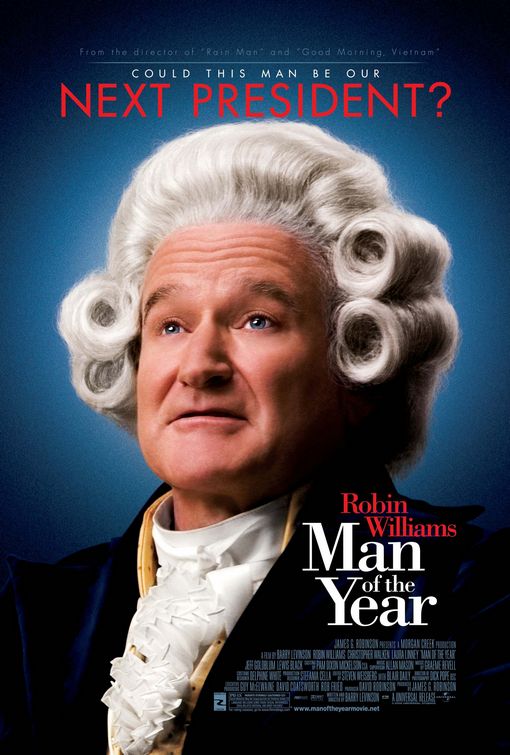
Man of the Year (Wicked Little Critta)

I hate being the last to review a Movie of the Month.
Anyway, for me, Man of the Year was a pleasant surprise. Honestly, the previews made it look pretty dumb, and I assumed it was just an outlet for Robin Williams to demonstrate some good old-fashioned low humor. The only really intriguing piece was the politics of it all. Living in the U.S.A, where we're all in politics up to our ears whether we like it or not, the idea of catching a flick making fun of the political system seemed rather cathartic.
As I said, I thought that the movie was a pleasant surprise. What seemed like the entirety of the movie (from the previews) really only made up 1/3 to 1/2 of it. I was surprised when, in the first 10 minutes, Williams was already a presidential candidate, and doubly surprised to see that he was a serious one. Williams played Tom Dobbs, a comedian who suddenly realized an honest interest in being president of the United States. He took the middle ground, rallying support by telling people how sick we are of two-party politics. And we are! He cast aside the party identification to focus on issues like the environment and the economy, and also made the point that politicians spend way too much money on campaigning by getting huge companies to finance them, and then are obligated to support those companies when elected to office. Even just typing this review, I'm getting excited.
The humor in Man of the Year was smarter and more entertaining than I expected. Robin Williams, while still a pretty large presence, wasn't larger than the movie itself, which tends to happen with him. Williams delivers a convincing performance as a comedian who also takes politics seriously. But Christopher Walken is fantastic. He is Dobbs manager, Jack Menken, a guy that really cares for Dobbs while trying to maintain a tough exterior. To me, he was the glue that tried to hold this thing together. He continually reminds Dobbs of who he is while still supporting him. And his character brings humor when things get too serious, as well as seriousness when things get too silly.
Laura Linney had a strange role. I guess she acted well enough, but if Walken was this film's glue, she was the force trying to rip it apart. The entire subplot that she was involved in sabotaged the film's success. It added a surprising amount of drama and intrigue--drama and intrigue which seemed terribly misplaced. I won't even talk about the silly "computer glitch" bit. Go ahead and read Dr. Worm's review for more on that.
In any case, while watching Man of the Year was very enjoyable for me, the film as a whole was sloppy and pretty much pointless. If it had stayed more with the politics, it would have been much more effective. That part was easy enough to get behind, as well as thoroughly entertaining. My favorite scene was the presidential debate, in which Dobbs didn't tiptoe around the issues or try to make everything sound "politically correct." If actual debates were like that, I think we might see some interesting politics follow.
The ending of the movie tried to tie up all the loose ends and leave us with some good, heartfelt message about our country. Or something. I think. The message of the film was good yet ineffective: It upholds honesty, but leaves us with the idea that political change is too much to hope for. We're all revved up, ready to shoot off in a new, better direction and change American government and politics after listening to Dobbs' unorthodox yet exciting approach. And then, what does he tell us? That we should leave it to the politicians. Huh? Why?! I was just pulled out of the dung heap only to be dropped back in! Not a good way to treat your audience.

Rating: 5

Man of the Year definitely entertains, and successfully gives us some high-quality Robin Williams humor in a new and exciting context. But then it rendered itself useless by telling us it never belonged there. Objectively, I know that this doesn't nearly qualify as a "good" movie. But the laughs, political humor, and even at some points the election drama pulled me in and gave me a good time. I'm pretty sure that's worth a 5.

Tuesday, October 24, 2006

Man of the Year (Stormy Pinkness)

Well, I was not expecting that. Over the past two months I have seen many previews for Robin Williams’ new movie, Man of the Year. These previews, along with the premise of the movie, led me to believe that I was going to see a good-natured comedy about the political promise. I feel like that was kinda half true. However, let’s first examine the premise of this film.
Imagine a country that is so disillusioned with its leaders that anyone who speaks up against them is instantly a better presidential candidate than the usual suspects in these elections. (I know, it’s hard.) This is what happens in Man of the Year. Robin Williams plays a very outspoken comedian who is told that he should run for president. Funnily enough, he actually decides to go for it. There is also a secondary story of a faulty new computerized ballot system. So the movie shows that there are two things that may not always be reliable in our society: Number one is politicians, and number two is technology.
As I mentioned, this movie was not what I expected it to be. I expected a comedic satire about the state of politics in our nation. While I did get that, I wasn’t expecting it to also be a sort of political thriller. With both of these put together it seemed to distract the movie. Maybe the movie has ADD, so it’s not its fault that it kept switching its attention back and forth between plots. Now, I’m not saying that this was a completely terrible thing, but I do feel like it could have been done in a more cohesive way.
Overall, the acting was alright. Robin Williams and Laura Linney both gave solid performances. The supporting cast, which included Christopher Walken, also provided a solid acting basis. However, there was nothing overly thrilling about the movie. Even Jeff Goldblum, who played a typical lawyer only out to help himself, did not really bring anything extra to the role, there was nothing that made you utterly despise him or root for him.
However, there were some outstanding scenes in the movie, where you envy characters because you wish you could just say what they are saying. But there were too few outstanding scenes to outweigh the ones that were just good. So this movie is a 6. It seemed to not choose which storyline it really wanted to follow, although it reserved both. Also the acting, while not sub-par, was not what I expected from Robin Williams and Laura Linney. I still think is the movie had a great concept, but the film is kinda a work in progress. It made me laugh, but when it comes to politics I want to laugh and think at the same time, like I do while watching Jon Stewart. But alas, my laughter was lonely without my thoughts to accompany it throughout the movie.

Monday, October 23, 2006

Man of the Year (Dr. Worm)

They should've listened to Christopher Walken.

In Man of the Year, Walken plays Jack Menken, manager to Tom Dobbs (Robin Williams), the late-night comedian turned presidential candidate. There are two things that Walken says to Williams in Man of the Year that could have saved this movie, if only the filmmakers had bothered to listen.

The first piece of advice is so important that Walken's character actually says it more than once. When Dobbs starts acting all serious on the campaign trail, his manager wisely tells him (on more than one occassion) that people come to see him because he's Tom Dobbs the comedian. They've come to laugh, not to be bored with your speeches about policy. There's nothing worse than being promised comedy and getting something else.

Sound advice. For example, it would be unfair to an audience to package a movie as a comedy when it's really a half-baked political-intrigue thriller with a couple of amusing quips thrown in. People would be disappointed, right? I mean, they came because they wanted to laugh.

But even so, that alone doesn't sink Man of the Year. I mean, if you were promised Naked Gun and ended up having to watch Casablanca, you might be disappointed and you might feel misled, but you would still have to admit that you saw a good movie.

But Man of the Year was not a good movie, largely due to the fact that it didn't pay attention to Walken's second nugget of wisdom. Quoting Mark Twain, Walken's character says: "The only difference between truth and fiction is that fiction has to be credible." If the people behind Man of the Year had heeded this advice, they probably would have tried a bit harder to make the film even remotely believable.

What's so unbelievable, you ask? Well, let's dissect the plot. (I'd throw in a spoiler warning here, but that really assumes the presence of something to spoil.) If you saw any previews--which you probably did--you got the basic idea: Robin Williams' Jon-Stewart-like character runs for president. And that's a really interesting premise. Would America's "hero worship" of some of these television personalities lead them to elect one as their leader? And if they did, what would happen?

Unfortunately, we don't get to find out. Tom Dobbs doesn't really get elected by the people, which is sort of like the movie cutting off its own foot. If the people didn't elect him, haven't you ceased making a comment on American society?

Apparently, the filmmakers thought the idea that a comedian could win the presidency too unbelievable--despite the fact that that in the past 10 years a former pro wrestler and a former bodybuilder have won separate gubernatorial elections, and despite the fact that this is presumably (according to the ads, anyway) the entire thesis of the movie.

Apparently not. Here's the real story: In time for the (whatever year it is in the movie) election, the country has decided to adopt an entirely computerized voting system, a seemingly sound idea after the Florida snafu of 2000. But there's a problem with the system, which the hard-working-but-lonely Laura Linney discovers. (Does anyone do hard-working-but-lonely better than Laura Linney?) Linney's character works for Delacroy, the company that has made a fortune by providing all the voting machine software. Working late one night, she decides to test the system and finds that no matter what numbers she enters, the same candidate ends up winning.

I'll go ahead and spoil the fun for you now. There's nothing sinister about this at all. Delacroy isn't in cahoots with a candidate; they apparently just write crappy software. The big revelation is that these systems choose a winner not by counting votes and deciding who has the most. No, due to a software bug, the chosen winner is the candidate whose last-name double letters come first alphabetically. So Tom DoBBs beats candidates KeLLoGG and MiLLs.

Now, I'm not a computer programmer, so I'm talking over my head here. If any of you readers know more about this than me, feel free to correct me. But isn't it almost completely unthinkable that your simple counting program would somehow pay attention not to the numbers, but to the letters in a candidate's last name? And even if that's not the case, the idea that Delacroy didn't test their system even once--because that's the only way an error this glaring would slip through the cracks--certainly has to strain anyone's suspension of disbelief.

But this fact is what drives the plot, which ends up being less about Robin Williams and more about Laura Linney. Linney shares the problem with the Delacroy powers-that-be, who--led by Jeff Goldblum--tell her in no uncertain terms: "Admitting we have a problem will hurt our stock options, so shut up."

And the movie twists and turns from there, with Linney struggling to tell Williams the truth, and the Delacroy execs trying to shut her up. And that's the movie we're left with. Tom Dobbs and his political-humor-for-president campaign are just a backdrop to an exceedingly crappy movie about an election gone awry and the one girl who knows the truth.

And you know what? That really pisses me off. I'm a big fan of Jon Stewart, and I was interested to see a movie that purported to explore what would happen should he run for president and win. My biggest misgiving going into the movie was the choice of manic Robin Williams to play the relatively dry Jon Stewart character. But Williams actually did an okay job. He reined in his zaniness enough to play the part well enough. In fact, all the actors--and there were plenty of good ones--did a good enough job. But when the plot is as harebrained as Man of the Year's is, you sort of stop caring about whether the actors are convincing.

The movie does have its saving graces. In spite of all its flaws, the movie does manage to fit in a number of lines that elicit laughter. And it does manage to say something about Americans relating less to the politicians making the news and more to the comedians making fun of the news. But it also commits the cardinal sin of combining a really promising premise with a monumentally sucky plot. And for that, it will forever bear the shame of a rating of -10.

Friday, October 20, 2006

Movie of the Month - October '06

The Departed/Man of the Year

Stay tuned for our reviews coming up Octoberber 22nd-28th! As you might already know, They Might Be Critics hosts a regular movie of the month. During this exciting time, all (or most) of our critics post reviews of a chosen movie that has come to theaters during the month. This month, we're continuing to shake things up a little with a double movie of the month. Three critics will review Man of the Year, and three other critics will review The Departed. We are all about providing a range of opinions and insights, and allowing for an open forum in which we discuss the film with each other and anyone who desires to participate. So, see one of these two movies in theatres now, and join in!

Wednesday, October 18, 2006

Take The Lead

“T-A-N-G-O.”
I really do not know what it says about a movie when the only useful effect it had on me was to ensure that I spelt “tango” correctly.
Take the Lead tells the story of Pierre Dulane (Antonio Banderas), a successful ballroom dancer and teacher who decides to teach his passion to underprivileged youth who are in detention at an inner city school. After initially getting off on the wrong foot, both sides (teacher and student) learn to trust each other.
I love stories about impassioned teachers being so moved at the plight of their students’ inner city existence that they find ANY glimmer of hope they can grasp onto. Of course, as these stories go, it looks like the teacher will never succeed, then they get through to the ringleader, and then things begin to fall into place. I love this kind of story. Dangerous Minds was great! But it feels like everyone saw the reaction to that movie and has tried to recreate it ever since. So I have some advice for the movie industry: “The idea was good but it’s been done. Please feel free to try to move us in some other way, and feel free to move away from this type of story.”
Well, now that I have finished with the problems I had with the movie concept, let’s go on to the problems I had with the movie itself. First of all: Antonio Banderas. Oh Antonio, you have never disappointed me (although I never saw Mask of Zorro). Why now? How could you do this to me? You lured me into a movie thinking that I was going to see a good dance movie, but as I was watching the truth came out. It was a bad dance movie. I love watching dancing, and can usually stand cheesy dialogue between good dance scenes. But where were the good dance scenes? After I had been so faithfully smitten with your acting and your voice, you led me down a path of boredom. Your acting was bland, and I do not even know where to start about the dancing; it wasn’t horribly done, but it wasn’t enjoyable to watch.
I would like to make it clear to everyone out in They Might Be Critics Land that I am not against this type of movie. However, I think it’s time that it gets done from a different angle. I have great respect for teachers who can mold and shape their students’ lives like that and give them courage to do things they never dreamed of. But I just feel like I have seen the same story again and again. Usually when I watch a recycled storyline, it’s enough of a salvation of the movie for me if the acting is done well. But the acting in this movie reminded me a poorly done high school musical. You want to support the actors, but you also demand that they take some acting and singing lessons so next time will not be as painful.
As I said before, I generally like movies that center on dancing. I am okay at dancing, but seeing people who are really great at it just awes me. Even if the movie has completely cheesy dialogue and an extremely contrived plot, usually the dance sequences are good enough to help save the movie in my mind. It seemed like this movie did not want to be saved. The dancing was somewhat enjoyable but not enough to outweigh the lack of outstanding or even mediocre acting, or the queasy feeling I experienced from seeing this plotline for like the fiftieth time.
Overall, this movie gets a -12. I’m sorry, Antonio. I still love you, but I think that we need some time away from each other after the hurt you have put me through. You led me on and then stomped on my heart. The only way to save our relationship is to take a break and do our own thing for a while. I guess this time I’ll have to take the lead.

Tuesday, October 17, 2006

Grizzly Man (a guest review by Number Three)

Once in a great while, a man degrades himself to metaphor. That rare person ceases to be merely human, and instead becomes an illustration to all humanity. In Grizzly Man, the metaphor of a man is Timothy Treadwell, the real-life and now really dead animal rights activist who spent more than a decade schmoozing with the grizzlies in Alaska. The illustration that he becomes is that of a man who lets the worship of his imagined god spiral him to the depths of utter foolishness.

Here’s the mechanics: Treadwell filmed hundreds of hours of footage while he was living with the bears, and along came the brilliant director Werner Herzog to fashion both a statement and an experience out of it all. It is gripping, moving, haunting, exciting, shocking, exhausting, and frightening. There’s even a bit of cheese and hyperbole, but make no mistake, it’s not a movie you can stop thinking about for weeks after viewing.


This movie is technically a documentary, and there are several occasions where Treadwell’s friends or the creepy coroner are interviewed, but these moments are quickly forgotten when footage of Treadwell’s exploits roll. Treadwell speaks to the camera directly, and thus speaks to us. His intent and use of the footage was to popularize his cause and educate tykes about the “impending danger” that faced the Alaskan bears. This makes for an interesting blend of a movie, because while we are listening to the man and considering his message, we are concurrently watching him descend into madness. And this is exactly what makes the movie so dramatically enticing to watch.


From the shot of adrenaline that will course through your body when you witness the raw power of those towering grizzlies to the utter amazement and glee you will feel when the foxes arrive, you will most certainly be moved. There are some scenes in this movie which must be experienced. Words fail to describe the awe and wonder of what Treadwell beheld. The strange, emotional tension of it all is that we can’t help but feel that Treadwell is not meant to behold it, and we are not meant to watch him behold it.


I struggle as a reviewer in knowing just how much to reveal about this man. But if the question is, “how far will a man let his god take him?” then the answer is “unto death.” It is then that we must consider if our god is worth dying for. And my own reaction as I watched Treadwell was, “No you fool! That is not worth dying for.” You’ll say the same.


Number Three’s Score:

Mouthspeak (impact of dialog): 12

Watchfeel (impact of visuals): 20

Mouthfeel (overall watchability): 16


Number Three

Friday, October 13, 2006

Broken Flowers

We all wonder about our past. Parts of it we cherish, other parts we regret. But many times we wonder about things not as they were, but as they could have and might have been. “Did she ever really hear me when I whispered ‘I love you’?” “I wonder where he is now.” “What would have happened if I’d stayed?” There are times when we actually find out what happened, and these times frequently end up in ways we’d never expect.

Broken Flowers spends a lot of time and energy looking back on the past of Don Johnston. Played by Bill Murray, he is a middle-aged bachelor who nearly defines the term. He’s had a string of girlfriends, and the movie opens with us viewing his listless form on the couch as his current live-in girlfriend is in the process of leaving him. It seems he’s not exactly happy about it, but he does little to prevent it.

After a bit of loafing, he finds a letter written to him that has come with the mail. It tells him that he has a 19-year-old son who might be on his way to try and find him. Never knowing he’d had any offspring, but also believing it to be entirely possible, he brings the letter to his friend for his input.

Don’s friend is his neighbor, Winston, played by Jeffrey Wright, who apparently never fully realized his dream of being a criminal investigator. Winston seems to have a more appropriate reaction to the letter. Taken aback, he obsesses over the fact that his friend might be a father. He gets Don to remember as many lovers as he had about 19-20 years ago, and even talks him into locating them. He plans an elaborate vacation of dread which includes finding these women, catching up, and trying to look for clues which would indicate writing the letter to Don and/or mothering a 19-year-old son.

And so, Don embarks on a journey that would make the bravest person nauseous with anxiety: searching for and catching up with four ex-girlfriends. He seems resigned to the fate that he’s probably a father, and we don’t get much of a sense of how he’s feeling towards re-visiting the ghosts in his closet.

This unremarkable film does elicit some remarkable feelings. There’s the intrigue of the environment he finds each woman in. There’s the extreme anticipation of their reactions to him. There are the four various life situations and relationships in which he finds each of them. Each actress who portrayed one of his former lovers was excellent: Sharon Stone, Frances Conroy, Jessica Lange, and Tilda Swinton all commanded the screen in their roles. This, to me, was by far the best part of the movie. Each woman has different feelings towards him, and watching these individual stories unfold as a result of him showing up out of nowhere was fascinating. It forces us to confront our fears, expectations, and hopes about reuniting with old flames. Have the years made them bitter, complacent, desperate? Are they more in love with me now than ever before? Have they been ok without me?

The plot feels very driven at some points and directionless in others. Armed with clues about which woman might have written him the letter, he keeps noticing things that might prove he’s on the right track. But nothing is confirmed. It ends up being simply a possibility. Possibility upon possibility, again and again. He ends up more confused than anything.

I was disappointed in Bill Murray’s character. He couldn’t have been more bland if he’d been an unsalted saltine. There was just…nothing. We follow him as he meanders around the country, disinterestedly poking around in the lives of former lovers for a day or two, then moving on. We have no clue what he thinks or feels about maybe being a father. It just seems like he’s lost a sock somewhere that he doesn’t really care about but he has nothing better to do than sift through the laundry basket.

Winston gives us a little comic relief, which is much needed. Most of the sense we get from the movie is poignant apathy. Don’t ask me how that works, because I still don’t know. As Don tries to find his son, he grows increasingly obsessed and discouraged. He begins to see signs everywhere, but what he has to go on is so vague that there’s no conclusive end to be reached.

Rating: -12

While some of the acting is solid, there is enough cardboard-ness in Bill Murray to make up for it. While the overall look and feel of the film is quite poetic, it doesn’t inspire. Even its thought-provoking quality is too limited to sink in. I’ve never watched a more dissatisfying movie in all my life. Even films I don’t like tend to have at least one or two redeeming qualities I can stuff in my pocket. But not Broken Flowers. It’s the realization of “What if?” without the hope of an answer.

Wednesday, October 11, 2006

Best of the Worst: A Bad Movie Roundup by Mr. Me

I'll admit that I routinely pay for movies I know are going to be terrible while more thought-provoking and better-executed films are in theaters. That's probably reason enough to be stripped of my film degree, but if they let English majors keep theirs after reading People magainze, I'm probably ok. So why do I do it? I, like many other movie-goers, love the spectacle of bad film; the sheer sense of, "We know it's bad, but how *unbelievably* bad is this one? How wildly ridiculous will one this get before we call foul?" It may not be responsible film-going, but it is good fun. Well, usually.

So before I ratchet up the pretension on this blog with some reviews of foreign films and indies laced with references to long-dead directors, I thought I'd confess my three biggest sins of the summer: My Super Ex-Girlfriend, Crank, and the ubiquitous Snakes on a Plane. All three have their merits, and all three definitely have their faults. I promise to review them all fairly, but with a certain appreciation for how they might be enjoyed by a connisseur of cinema terrible. Also, as a bonus feature, I will point out the most glaring plot hole in all three. So let's get to it!
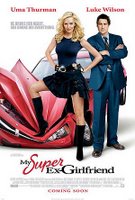
First off is director Ivan Reitman's latest, My Super Ex-Girlfriend. Reitman, although responsible for some extremely memorable and endlessly enjoyable comedies early in his career (Stripes, Ghostbusters I & II, Dave), seems to have lost his spark a bit and hasn't done much worth seeing in recent years. Sadly, this trend continues and Reitman becomes increasingly forgettable as a director with a lackluster recent résumé, including films such as Father's Day, Evolution, and now, My Super Ex-Girlfriend.

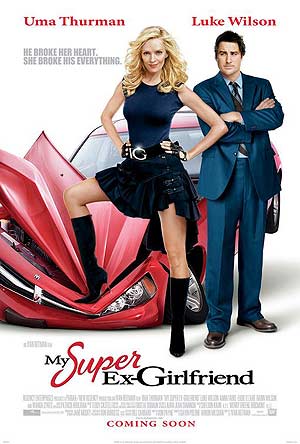
This isn't to say My Super Ex-Girlfriend is that bad of a film. Of the three films I'm reviewing, this one is easily the best in the sense of plot development, characterization, and pacing. The film moves along at a nice breezy clip, introducing us to Matt Sanders (Luke Wilson), a luckless shlub who seems to have finally found a nice, if slightly needy, girlfriend in Jenny Johnston (Uma Thurman). The twist is that Jenny is actually G Girl, who is apparently Earth's only superhero. This premise treats us to some fun visual gags of the amusing aspects of dating and breaking up with a woman who can't stopped by any force known to mankind. These diversions are definitely the most fun part of the movie, recalling Reitman's better films that were full of tossed off lines and gags. Rounding out the cast is Anna Faris, who also gets her fair share of super-harassment as Luke's new girlfriend, and Eddie Izzard as Professor Bedlam is the supervillian to G Girl's superheroics, despite the fact we never really see him do anything particularly villianous.

That ends up being the big sticking point that keeps My Super Ex-Girlfriend from being a truly enjoyable regular comedy. The villian's not a villian, the hero's not a hero, the male lead isn't particularly engaging in any way, so the viewer is stuck wondering, "Well, who cares?" Eddie Izzard and Rainn Wilson of NBC's The Office are both tragically underused comic foils, with Izzard being limited to only a few minutes of screen time and Wilson forced to deliver stock frat-boy lines about picking up girls, and how hot said girls are. Yawn.

I rate My Super Ex-Girlfriend a one on the 22 scale, keeping in mind our multiplication basics about the number one. If you're in a good mood (a 12, say) and you see My Super Ex-Girlfriend, you'll probably stay a 12. If you're a -12, I doubt it will cheer you. Either way, I wouldn't go too far out of your way to see it.

Biggest Plot Hole: The filmmakers suggest that Luke Wilson's cold fish of a character is the only man that hot blondes can date in New York City. Let's be real. He ain't that great a guy.
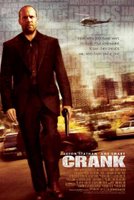

Next on the docket is the revved-up revenge film Crank, featuring Jason Statham as the oddly named Chev Chelios whose seconds are numbered while he hunts for the gang boss who pumped him full of Chinese poison in a poorly explained double cross. Our hero Chev figures out early on in the tightly paced eighty minutes of Crank that adrenaline combats the effects of the poison that is slowly taking over his body and mind. So, off he goes, trying to pull off every crazy stunt to keep his panic response going, no matter how dangerous or, in most cases, completely implausible said stunt is.

Let me get the bad out of the way first, as there are only two problems that keep me from wholeheartedly recommending Crank. The first is that the main idea of the movie is utterly and completely unbelievable. This is not a dealbreaker, or even necessarily a negative thing, but the movie reaches ridiculous levels of suspension of disbelief within the first ten minutes. The other complaint I'll register vs. the defendants of the movie Crank is that it is, for the most part, very misogynistic. The prime example is the scene in which our dear Chev tries to keep his adrenaline up in the middle of Chinatown by attempting to make love to his girlfriend Eve (played by Amy Smart, who deserves better), which comes amazingly close to becoming a sexual assault. Thankfully the movie avoids it, but it's only by technicality and I have to deduct points for it.

Those issues out of the way, Crank is actually a lot of fun. The filmmakers get very inventive with their adrenaline boosting methods, from chugging Red Bull to shooting up epinephrine, and the camerawork is equally mobile. Statham's B-action movie pedigree from films like The Transporter 1 & 2 and his unpretentious attitude keep things from getting too serious, as does the fine supporting cast. Dwight Yoakam, Efram Ramirez, and the aforementioned Smart all act as humorous bridges back to the real world whenever Statham's manic universe is getting too hectic. Rest assured, "hectic" is a loose description of how crazy the antics get in Crank, but to spoil any of it would take away from the fun of the film.

Crank racks up a solid seven on the ol' 22 scale for sheer intensity and fun. Not much brain, but a lot of brawn, and its short running time and relentless pace lets you burn off all of your action movie cravings in one drug-like burst. If you have a beer or two beforehand, even better.

Biggest Plot Hole: Too much adrenaline can make your heart burst. The way Jason Statham goes at it in this movie, he should be dead in under 30 minutes from overexcitment. More accurately, he should last about five seconds, when he should get riddled by the ten-man gang that corners him at the beginning of the movie. But let's not pick nits.


Finally, we reach the most hyped film of the summer, or the year for that matter: Snakes on a Plane. Now granted, I saw all of these films at varying states of intoxication, but Snakes on a Plane I saw out and out wasted. Let me tell you: it. was. awesome.

(Click here to see Your Racist Friend's take on Snakes on a Plane.)

Forget the fact that putting a giant case of poisonous snakes on a plane is an absolutely terrible way to kill one specific person on said plane (a witness to a brutal killing of a DA by a mob boss, if you care about things like plot). Forget that you will recognize only Samuel L. Jackson and a handful of others in the cast of many (in fact, you may not recognize Juliana Marguiles, as she seems to have had some unforgiving work done). Forget that you have heard about this movie non-stop since January (and the many accompanying stories that led to its immediate cult status). The bottom line is the film delivers.

When I left the theater after seeing Snakes on a Plane, I was at a loss to envision a snake-related death that did not actually already occur over the course of the film. So many incredible shock-tastic deaths pepper the first half hour of the movie, the viewer is left impressed with the breadth of ingenuity. This is a film that is not just giving shout outs to its internet fans; it acts as a out-and-out maitre'd to an exclusive bistro of thriller movie delights. And let's face it: that's why we came.

We paid to see anonymous actors flail around with snakes clamped on to their jugulars, screaming for help. We asked for a movie that offered little to no explanation for its ludicrous premise, other than the sheer visceral response that one has to the idea of cobras in the cockpit. We wanted to hear Sam Jackson tell us what, specifically, he had had it with. Lo and behold, they gave it to us. They gave it all to us. Snakes on a Plane is so unabashed about its service to its fans that it is easy to overlook the fact that the tension peters out with about thirty minutes left in the movie. It's still plenty entertaining from that point on, but there is a sense that the snake-death toll isn't going to be spiking upward anymore.

Whether Snakes on a Plane becomes one of our generations cult classics a la Rocky Horror Picture Show or Plan 9 from Outer Space, only time will tell. But I'l say this much; it certainly deserves that status. It would be a shame to lose all of the great stories and anecdotes that have come from the hype of this film that built its legend over the months. Snakes rates a twelve, making it definitely the best of this summer's worst. May it hold such a title forevermore.

Biggest Plot Hole: Seriously? How about the fact that a mob boss thought the most efficient way to kill someone would be putting SNAKES on a PLANE?!

-Mr. Me

Saturday, October 07, 2006

Saw

When I was about 13 years old, one of my friends was having a sleep-over party, so the bunch of us went for a walk real late at night. We thought, “We’ll just go out at 1:00 in the morning, get some food at the 7-11, and on the way back, we’ll go on the train tracks back to Chris’s house. And right about that time, the train should be coming. It’ll be awesome!” Ah, youth; the one time when you can be stupid and it’s okay because everyone expects it. We should have known it would be a bad idea. Having seen Saw, I can say the same thing. I should have known it was a bad idea.

I won’t sugarcoat it; Saw was a terrible movie. It didn’t teach me anything about myself or the world around me, it decreased my faith in humanity a little, and it made me feel like committing suicide when it was over, because the world was just too horrible a place for me to exist in it. It contained in it no essentially good characters, the acting ranged from laughable to downright insulting, and it was very obviously the work of an amateur writer and a hack of a director. To sum up: terrible.

It wasn’t just that the particulars were done sloppily or that the movie as a whole was clumsy and unconvincing. All that is true, but the real sin of Saw is something much deeper. Its philosophy on life, and presumably that of the director and writer, is one of utter despair, ugliness, and reckless hate. The fact that people actually think this way, as evidenced by this movie, makes me wish for the end of the world. No movie should make me wish that.

The stereotypically “happy” family in the movie is painted in an extremely negative light, and their pleas for the killer not to kill them are viewed as a joke for the amusement of the movie-watchers, as if the director is expecting us to be as sadistic and fetid as he is. There is no one we can root for, no one we can get behind, and the movie doesn’t even try to force anyone into that role. It doesn’t even make an effort to make this a story we can feel engaged in. The two main characters are despicable people, the detectives investigating the killer are both vapid and alien, and the killer himself comes across as being the hero of the story. What’s wrong with this picture?

I will also say that the means and mechanics of murder are the most inventive I have ever seen. Don’t get me wrong, that’s NOT a good thing. The things the killer forces his victims to do in this movie are unimaginable, or at least they were before this movie came out. I think they should have stayed that way. The fact that someone actually thought of the things in this movie brings the human race down a few notches. If ever there was a doubt that we had within us the capacity for evil, this movie crushes it with great discrimination. I would say that anyone who thinks that mankind is intrinsically good should see this movie, but I wouldn’t wish that on them or anyone. Saw is bad in both the mechanics of movie-making and philosophy of life. Avoid it at all costs, including its sequel, and the third part of the trilogy soon to come out. And if you meet a person who loved this movie, run.

Iconic lines:
(none)

22 Rating: -19

Particle Man

Tuesday, October 03, 2006

Thank You For Smoking

I haven't enjoyed a movie this much in a long, long time. In fact, I haven't enjoyed a movie this much since Eternal Sunshine of the Spotless Mind, and since that currently stands as my favorite movie (and a near-perfect 21 on the 22 scale), that's saying something.

Because of this, I won't be able to give you the shrewd, critical breakdown you've come to expect from Dr. Worm. Instead, I'll give you a brief plot synopsis, and then I'll gush about the movie in the hopes that you run out and rent it--it's video release is today, October 3rd--as soon as you finish reading this review.

Thank You For Smoking follows the life of Nick Naylor (Aaron Eckhart), a lobbyist and the public face of Big Tobacco. Given that fact, you might expect to spend the movie hating him. Oddly enough, you don't. You don't particularly like him, but you don't hate him either. You keep waiting to find that moment to hate him, and it never comes.

Which is good, since Nick Naylor's career is based on turning hate into like. He spins, he twists, and he maneuvers so beautifully that you hardly know he's doing it--the mark of a master. The opening scene is telling here: He's appearing on a talk show with three anti-tobacco advocates and a boy who got cancer from cigarette smoke. The movie shows us a few still shots of audience members' faces contorted with hate at the sight of Naylor. But within two minutes, he has the audience on his side and he's high-fiving cancer boy.

The plot, following a few weeks in the life of Nick Naylor, actually moves in a few different directions at once (which makes sense, since people usually deal with a few different matters in their lives simultaneously). In one, he's engaged in a battle of rhetoric with Vermont Senator Ortolan K. Finistirre (William H. Macy) over the senator's proposition to put a comically graphic skull and crossbones image on cigarette packages. In another, he's talking with super agent Jeff Megall (Rob Lowe) about a plan to improve the public of image of cigarettes by having actors smoke in movies. In still another, he's talking to/boinking reporter Heather Holloway (Katie Holmes), who is working on a feature story about him. In another--and the best--subplot, he's bringing his 12-year-old son Joey (Cameron Bright) along to work with him, putting him in the delightfully awkward position of having to be a good role model for Joey while simultaneously twisting the truth to get people to smoke cigarettes.

There are even more elements to this somewhat crowded plot, but there's no need for me to share all of them with you here. You're not going to see the movie for the plot.

The acting in the movie is on the whole above average, with Aaron Eckhart especially acting like he was born to play his role. His performance especially cannot be overstated, because if he sucked, the movie would suck. And as I said before, this movie doens't suck. William H. Macy, Cameron Bright, Rob Lowe, and Adam Brody (as Rob Lowe's assistant) all turn in above average supporting performances. Really, there are just two blemishes in the cast. Robert Duvall gave a rather strained performance as Doak Boykin, aka "The Captain"--the patriarch of Big Tobacco. And nearly any other actress would have been an improvement over Katie Holmes, who was given a role where she basically just had to be hot and enticing and didn't even pull that off properly.

But you're not going to see the movie for the acting either. You're going for the spin. The delicious, scintillating, captivating, joy-inducing spin. Oh, that wonderful spin. And this movie is full of it. Thank You For Smoking is a satire, yes, but not of the tobacco industry. It's a satire of spin. And not just lobbyists' and politicians' and talking heads' spin. Everyone's spin. My spin. Your spin.

"Wait a minute," you may be saying, "I'm just some guy (or some girl, as the case may be). I don't use spin."

Yes you do. We all do. Spin isn't necessarily lying, or even stretching the truth. It's just presenting information in such a way as to make yourself look good, or to make another look bad. And yes, you definitely do that.

But so do I, and so does everyone else. And it's absoluely, positively fascinating to watch people do it when you know what's going on. And since Thank You For Smoking is pretty much 90-minutes of spin--and a very clever and funny movie on top of that--it too is absolutely, positively fascinating to watch.

I give this movie a 17, but I'll be up front: I don't know that it's that good. I just know that's how much I liked it. But I also have a weird preoccupation with noting how people phrase things. So I probably liked it more than you will. But the two people I saw it with gave it a 12, and I think that's a pretty fair predictor of how much you'll enjoy this movie. In any case, just see it. You definitely won't be disappointed.

Monday, October 02, 2006

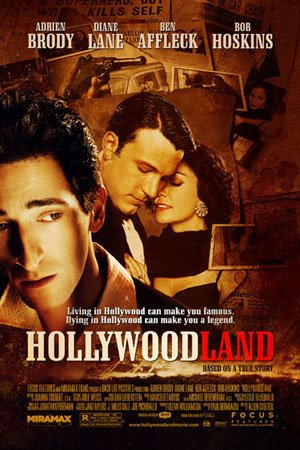
Metareview: Hollywoodland and The Black Dahlia

These two movies are just begging to be lumped together.

Consider the facts: The main character of both movies is a detective trying to solve a crime. In both movies, the crime is the murder (or perhaps suicide) of a Hollywood actor or actress. In both movies, the Hollywood actor or actress is--to varying degrees--struggling to make a name (or a better name) for him or herself.

I'll go on: Both movies are based on true events. Both movies are set in post-World War II pre-Vietnam America (The Black Dahlia in 1947, Hollywoodland in 1959). Both movies feature not-too-widely respected pretty-boy actors trying to earn their acting stripes (Josh Hartnett in The Black Dahlia, Ben Affleck in Hollywoodland).

With all these things coinciding, it's amazing that no one thought, "You know, maybe we shouldn't release these two movies within one week of each other." I haven't seen two movies with such similar themes released so close together since Deep Impact and Armageddon were both released in the summer of 1998. Those movies were released 7 weeks apart, and people still got them mixed up. In another slew of similarities, the Deep Impact-Armageddon tandem also featured Ben Affleck, and--perhaps this shouldn't be surprising--the Deep Impact-Armageddon tandem also kinda sucked.

Clearly, you helpless members of the general public need some brave souls to assess both movies simultaneously and let you know which of the movies--if any--is worth your hard-earned money and too-precious two hours of your time.

Into that breach steps They Might Be Critics, and I'm glad to see my fellow critics did an excellent job laying the groundwork for me to sum up the experience of both in this metareview. If you'd like to see some plot synopses or read their takes, just scroll down.

The thing is, both movies are kinda mediocre. Neither is terrible, but neither really wows you. With Hollywoodland, it's just frankly not that ambitious. It's competently done, but it really feels like nothing better than a television special you might stumble across while flipping through the channels. If you're interested in the life of George Reeves, or have a deep love of one of the main actors, you might decide to keep watching. Otherwise, you'd probably just change channels at the next commercial break.

The Black Dahlia suffers from the opposite problem, saddled with perhaps too much ambition. Based on James Ellroy's novel by the same title--which was in turn based on the 1947 murder of Elizabeth Short--it suffers from the same malady that plagues many book adaptations: it tries to squeeze 300 pages of plot and character development into 120 minutes of movie. The result is a film that might be satisfying for those who have read the novel, but is ultimately confusing and frustrating to those who haven't.

Both movies look good, cinematographically speaking. The Black Dahlia takes the edge here as it's the more visually ambitious, though there also a few bits of gruesomeness that--while probably important to the visceral appeal of the movie--I could've done without seeing.

The acting in both movies ranges from credible to exceptional. Adrien Brody and Hilary Swank both remind us why they're Oscar winners. Josh Hartnett, Scarlett Johansson, and Aaron Eckhart do nothing to stunt their rising reputations. Of those three, Josh Hartnett probably raised his stock the most, though that's tempered by the fact that it was probably the lowest of the three beforehand. Many critics are hailing Hollywoodland as Ben Affleck's return to form, but he seemed decidedly mediocre to me. The only person to truly knock my socks off was Diane Lane. She was young, charming, sexy, jealous, entitled, sad, lonely, bitter, jubiliant, steady, capricious, and old all at once. It's apparently already being speculated that she may win an Oscar for this role. It's probably too early to say, but she at least needs to be part of the conversation.

In retrospect, she's probably the best reason to see either movie. So if you absolutely have to see one or the other, and you don't already have some loyalty to Brian De Palma or James Ellroy or Scarlett Johansson, you should probably see Hollywoodland. In reality, though, you're probably better going off to your local video store and renting that forgotten classic you've been meaning to rent.

Because, all things considered, The Black Dahlia is probably a -2, and Hollywoodland isn't much better, rating only a 3.

Sunday, October 01, 2006

The Black Dahlia (Your Racist Friend)

The Black Dahlia is a film that will be widely misunderstood by many of the people who see it. This isn't to say that the studio is guilty of misleading promotion and advertisement, but the overriding theme is going over a lot of people's heads, from what I've been hearing and reading. People will go to Black Dahlia expecting a noirish tale of the seedier parts of LA and it's citizens in the 40s, and they will get that. But the title, referring to the infamous unsolved murder that hung over the LAPD for years, and still does to a lesser extent today, might not only refer to murdered "actress" Elizabeth Short, but also "The Black Dahlia" as a metaphor for forbidden desires that shouldn't be fufilled, and what happens if those desires are fufilled.
The film opens with the voiceover of Officer Dwight "Bucky" Bleichert (Josh Hartnett) over a massive brawl in the streets between sailors and local Hispanics, being occasionally broken up by Officer Bleichert, and Sergeant Lee Blanchard (Aaron Eckhart), his future partner. The two are dubbed "Fire and Ice" by the media, for Blanchard's hot disposition, and Bleichert's more stoic demeanor. We see the two partners compete in a boxing match, and do practicially everything together along with Blanchard's significant other, the sultry Kay Lake (Scarlett Johansson). Before long, the relative peacefulness of their lives is disrupted by the discovery of wannabe actress Elizabeth Short's mutilated body, and the shadow of The Black Dahlia is cast over the assembled players. The film continues from there in labyrinthine fashion, introducing us to Madeleine Linscott (Hilary Swank), and the secrets she holds that threaten to unravel the mystery of why Elizabeth Short died, and other terrible things.
The mystery of why Elizabeth Short was killed is not the focus of the film, but rather serves as a MacGuffin that illuminates, and gives drive to the secrets surrounding the other characters. Why is Lee so high-strung about a pimp named DeWitt and his imminent release from jail? Why does he make Bucky promise not to ask Kay about it? And just how involved is Madeleine anyway?
While TBD is not as good a film as L.A. Confidential, the other high profile James Ellroy film adaptation, it does do a better job of conveying "The Demon Dog of American Crime Fiction"'s dark vision. A word that I've heard a lot of people use in describing the film is "modern" due to the presence of nudity, violence, and cussing. I disagree. While these things wouldn't have been shown in older films, they are true to the general time period and setting shown in the film. Josh Hartnett turns in a solid performance that shows that he can indeed carry a film, and shows great promise. Hilary Swank, Aaron Eckhart, and Scarlett Johansson are all good as usual, but the breakout performance here comes from Fiona Shaw, aka Aunt Petunia Dursley from the Harry Potter films. With no more than five minutes of screen time, she shreds the competition with a performance that teeters towards melodrama, but doesn't quite cross over. All of this is framed by DePalma's vivid depiction of 40s LA, with the occasional soft-focus thrown in for old-timey charm.
There's a lot of negative buzz flying around about The Black Dahlia, which made me enjoy it a lot more than I though it would. While not an excellent film, it's not terrible either. I give it a 7 on the 22 scale.