Saturday, August 19, 2006

Love Actually

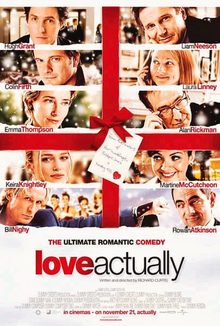
Love Actually is like a good hug. It’s warm, it’s peaceful, and it makes you much happier when it’s over than you were before it began. Sure, it’s unbelievable. Sure, it’s way over the top. Sure, it makes ridiculous assumptions about our emotions and the optimism of them. For me, however, all those assumptions are right on. You really have to check your instinctual disbelief at the door to really enjoy this movie. You have to let it work its magic on you. However, the movie’s just so charming that it’s really not all that hard. It features a veritable bevy of British talent, at least four of which have been in the Royal Shakespeare Company.

Okay, just allow me to let my hopeless-romantic tendencies run wild for a little while. I promise I’ll keep them in check from now on.

Daniel, Sam & Joanna
The real story in this section is what happens to Sam and Daniel, and Joanna is just window dressing. Liam Neeson gives probably the most sympathetic performance of his career; from the second he comes on the screen in the funeral scene, you feel like giving him a hug. Thomas Sangster violates about 50 international laws with how frickin’ cute he is, and the two of them together play off each other so well, you might forget it’s a movie. Sam represents the carpe diem philosophy the film puts forth. The moment Sam comes back from the terminal and hugs Daniel was really what the storyline was about: Sam connecting with Daniel, not Joanna.

Jamie & Aurelia
Colin Firth is very convincing as a British writer, but he basically plays the same character in every movie he’s in. His performance here is basically exactly the same as his two Bridget Jones’ Diary turns, and his role in Pride & Prejudice was so minimal that it can’t bear comparison. LĂșcia Moniz is a stunning physical specimen as Aurelia, and her smile lights up a room, but it really goes no further than that. This storyline, however, is responsible for one of the sweetest and most hilarious moments in the entire film.

Billy & Joe
These two are fantastic. Not a romantic relationship, but still love, though they don’t realize it till the end. Here we have one person very polite and composed (Joe), and the other a seemingly rude prick (Billy) who’s progressed to the point where he doesn’t need to be careful what he says. This relationship shows that love is different than romance, and really needs a much wider definition then romance.

Karen, Harry & Mia
This storyline is very predictable, and yet it’s not. We can see from the get-go that it’s going down a very dark road, from the first interaction of Harry and Mia. In theory, Mia is very attractive and sexy, but I didn’t find her so; maybe it was because she was just so slutty. Add to that Emma Thompson’s performance as Karen, and I just thought Harry was the biggest prat in the world. But Alan Rickman plays a prat like no one else. He is simply brilliant, like he always is. Note: Even standing at a counter is completely hilarious when it’s done by Rowan Atkinson.

Colin
This section infuriated me, and made me pout a little. I thought, “why does this happen to him and not to me?” Colin, who’s the very definition of a loser, experiences some incredibly fantastic luck, and amazingly, karma never catches up to him. By the end, I was sticking my lip out and going “NOT FAIR!!!” It’s saved, however, by Kris Marshall’s unendingly charming performance.

John & Judy
Nothing much happens in this storyline, and it’s basically just the comic relief in a movie that needs none. The fact that they’re very innocently pursuing a romance while they’re doing what they’re doing is pretty funny. It’s like they don’t even take notice of their surroundings. Funny, but unnecessary.

Peter, Juliet & Mark
It’s hard to choose, but this is probably my favorite section. Keira Knightly is very good in a subtle and sweet turn, as is Andrew Lincoln. Of all the characters, I probably empathized with Lincoln’s character Mark the most. The shot where he’s just walked out his door and he’s deciding whether or not to go back inside almost made me cry, and the choice of the Dido song was pitch-perfect. The way the storyline ends exists on an incredibly delicate balance; if it ended any other way than it did, it would have been horrible, but as it is, it’s brilliant.

David & Natalie
The non-believability of this section is really what makes it shine. Hugh Grant seems to have carved his place out as the selfish bastard, but I think he’s a lot better when he plays passive-aggressive nice guys, like here and in Notting Hill. This storyline really emphasizes that you have to have your suspension of disbelief cranked to 11. Once you do, however, Hugh Grant and Martine McCutcheon make a very cute couple. The Billy Bob Thornton cameo is a case of dead-on casting, too.

Sarah & Karl
This section, one of the not-as-good ones, is redeemed by two things: that they got Laura Linney to play the part of Sarah (as opposed to basically anyone else), and the turn it takes. Normally, very stark turns in a mostly happy film are not advisable, but here it works. This section brings the movie to giving a complete view of love; it shows that it doesn’t always work out the way you want.

We may live in a fallen and sinful world, but no matter how much filth and ugliness you apply to some things, they still reflect something holy and pure. That’s what Love Actually brings out to me. Okay, hopeless-romantic moment over.

Iconic lines:
“I’m on Shag Highway, heading west!”
“Tell her that you love her! You’ve got nothing to lose, and you’ll always regret it if you don’t. You’ve seen the films, kiddo. It ain’t over till it’s over!”
“Enough. Enough now.”

22 Rating: 18

Particle Man

Friday, August 18, 2006

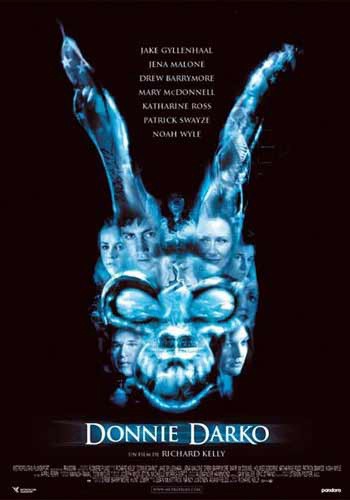
Donnie Darko

Initial Reaction: I’m not sure why that was so good.

After my first Donnie Darko viewing, I loved it, but was convinced that I needed to see it again to understand it. I did, and loved it, but was convinced that I needed to see it again to understand it. I did, loved it once more, but was saddened to realize that I needed to see it again to understand it. I watched the movie for probably the sixth time today, and I still don’t freaking understand it.
Donnie Darko fascinates its audience in almost every way possible. Jake Gyllenhaal, who plays Donnie, delivers a seamless performance as a teenager who is—big surprise—disturbed. He suffers from bouts of sleep walking and trouble at school, and as we learn further into the movie, an “imaginary” friend named Frank. The relationship between Donnie and Frank (who, by the way, is a guy in a creepy rabbit suit) seems predestined, and a bit schizophrenic. Frank comes to Donnie at night or when he’s alone, and in the beginning tells him that the world is going to end in 28 days. He continues the countdown throughout the film, and also instructs Donnie to do various illegal acts, mostly vandalism. These scenes are haunting, yet somehow reassuring. Frank is a character that we feel like we should figure out, but his purpose and cryptic messages are a little too random and sporadic.
As we would expect from a movie focusing on a troubled teen, we get to know the rest of the family. And the Darko family is totally engrossing. Holmes Osborne and Mary McDonnell play lenient parents, seemingly forced to be that way because they’ve lost control of their children. Gyllenhaal and his sister, Maggie Gyllenhaal, are on-screen siblings who are picture-perfect as teenage brother and sister. Each character contributes to a realistic sense of familial dissatisfaction, frustration, and hope.
The other characters, some almost caricatures, and some painfully normal, are nothing amazing. They serve the purpose of the movie. The only person noticeably not good in a role was Drew Barrymore as a young English teacher. I felt like she must have happened to be walking by the set the day that their English teacher called in sick; they grabbed her, gave her some shoulder pads, and wrote her lines on the back of her hand. This is especially sad, since she was one of the film's executive producers.
I love a lot of the different pieces of Donnie Darko. As I mentioned, the actors who play the Darko family are dead on. The music is delicious…a soundtrack that reflects a part of the 80s we actually enjoyed. Never without an appropriate mood, each scene allows the actors, music, set, and effects to build upon each other in an expert way. And the film does make some great points. One of my favorite subplots involves Patrick Swayze’s character, and gives us an ugly picture of how deceiving people can really be.
The movie gets so many things right. But it’s also too confusing for its own good. The characters explore such intriguing concepts as God’s plan, time travel, and ethics. It somehow tries to tie all of these things together in the midst of adolescent turmoil, and nearly does, but fails to deliver. I’m convinced that most people walk away from this movie mostly confused. If they don’t, then they probably missed something. There are so many loose ends that we’re confused about where we’re being led, and by the end we’re forced to forget about most of them anyway. The director has various subplots going on, and because of the nature of the film, they’re left in a tangled mess. The running story of Cherita (which I loved) just sort of…happened. There was a subtle theme of “everything’s going to be OK” that didn’t seem to fit well. The reasons behind what Frank tells Donnie to do are super-vague and not explained at all. I’m considering the fact that these things were maybe left open because of the way that time travel fit in. But, wait a second… then what was the point of this movie?
I loved the movie It’s a Wonderful Life. I generally enjoy the story in which the main character gets to see how his life affects people around him. It forces us to reevaluate our lives, our choices, and our significance. Donnie Darko, in almost a reverse way, gets to see this in his own life. I thought this was brilliant, and always an admirable choice for a movie scenario. However, this one lacks the punch that most of those movies have. We’re left drifting, wondering about existence and if our own is currently helpful or harmful. And no one wants to feel uncertain about purpose.

Rating: 14

I know, I know, it makes no sense. But I love this movie. I feel like if the director didn’t let it run away without him, it would be just about perfect. Richard Kelly is like a child roasting marshmallows on a stick for the first time. He slowly gets the sticky treat close to the fire. When he sees it turn a beautiful golden color, he gets bolder and sticks it directly into the flames. The white ball is now engulfed, and burning quickly. Once the kid finally gets the fire out by swinging the stick around in the air, his wonderful, fluffy white marshmallow looks like a hunk of coal. In the end, he (and the audience) are left with no other course of action but to eat through the charred and bitter coating in order to get the gooey sweetness.

Iconic Lines:

“Chut up!”
“Rose, sometimes I doubt your commitment to Sparkle Motion.”
“I’m NOT afraid anymore!”

Wednesday, August 16, 2006

Movie of the Month - August '06

World Trade Center

Stay tuned for our reviews coming up August 20th-24th! Lucky for you, They Might Be Critics hosts a regular movie of the month. During this exciting time, all (or most) of our critics post reviews of a chosen movie that is due to come out this month. We are all about providing a range of opinions and insights, and allowing for an open forum in which we discuss the film with each other and anyone who desires to participate. So, see World Trade Center, and join in!

Tuesday, August 15, 2006

The Descent

The Descent is a little horror movie that was released in England last year, made the rounds at quite a few festivals in Europe, and finally reared its head in America to do what seems to be good sleeper business. It is the tale of Sarah (Shauna McDonald), who loses her husband and child in a tragic accident at the beginning of the film. From the accident and the immediate aftermath, we fast-forward a year to Sarah and her friend Beth (Alex Reid) as they arrive at their friend Juno's (Natalie Mendoza) cabin near the Appalacian Mountains to meet up with some friends for a caving expedition. But one of the girls has a secret that gets them into more than they bargained for, and they find themselves stalked in the caves by....something. Or do they?
The Descent was directed by Neil Marshall, director of cult favorite Dog Soldiers. The film grabbed my attention from the first frame, and held on to it for the rest of the movie. It is well shot, and the trees, mountain landscapes, and caves are visually much more pleasing than in your average horror movie. The score serves the film without drawing attention to itself, and the performances are.....well, nothing amazing, but nothing to complain about either. Like many other elements, they serve the film.
The things that The Descent gets right are atmosphere, ambience, and tone.....three very similiar traits that can and will make or break a horror film. There is gore to be had, but it doesn't create tension like the scene where one of the girls scouts out a VERY narrow passage to the next tunnel......if you're claustrophobic, you might want to avoid this film like a ophidiophobe will be avoiding this week's much-talked-about Snakes On A Plane.
Neil Marshall has done well here: The Descent is one of the most honestly frightening films I've seen in years.....if it doesn't make it into my top 5 for Horror, which it might. I give The Descent a 14, in terms of how much I liked it in terms of replay value. But the actual score the film deserves? It's an 18 out of 22, all the way.

Saturday, August 05, 2006

Munich

Every human being is just that: a human being. Now, this may not seem like a huge revelation or a deeply profound statement, and maybe it’s not. But when dealing with conflict, with wrongs being done to us and deciding how to answer those wrongs, we very often forget that those wrongs are being done to us by humans. Remembering that might make us think twice about how we react to things.

Munich
is a very important movie, one of the most important movies to be released in recent years. Leave it to Spielberg to make a movie like this. He’s the most famous director in the world for a reason, and that was brought home to me by this movie. He has a golden touch for most things, and does social issues with a certain delicacy and gentleness. His methods are kind of like a good father’s: he unflinchingly lets you see the horrible things of life, then cradles you gently and whispers words of comfort while you’re trying to deal with them. Usually with Spielberg, there’s some sort of hope. Whether it’s the fun and pluck of such films as E.T. or Indiana Jones, or the quiet endurance of Schindler’s List, there is some element in there that lets you know the whole time that it’s all going to be all right. In Munich, that hope is muted and frail, but it’s still there. The hope comes in the human element of the story, in the simple fact that no amount of ugliness can quench the human spirit.

The framework of the plot of Munich is real events. The only things we know for absolute certain as being real and true are that in 1972, 11 Israeli athletes were kidnapped and murdered at the Munich Olympics by Arab terrorists, and shortly afterwards, 9 of the men thought to be responsible, directly or indirectly, were dead. After that, everything ranges from “could have been” to “probably was” to “almost certainly wasn’t.” The thing that’s so remarkable about Munich is its inability to let anyone off the hook. It never lets us forget that these are people involved in these stories, people with mothers, fathers, jobs, needs, obsessions, fears, and aspirations. When someone dies, it’s not just a statistic, a mark on a chalkboard.

The actors, who are mostly unknown to the general public (Geoffrey Rush aside), do a nice job of creating people who are real, whole, and don’t know they are in a movie. The cinematography is spectacular, creating a surprisingly warm atmosphere. Eric Bana carries the movie with ease and fluidity, making sure to highlight the issue at hand instead of himself. The movie doesn’t deal in answers, and brings out that the questions it poses don’t in fact have answers. It instead attempts to understand the actions of these characters through empathy, which is what any great film does. Once it does that, however, it doesn’t wave that power around irresponsibly like a kid who’s found his dad’s gun. It tries to bring us to a place where we can be more aware, more understanding, and maybe more compassionate.

In retrospect, Crash just barely has the edge over Munich for the Best Picture Oscar in my opinion. Both movies make you think very hard when they’re done, and spark a little bit of soul-searching. Crash deals with something that’s a little more universal, and does so in a more explicit fashion, but watching Munich doesn’t make you feel like a bastard the way watching Crash does, and that’s actually to its credit. The last line that’s spoken in the film is by a wife to a husband, saying “I love you.” After all that ugliness, there is still hope.

Iconic lines:
“Oh, we are tragic men; butcher’s hands, gentle souls.”
“If my fingernails grow, do I not cut them off?”
“Don’t f*** with Israel.”

22 Rating: 17

Particle Man

Sunday, July 30, 2006

Pirates of the Caribbean: Dead Man's Chest

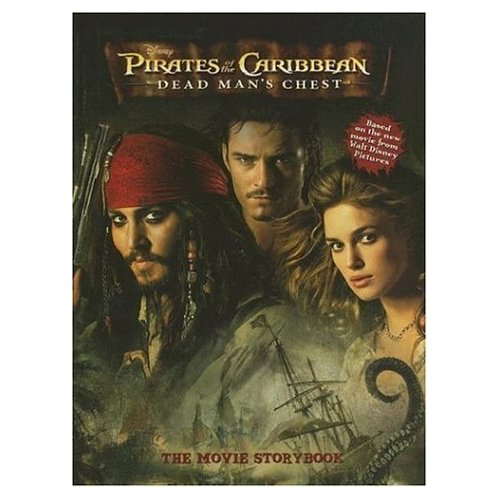
“Drink up, me hearties, yo ho!” Once again it is time for some piratey goodness. Pirates of the Carribean: Dead Man’s Chest finds us in the world of Captain Jack Sparrow and his wacky adventures yet again. We are wrangled into a setting of pirates and propriety that are always fighting each other for prominence.
The movie opens as a bride is sitting in the rain (it actually kind of reminded me of some of the Guns N’ Roses: “November Rain” video.) As the camera focuses, we see that it is Elizabeth who's the wet bride. One can only assume that she was waiting to marry Will Turner, whom she chose at the end of the first movie. However, the audience is soon set right that no marriage can happen. Both Elizabeth and Will are in grave danger from having helped Captain Jack Sparrow and must find some way to avoid the noose. A shrewd businessman comes to Port Royal to make a deal for their freedom. Will must retrieve a certain item of Jack’s if he is to live until his wedding night. He sets off on this adventure to save his love and himself. Elizabeth however, not one to sit around and wait for her man, takes matters into her own hands.
Jack in the meantime has once again escaped from a prison and is back sailing on the Black Pearl. His bliss is short-lived, however, as he is soon reminded of a debt he owes to Davy Jones, the legendary pirate who rules over an army of enslaved sailors. When I first heard this name in the movie I expected the old Monkee to come out and start singing, however, I was sorely mistaken ;). An old friend shows up on the Black Pearl to remind him of his debt. That friend's name is William Turner. Yes, boys and girls, William Turner Sr., the dashing Will Turner Jr.’s father. Jack tries several ways to get out of repaying his debt, including offering Will Jr. as a replacement. Young Will tries to find a way to destroy Davy Jones, if he can just find his vulnerable point. Elizabeth is not far behind and rushes along with Jack to save Will. For anyone who has seen the first movie, the dashing Commodore Norrington does appear in this installment, but in somewhat of a different form.
OK. First of all, I have to say how excited I was that this movie was coming out. I had seen The Da Vinci Code and X-Men: The Last Stand, both with entertaining results, but felt a mourning for my summer that would go by without any more big blockbusters. In come my heroes, Johnny and Orlando, to save the day. As I anxiously awaited this movie’s premiere, I read some reviews written by the people who were lucky enough to see it early, which left me rather bummed. None of the reviews were good. “Oh, no!” I thought, “I didn’t think my boys would let me down!” Then D-Day came (Debut Day). I braced myself for what I was about to see, and two hours and 45 minutes later I was walking out of the theater with my group of friends.
During that walk so many things were bouncing around in my head. “That was so entertaining!” My brain was yelling at all the critics who had bashed the movie. What did they expect? A moving piece of cinema that rocks the very foundation of our society? Or maybe they were hoping for something showing that the world may have gone off kilter but it would right itself soon enough. Ok, what about the concept of a PIRATE movie did these people not understand? I didn’t go to this movie to be challenged, I came to be entertained. Pirates achieved that goal in stellar form. It was not about this movie meeting me where I was in my life, it was about pirates (although not as cool as ninjas) still being really cool and able to entertain, love, betray, and pilfer without too much alienation. I do not know what these critics were expecting, but I think they might be spending too much time at the movies (yes, there is such a thing) and not enough time on their personal lives. This could be causing them to try to have movies double as fulfillment in their lives and also their livelihood. You’re bound to be dissatisfied when you’re trying to live vicariously through movies.
The movie has amazing special effects. One thing I would really like to congratulate the movie on was the ability to use jokes from the first movie, but not to a point of exhaustion. Otherwise, I do not know what else to say about this other than, “It's entertaining.” Some movies are made to change our lives. Others are made to show what we need to change. However, some are made to remove us from reality for a bit of relaxation. The night that I saw this movie, I was definitely in need of the latter. I don’t care what the critics say. I liked it!
I ran through several different ratings in my head trying to figure out what would be the right one for this movie. I came up with a set of requirements that the movie had to meet, and I would rate it accordingly to how it met my expectations: 1) Was it worth the money I spent to see this movie? Definitely. Therefore, the movie already starts at a ten, since that’s the amount that I spent. 2) Did I have any need to hurt the directors or producers of this movie? (note: I have sometimes felt like that when I have seen a sequel that they totally ruined) No. That brings the movie to a 12. 3) How much did I enjoy this movie? Very much; I didn’t go to see something deep, I went to see some pirates. Good job, movie! Way to stick it to the man! My enjoyment of the movie bumped it up another 4 points. Bringing the total to 16. No matter what, I suggest that you go and see the movie for yourself and see if you enjoy it or if it reminds you of really bad eggs.

Friday, July 28, 2006

Brokeback Mountain

Cowboys and fishing trips and homosexuality, oh my! Considering all the Oscar buzz and controversy surrounding this movie, I was preparing myself for a great movie-going experience, or at least an intense one. Heath Ledger and Jake Gyllenhaal kissing is bound to ruffle a few feathers, and so many people were up in arms about something as masculine as the cowboy lifestyle being crossed with homosexuality. Needless to say, my interest was piqued. Now that I’ve seen the movie, I feel sort of gypped.

The movie didn’t go for shock value, which is good. It didn’t look at a homosexual relationship as something entirely normal, either, which is good, too. But that doesn’t leave it with very much room to go to. It would have been nice, I think, if the director made some sort of comment, even a miniscule one. Instead of making a statement and then letting the audience members make up their own minds, Ang Lee cut off his own tongue before he even got to that point.

The plot of Brokeback Mountain involves Ennis and Jack, two cowboys who find an interesting way to keep warm during cold nights on the prairie. The time period of the story is 1963 and back then, this type of thing was just not done. Even in this day and age, it would be met with acceptance but a few raised eyebrows. As unsettling or unusual as the subject matter is, the movie doesn’t really seem to care. The tone through the entire first act is one of voyeurism, with no energy put forth to make us like, sympathize with, or even understand the characters or their actions. The actions and reactions of the characters (at least in the first part) seem random and inexplicable, and the movie doesn’t even try to explain them. Things happen, and we as the audience feel like intruders, watching events that have nothing to do with us. Not that I’m callous, but why should I care?

It took awhile for the story to introduce a character I could really get behind, but it did with Alma, Michelle Williams’ role. I totally felt for her as she watched her husband have an affair. I get the feeling that I would have had sympathy for Anne Hathaway’s character as well, if she had had more screen time. Jack and Ennis were the two involved in the relationship that was the main focus of the film, but the story I found much more involving was what happened with their respective wives. I wish a movie could have been made from their perspectives. The other supporting performances (Randy Quaid and Linda Cardellini) added great touches, being fully realized characters with very limited screen time.

Brokeback Mountain was supposed to be a big movie, as it received a lot of hype and generated a lot of controversy. Honestly, I don’t see what all the fuss was about. While it’s true that it was strange to see two big-name actors (that were both men) having sex with each other, the tone of the movie encouraged non-reaction instead of the opposite. The cinematography and sets were very good, but the story had a messy resolution. Thumbs up to Michelle Williams for making a character that I could really believe in, but as for the rest of the movie, I could really take it or leave it. I imagine the novel is a whole lot better.

Iconic lines:
“Brokeback got us good, don’t it?”
“Texans don’t drink coffee?”

22 Rating: 2

Particle Man

Friday, July 21, 2006

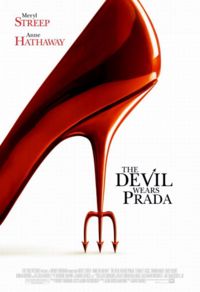
The Devil Wears Prada (Wicked Little Critta)

The following is a true story* about John and Jane, your average American movie-going couple.

John and Jane headed out one drizzly, humid July evening to the Centerville Cinema to catch a movie. Neither one really knew of any movies in theaters, but John was confident in the possibility of some variation of a race car/horror movie starring The Rock, and Jane was comforted in the knowledge that John would be more than happy to accommodate her preferred movie tastes. After about 15 minutes of meandering through a packed stadium-sized parking lot, they eventually landed in what some might call a “parking space” from which they were pretty sure they could see the theater in the distance. They headed in and hopefully scanned the movie listings and show times. Just as John’s suggestion of Fast and Furious IV was on his lips, Jane exclaimed with glee: “OH! The Devil Wears Prada is playing! I’d forgotten about that one…” she turned to John as though he’d be interested: “You know, the girl from Princess Diaries, and um, Meryl Streep! I’ve wanted to see this. I forgot it was playing!”

And so, John shelled out about $20 on tickets for The Devil Wears Prada, a movie starring women, about women’s fashion, and another $20 for popcorn, soda, sugar-free Mike and Ike’s, and a bottle of water. Jane got in line for the ladies room.

After John had made all of his purchases, memorized all the movies coming out in the next three months, and played a game or two in the arcade, Jane joined him. They were early enough to get fabulous seats.

They waited. Ate 80% of their food, did some word scrambles, and watched previews. The movie starts.


Jane: Wow, Anne Hathaway looks great!

John: Hey, that girl isn’t bad looking. Maybe this won’t be total torture.


Jane: Oh my word, my boss is just like that! Get out now, Andy!

John: What a b*tch. Just punch her!


Jane: Hey! That girl was in Rent!

John: …


Jane: Those clothes are soooo gorgeous. What I’d do to wear Gucci…

John: Umm, is that actually clothing? I mean, is it even wearable?


Jane: (giggles) The gay guy is so funny!

John: That gay guy is pretty funny.

Similar thoughts ran through their minds as the movie continued. They both learned a number of things. Jane learned that doing what one is told to do is always a choice, and a person is responsible for his or her choices. She also learned that size 6 is the new 14, so she had some dieting to do. John learned that there’s a lot of money in the fashion industry, that there are more than five colors, and that it’s never cool to put work ahead of the people you love. Finally, they both learned that sometimes a person needs to give up one good thing to get an even better thing.

All in all, a good movie experience. On the -22 to 22 scale, they rate it a solid 10. Tune in next time when Jane and John watch Fast and Furious IV.


* True, as in “probably happened.”

Thursday, July 20, 2006

The Devil Wears Prada (Dr. Worm)

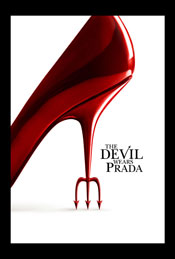
So The Devil Wears Prada is actually pretty good. This is not what I expected when the TMBC Illuminati suggested it as our next movie of the month, but I was pleasantly surprised.

My initial hesitation probably stems from the fact that this movie is marketed almost exclusively to females, which I took to mean one thing: chick flick. And I can appreciate a good chick flick as much as the next reasonably sensitive guy -- I enjoyed My Best Friend's Wedding, for example -- but in general the prospect of chick flicks doesn't set my heart racing.

You can imagine my confusion, then, when -- sitting beside fellow critics Wicked Little Critta and Stormy Pinkness (both girls), in a movie theater filled with women -- I actualy found myself enjoying this movie. In fact, that very idea frightened me a little bit. Would I soon prefer salads over beef? Would my interest in sports start waning? In short, were my testicles shrinking?

I'm pleased to report, however, that none of these fears were warranted. I didn't enjoy the movie because I was becoming a chick; I enjoyed it because it's not a chick flick.

Now I understand that some of you may balk at this. How can a movie in which the two leads are female and which is almost wholly concerned with the fashion industry not be a chick flick? Well, here are three big reasons why The Devil Wears Prada does not fall into the "chick flick" category.

1. Chick flicks are obscenely predictable. The Devil Wears Prada is not. I'm not saying it's an edge-of-your-seat, keep-you-guessing thrill-ride, but at least you don't know the ending just by looking at the movie poster.

2. Chick flicks are typically pretty shallow. Really, they're just about biological urges. Sure, they claim to be about "true love" and all that, but they're really about what every female wants: to find a partner with the best genes possible so as to pass favorable traits on to her offspring. The Devil Wears Prada, however, is not shallow at all--shocking for a film that centers around fashion. Instead, The Devil Wears Prada asks relevant and cutting questions about human mutability, about the nature of commitment, and the all-important (for this generation) quandry of how to balance career and personal life.

3. Chick flicks tend to be dishonest. The insidious message that chick flicks send is that each human being has a perfect match out there, so if you are unhappy in your current relationship it's because you're with the wrong person. This sentiment, I believe, is largely responsible for our society's staggeringly high divorce rate, and chick flicks have for many years contributed to the acceptance and prevalence of this myth of the "perfect match." I could go on here, but I really only mention this to compare it to The Devil Wears Prada, which is a surprisingly honest movie. There is a seemingly "perfect" guy in the mix to tempt our heroine, but much to my relief this movie didn't dabble in the aforementioned dark arts of chick flicks (and that's all the spoiling I'll do on that topic.)

But the movie is in fact quite honest in showing our herione to be, like everyone else in the movie (and the world), a flawed human being. And she behaves the way a human being might in her situation. Characters in this movie don't overreact to petty offenses for seemingly no other reason than to throw a wrench into the plot, and there are no absurd twists based on miscommunications (both chick flick staples). When you see the movie, you believe the events in it could really happen--even though some of the characters are comically farcial. But I suppose that's because the novel that spawned the movie is based on real events from author Lauren Weisberger's life.

I suppose no two words better describe this film than "exceeds expectations." If there's any exception to that, it's the acting, but that's no dig. Anne Hathaway is charming as Andy Sachs and Meryl Streep effortlessly chews scenery as Miranda Priestly, Andy's boss. But both actresses have impressed before, so seeing them succeed here is expected. But for the plot, the script, the supporting cast, and the suprising freshness the movie demonstrates, "exceeds expectations" is a perfect modifier.

And it's especially apt for the title. I first read the title as, "Okay, her boss is really mean, so she's the devil, and because she works in fashion she wears Prada." Fortunately, the title is much deeper than that. It refers instead to the Faustian offer that Miranda presents for Andy: Work for her, and Andy will soon be able to do anything she dreams of, careerwise. But, as Andy learns, she may just lose her friends, her humanity, and her soul in the process.

And if I had to condense all these thoughts into a single number, I'd condense them into the number 9.

The Devil Wears Prada (Stormy Pinkness)

“Wait a second! You want me to do what? Are you so lazy and incompetent that you cannot manage to do one simple task by yourself?” Pretty much every secretary on earth has had these thoughts at one point during those long, eight-hour days. The life of a secretary or assistant is usually one of non-existent thanks, long hours, and passive-aggressive behavior. With all this in mind, it is time to discuss The Devil Wears Prada, starring Anne Hathaway, Meryl Streep, and Stanley Tucci.
The Devil Wears Prada tells the story of Andy Sachs, a young journalist who is willing to do anything to start her career. Finally, she interviews for a job as an assistant to Miranda Preistly, who is basically the be all and end all of the fashion magazine world. After, seeing people run around like chickens with their heads cut off to please this woman and after a rather strange interview (personally, if I had been in Andy’s position I would have run the other way rather than taking the job), she gets the job that every girl who loves fashion would die to have. She soon realizes that there are sacrifices and challenges that she will have to face in this job and in her life. She will have to learn how to deal with her demanding new boss, who has a great amount of clout in the publishing world, and she will also have to balance her work life with her life with her friends and her boyfriend.
Anne Hathaway entertains in her portrayal of Andrea Sachs. She has just graduated from college and needs a job, so basically anything that has even the slightest thing to do with her chosen field would be great. She soon realizes that this is not as easy as she originally thought, until she finally receives the job as Miranda’s assistant at a fashion magazine.
As someone who works as an assistant/secretary, I thought that she portrayed the role believably I don’t know how many times I have been confused by vague instructions, or passive-aggressively completed a job that my boss thought was impossible and silently gloated after doing so.
Although Anne Hathaway did a good job as the assistant Andy, nothing could top Meryl Streep’s portrayal of Miranda Preistley, the Evil Fashion Dictator. The moment she showed up on the screen she made me feel like I should be doing work instead of watching a movie—I felt like I should pretend to be busy so I wouldn’t get in trouble. Streep’s character is someone who knows she is powerful and uses that to get anything she wants.
Throughout this movie, Andy is faced with a number of decisions that she needs to make. She continually tries to be true to herself and not end up like her boss, who is characterized as the epitome of evil. However, even though she goes through the movie doing everything with the best of intentions, it soon shows that people can change without even knowing it.
Immediately after the movie ended, I was not too impressed. I thought it was too long. However, as the days passed, my opinion of the movie continued to improve. Overall, it was not an awful movie. It was entertaining and had an enjoyable cast. After going back to work, a few days after seeing the film, my appreciation for it grew as I went through the same tasks that Andy does and also dealt with some of the same challenges.
And now for the moment that everyone has been waiting for: the rating. I would give this movie an 8. It was something I related to and the acting was very believable. I have heard complaints that the movie was not true enough to the book, but if you feel that then stick to the book, because last time I checked movies and books were different.

Tuesday, July 18, 2006

The Devil Wears Prada (Particle Man)

When I was about 13, we got a kitten. We hadn’t had a cat for a period of about 6 months; quite sometime for us to go without a cat. We had a dog and a bird, but it just wasn’t the same. We got this kitten that was all white except for a small black mark on her head. We named her Sasquatch, initially because she was all white. We later found out that the name was entirely appropriate because she was a total monster. On the other hand, she was so cute she could peel the paint off an ocean liner. Seriously, I think cuteness of that magnitude is illegal in some states.

The Devil Wears Prada is like Sasquatch. At first look, it appears, cute, fluffy, and harmless. You pet it, play with it with a ball of yarn, laugh and smile, and it playfully attacks your hand. But after you’re finished, you notice that your hand is all scratched up and bleeding from the kitten’s little claws and teeth. And you think, “did that little thing really do all this?”

Anne Hathaway (no, not the wife of Shakespeare) stars in this little comedy as Andy Sachs, though Meryl Streep gets top billing. Part of me thinks that’s unfair, but then I think, “hey, it’s Meryl Streep.” Speaking of Meryl, I cannot say enough good things about her performance in this movie. Instead of making us hate her character through loathsome and instantly enraging acts, she instead chooses crushing indifference. The way she lightly says “that’s all” simultaneously implies apathy, condescension, and finality. She’s calm, cool, collected, and in charge, and she doesn’t let anything ruffle her. Well, almost anything, but I don’t want to give a spoiler.

This is not to impugn Anne Hathaway’s performance, or the many great supporting performances. Anne simply glows with that charm and appeal she radiates as second nature. Given the right role, she has the ability to draw you in, even in saccharine Disney movies like The Princess Diaries or its sequel. Stanley Tucci and Emily Blunt are fantastic in their roles as scenery-chewing fashionistas, slaves to the whim of the almighty Miranda Priestly (Streep’s character). Even Adrian Greiner gives a competent performance as the boyfriend who stretches to ridiculous lengths in the wake of Andy’s transformation, but only so far.

The characters in The Devil Wears Prada aren’t one-dimensional or paper cutouts, as would be expected in a fluffy comedy like this one. It only appears fluffy, though. Like Sasquatch, it has unexpected claws. It ever-so-gently skewers the fashion industry, and you see the materialistic nature of it. Andy is definitely not a fashionista, but through working at Runway magazine, she starts to become one. The question that the movie presents is “does she want to advance in her job, or keep her integrity and humanness?” It’s a great job, but not one for her. We as the audience know that, but Andy at some point forgets.

This movie appears nice and quaint, and it is, but it also has barbs that you appreciate, mostly because they’re directed at the movie itself and not at you, the audience. Enjoy it, but be wary of its claws. It may be cute, but it’s really a Sasquatch.

Iconic lines:
“I’m on this new diet where I don’t eat, and then when I feel like I’m about to faint, I have a cheese cube. I’m one stomach flu away from reaching my goal weight.”
“That’s all.”
“The person whose calls you always take? That’s the relationship you’re in.”

22 Rating: 10

Particle Man

Thursday, July 13, 2006

Movie of the Month - July '06

The Devil Wears Prada

Stay tuned for our reviews coming up July 18th-22nd!
Lucky for you, They Might Be Critics hosts a regular movie of the month. During this exciting time, all (or most) of our critics post reviews of a chosen movie that is due to come out this month. We are all about providing a range of opinions and insights, and allowing for an open forum in which we discuss the film with each other and anyone who desires to participate. So, see The Devil Wears Prada, and join in!

Wednesday, July 12, 2006

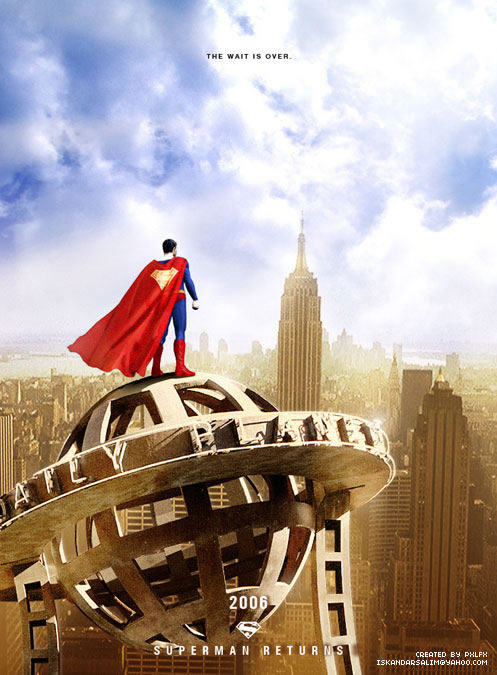
Superman Returns

Does the world need a Superman?

That's the question that a lot of people have asked, and a lot of people just can't get behind the idea. He's "too powerful," "too much of a goody two-shoes," "not dark enough," etc. I am not one of those people. I think that Superman works as a character ... how else would he have survived the last 68 years? But people do have a point in that he seems an ill-suited character for these dark times ... a point that is negated by the argument that in darker times, you need a bright icon like The Man of Tomorrow. But ... enough rhetoric.
Superman Returns takes place 5 years after the events of Superman II ... we are told that astronomers discovered the remains of Krypton, and Superman went to see it, and had been absent for 5 years. He returns to Earth to find that his world has changed: Lois Lane has a child, is engaged to be married, and has written a Pulitzer-winning story called "Why The World Doesn't Need Superman." Lex Luthor has gotten out of prison, thanks to his gold-digging of an old widow, and Superman not being around to testify at his trial (oops). What follows is the story of Clark/Superman getting back into his old life, and overcoming the obstacles presented before him.
This film is more ... orchestral in tone that most of the other superhero films we've seen in the last few years, save the transcendent Batman Begins. Bryan Singer set out to make an epic befitting the Man of Steel, and he succeeds nicely. The film doesn't feel any longer than it's 2 hour and 40 minute running time, and there are no script problems save a minor one that a new character presents and that I won't go into here ... too spoilery. The special effects are among the best I've ever seen, and Superman's powers are rendered impressively. I was impressed by Brandon Routh, who exudes authority as the Last Son of Krypton, and hits all the right comic notes as the hapless (?) Clark Kent. Kevin Spacey chews scenery as the orginal bald genius Lex Luthor, leaving Gene Hackman's hopelessly dated performances in the dust.* Kate Bosworth and Frank Langella turn in serviceable performances as Lois Lane and Perry White, and Sam Huntington shines as the enthusiastic Jimmy Olsen. Parker Posey also shines in a patented Parker Posey (tm) performance, as Kitty Kowalski, the "new" Miss Tessmacher.
This movie may not do as well as it deserves to because of the daunting box-office performance of POTC: Dead Man's Chest, but it is well, well worth your time. I give Superman Returns an 18 out of 22** on the 22 scale.

*To be fair, this isn't exactly Gene Hackman's fault. The old Lex Luthor was written as more of a Prankster/Funky Flashman type character, not the cunning and intimidating genius that Lex was/is.

** 18 is the lowest score I would give to something that I would actually deign to own on DVD ... normally.

Tuesday, July 11, 2006

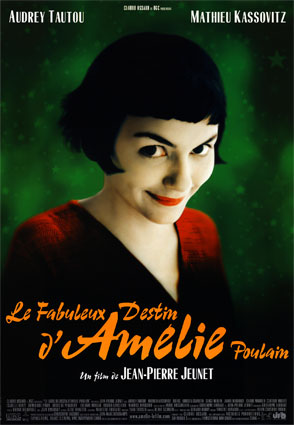
Amelie (Le Fabuleux Destin d'Amelie Poulain)

Initial Reaction: *big smile*

Watching the movie Amelie (Le Fabuleux Destin d’Amelie Poulain) is similar to strolling along a bright sunny beach with a group of best friends while eating an ice cream cone and belly-laughing at the funniest joke you’ve ever heard. Or eating Thanksgiving dinner after your team has won the football game and you know they’re serving your favorite dessert. Or skipping through a field of daisies holding hands with the Easter bunny and singing like Julie Andrews. In any case, whatever your cup of tea may be, Amelie is thoroughly delightful and smile-inducing from start to finish.

The main character is Amelie Poulain, our heroine. She is a shy, socially-awkward young woman who is nevertheless incredibly sweet. Her life consists of her job as a waitress, visiting her father, observing the people around her intently, and dreaming of the many fantastic possibilities that the world holds. Amelie is completely captivating, and fascinates the audience with her childlike aura and unique approach to life.

In most ways her life is very ordinary, but all this changes when she stumbles across an old tin filled with children’s treasures in her apartment. When she realizes it belonged to a little boy who must have lived there years ago, she is overcome with a desire to return the treasures to their owner. She imagines the wonderful moment when he finds it, and thrills herself with the idea that she might make someone’s life better. After some detective work to find the man (now middle-aged) it belonged to, she is able to return the tin, and she is pleased with his reaction to being reunited with this long-misplaced piece of his past. At this crucial point, Amelie decides that she will devote herself to helping people around her. The scenarios that follow are sweet, hilarious, and surprising as she—for better or worse—gets involved in people’s lives to help, as well as punish those that steal happiness!

We follow our beloved heroine through all these escapades, and incidentally, through a developing romance as well. In a twist of fate, she manages to meet someone just as wonderfully odd as herself, but because she doesn’t really know how to interact with people, she gets pretty darn creative in trying to woo him. The whole thing is unbelievably funny and sweet, and she makes some interesting friends that help her along the way.

Rating: 20

This movie, as you might have guessed, is a French film. I will recommend (as I always do) getting the version with English subtitles. In my opinion, it takes so much away from the movie when you are unable to hear the characters’ true voices. And these characters are worth every second of screen time they have. Each one is perfect in his or her role. Some that stand out are Audrey Tautou (Amelie), Rufus (Raphael Poulain), and Isabelle Nanty (Georgette). The director, Jean-Pierre Jeunet, did an excellent job. The plot moved smoothly, but still kept me thoroughly involved. There were an incredible amount of creative touches that made the movie complete and unique, a work of art. I can’t rave enough about this movie. If you are currently a member of TMBC and haven’t yet seen it, don’t see it without me! ;)

Excuse me, Partical Man, for using your “Iconic Lines” section, but I couldn’t resist.

Iconic Lines: “If AmĂ©lie chooses to live in a dream-world and remain an introverted young woman, she has every right to mess up her life!”

“With a prompter in every cellar window whispering comebacks, shy people would have the last laugh.”

Monday, July 03, 2006

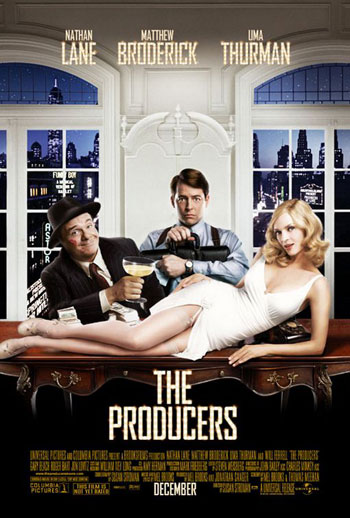
The Producers

Ever since I had heard it was coming to the stage, I'd been hoping to get a chance to see the musical version of Mel Brooks' 1968 classic The Producers. Unfortunately, it's impossible to get tickets. The multi-Tony-winning production is booked so far in advance, my best bet would be to order tickets now and then will them to my great-grandchildren, who could enjoy the show in 2116.

Fortunately, the makers of The Producers musical anticipated my plight, and selflessly made a big-screen adaptation of the Broadway hit that I could order from my Comcast On-Demand service for $3.99 and watch in my underwear on an idle Sunday evening in July.

But enough foreplay, onto the review. I'd love to answer the question of how this movie stacks up against its Broadway counterpart, but I'll instead have to compare it to the 1968 original, to which it remained commendably faithful. Of course, some changes are to be expected, since the remake is a musical and the original is not. As a result, we're treated to a few moments where characters reveal their thought processes via singing. (Audiences were forced to intuit thought processes in the original.) But the plot moves from point A to point B to point C in more or less the same way, with only a few major departures.

One such departure is the addition of a relationship between accountant Leo Bloom (Matthew Broderick) and secretary/receptionist Ulla (Uma Thurman), who, in another departure, also has a role in the film's showpiece musical: "Springtime for Hitler."

If you haven't seen either version, I may have lost you by now, so here's a quick rundown. Max Bialystock (Nathan Lane) is a down-on-his-luck Broadway producer; Leo Bloom is the accountant hired to do his books. When Bloom discovers a loophole in the system that would allow a producer to make more money from a flop than from a hit, Bialystock takes the idea and runs with it, dragging Bloom along with him. The pair set about finding the worst script, worst director, and worst actors they can find, eventually hiring a flamingly gay director to direct the neo-Nazi-written travesty "Springtime for Hitler." (In another departure from the original, the neo-Nazi (Franz Liebkind, played by Will Ferrell) ends up getting cast as the lead actor, only to be replaced on the eve of the show by gay director Roger DeBris (Gary Beach).) Needless to say, the audience mistakes the horrid show for a comedy and it becomes a hit, much to the chagrin of Bialystock and Bloom.

The whole show (both the original and the musical adaptation) is fused with Mel Brooks' not-so-subtle sense of humor. Physical comedy, ridiculous characters, and a whole lot of screaming are his comedic staples, garnished with the occasional one-liner or pun (always delivered with a big ol' wink, just to make sure no one misses the joke). But you know what? It's still funny. It's not sophisticated humor, by any means, but I still laughed out loud on more than one occassion.

Much of that is down to the quality of the acting, as the new cast does a fairly admirable job of living up to the standard set by the old cast. Leading the pack is Nathan Lane, playing a part that's probably better suited to him than it was to original actor Zero Mostel anyway. Both Lane and Mostel give excellent performances, and Lane to his credit walks that fine line between copying the original and making the part his own. Matthew Broderick is not as lucky, having to fill the shoes of the legendary Gene Wilder, andas Johnny Depp found out playing Willy Wonkathat's easier said than done. Broderick falls a good five or six steps shy of Wilder, but his performance is still passable (which I suppose is a testament to how brilliant Wilder's performance really was.)

Uma Thurman does a solid job as the female lead, not that her role is that taxing. She basically has to be tall, sexy, and speak in a ridiculous Swedish accent. Thurman's Swedish accent worked just fine, and I imagine it wasn't too much of a stretch for her to play tall and sexy. Will Ferrell gave a trademark over-the-top performance, but he's hurt by the fact that he's Will Ferrell. Watching him, you can't help but think, "Hey, you're not German! You're Will Ferrell!"

All things considered, though, I was quite satisfied with the musical adaptation of The Producers. It doesn't have everything the original had, but at the same time it brings new things to the table (i.e. songs). If you haven't seen the 1968 original yet, watch that first. But if you've seen and fallen in love with Zero and Gene, you won't be disappointed by Nathan and Matt. Zero and Gene gave unforgettable performances that netted the original an 8 on the 22 scale, while Nathan and Matt are just a shade behind them, earning the new The Producers a perfectly commendable 7.

Friday, June 30, 2006

The 40 Year Old Virgin

I seem to have contracted Dr. Worm’s illness of using food analogies, but watching The 40 Year Old Virgin is like eating a whole ton of Brussels sprouts. They taste horrendously terrible, and each bite is utter torture, but they’re filled with nutrients, vitamins and minerals, good stuff that your body needs, especially since you just got off that bender of Twinkies and peanut butter cups. The 40 Year Old Virgin has a really good message (though it’s buried), and generally promotes good feelings when it’s over. It’s the “before it’s over” period that’s the problem, and it’s a freakin’ huge problem.

I saw the unrated version, and I think that’s the only version available on DVD. So there was stuff in it that might have been taken out for its theater runs. If there was, I couldn’t actually tell except for in one part. Let me just say that this is the most vulgar, filthy, disgusting, base, and retch-inducing movie I have ever seen, and I’ve seen a lot of movies. At the same time, I kinda fell in love with it.

I should rephrase that: I fell in love with the main character. Actually, I should rephrase that, too, since the main character’s a man, and a fictional one at that. Andy Stitzer, played by the hilarious and endearing Steve Carell, is a virgin, meaning that he has never had sex. This is partly from a lack of opportunities, partly from bad luck, and partly from something that separates him from almost every other man on the planet: a slight lack of interest in sex. Don’t get me wrong, he definitely sees it as something he would like to do; it’s just not a high priority in his life, especially at this point. After all, he is 40 years old, and it doesn’t seem all that important anymore.

For the first hour of the movie, he is the only endearing character in the movie. The three guys he works with in a Circuit City/Best Buy type of store, who in desperation invite him as the fifth guy in a poker game, are ASSHOLES!!! Forgive me for my swearing, Stormy Pinkness, but there was no other word to describe their utter lack of any redeeming qualities whatsoever. When it is revealed (through gross but hilarious means) that he is a virgin, the three guys do everything in their power to end his dry spell. They teach him all their techniques, some of which are not only wrong-headed but reprehensible, and give him ridiculously bad advice. He tries it all out, much to the audience’s chagrin, with varying results. Why chagrin? Because we like Andy, and don’t want to see anything bad happen to him. Thankfully, he’s smart enough to let everything roll off him after a while.

His girlfriend, Trish, is great, too. Played with scenery-chewing expertise by Catherine Keener, she’s the perfect yin to Andy’s yang. If only his “friends” would stop interfering! The movie would be a lot shorter and a great deal less interesting if they would just shut up and leave him alone, but Andy is so endearing and we care about him so much that we’re willing to make that sacrifice. Also, Trish has the exact right reaction to finding out that Andy’s a virgin.

The message of the movie, amazingly, and going against everything that we as secular Americans are taught, is that virginity is something to cherish, to hold on to, and is not to be given away lightly. When you do finally give it away, you should make sure that the person to which you are giving it away truly deserves it, as Trish does for Andy. You can probably guess that by the end of the movie Andy is not a virgin anymore, so I’m not giving anything away. It’s very important to note that Andy has sex for the first time AFTER he gets married, because that says something very valuable about marriage as well. It suggests that like sex, the person you marry should truly deserve it as well, and it’s not something to be done lightly.

Iconic lines:
“Wanna know how I know you’re gay? Because you like Coldplay.”
“Andy, for the last time, I don’t want your big box of porn!”
“He’s performing a public colonoscopy. Isn’t that sweet.”

22 Rating: 0

Before now, I didn’t think I could ever give a movie 0, since 0 represents, for me, complete apathy, lack of feeling. Every movie generates some feeling in me, no matter how slight. Now I see another purpose for 0, and that is when a movie balances out. I want to give The 40 Year Old Virgin a 15 for its message and skill with character, but I also want to give it a -15 for it’s unbelievable vulgarity. So I guess it balances out.

Particle Man

Tuesday, June 27, 2006

The Weather Man

You know, I think we frequently take screenwriters, actors, and directors for granted. With every film they collaborate on, they have to—among other thingscreate protagonists that not only are flawed and real, but are also characters that the audience can root for. And you know what? Most of the time, they do an okay job at this. But that makes it very glaring when that subtle balance is off.
Such is the case, unfortunately, with The Weather Man, a movie that can best be described as good-yet-unsatisfying. It's well-shot, it tackles big and meaningful issues, it's entertaining, it's led by two Oscar-winning actors. And it's still unsatisfying.
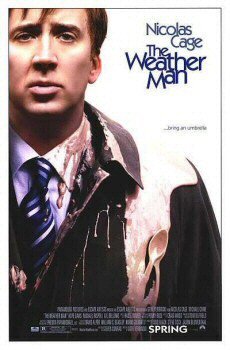
Some of that has to do with Nicholas Cage, who plays David Spritz, the titular weather man. Cage sports the exact look you see on the poster in the upper left corner of this review throughout 90 percent of his time on screen. I believe the only time we see him smile in the film is when his character is predicting the weather on television.
But some of the blame must also fall to director Gore Verbinski, who must be either asking Cage to act that way or allowing him to do so. The bigger problem, is that Verbinski and screenwriter Steve Conrad have done everything in their power to make us pity this character: his wife is involved with another man, his preteen daughter is obese and unhappy, he can't live up to the reputation set by his Pulitzer Prize-winning father (Michael Caine), his 15-year-old son (Nicholas Hoult, the kid from About a Boy) has very adult problems, and to top it all off, people occasionally throw fast food at him (again, note the poster). Yet Verbinski and Conradand to a lesser extent Cagedo nothing to make this character likeable: he's shallow, he's simple, he's largely self-centered, he's more or less a schmuck.
This is really disappointing, because the rest of the film is really, really good. It's interesting, it's thoughtful, it's well-shot and well-acted. But all that gets tainted by the unfortunate unlikeability of the main character. To use my second food metaphor in as many reviews: It's a bit like ordering a hamburger where the bun is soft and warm, the lettuce and tomato are crisp and ripe, the condiments are perfectly balanced and deliciousbut the burger itself is burnt to a crisp. So even while you'd love to be enjoying the bun, vegetables, and condiments, every bite you take tastes like ash.
Strangely enough, though, even with all that said, I'd still recommend seeing this movie. Don't rush out to rent it, and don't put it at the top of your Netflix queue, but if you get a chance, have a look at this movie. Just don't go in expecting to enjoy it. Go in expecting to learn from it. Because even with the overcooked main character, all the excellent surrounding elements are still enough to get this movie a 6.

Saturday, June 24, 2006

Wal-Mart: The High Cost of Low Price

Sometimes, a film garners merit not for the quality of storytelling, or how escapist it is, but by the importance of its message. This was going to be a review of Phantasm, but I'm towards the end of a film that appalled me so much, that I have to tell every person I know about it. This is a review of Wal-Mart:The High Cost of Low Prices.
Wal-Mart's first official store opened in 1962, and it has proceeded to become a true juggernaut, today grossing $315+ billion dollors in revenue, and employing 1.5 million employees. The company has however come under fire for such problems as not providing health care to its employees, inadequate safety measures in the parking lots, sexist and racist treatment of its employees, multiple violations of environmental laws, excessive store growth, sub-substandard wages for company employees, terrible pay and deplorable living conditions for overseas factory workers, and the negative impact it has on surrounding businesses. Whew! Did I forget anything? As of yet, Wal-Mart hasn't been found guilty of taking candy from babies (not literally, anyway), or raping people's pets. But give it time.
Wal Mart: The High Cost of Low Price is a documentary in a very simple style. There is no narration, and the director doesn't make his presence known. The story and the facts are told by people interviewed, footage from news stories and other sources, internal memos, and statistics. The tone is quiet, and a welcome respite from flashy Michael Moore style documentary storytelling. We hear about, and see, how 47% of Wal-Mart employees are without health insurance. About how Bill Gates has given 58% of his fortune to charity, and the Walton family (officially the richest family in the world) has given less than 1% of theirs. And so on. We talk to families whose businesses have been put out of business by Wal-Mart, while the city gave Wal-Mart generous stipends to get started in the area. To factory workers in China, who make less than $21 a week. To friends of a young woman who abducted from a Wal-Mart parking lot and later murdered. We are told that Wal-Mart has been fined by the EPA more than any other company in history.
I promised myself that I wouldn't use this forum as a soapbox, but I feel strongly about the problems talked about in this film, and felt even stronger about them after watching it. I feel that Wal-Mart is bad for every man, woman, and child in America. For every dog, cat, and blade of grass. This is important, important stuff that the films talks about, and everybody can benefit from it. The injustices this film discusses made me feel sick and disgusted.
But it's not all doom and gloom here. The last bit of the film focuses on Inglewood, CA, as they (successfully) fight Wal-Mart from entering their community, and touch upon other communities that go through the same thing.
I give Wal-Mart:The High Cost of Low Price a 10 of out 22 for film/quality value, and an 18 out of 22 for the social and civic responsibility it shows by tackling this subject. I urge everybody reading this review to see this film, and to tell everybody you know about it.

Sunday, June 18, 2006

Metropolis

Okay, people, time for a history lesson! This is really Stormy Pinkness’ area, but I’ll give it a whirl. At the place where I work, there’s this guy named Dave. He’s 25, like me, but he was born about 80 years too late. He wears a golfer’s cap, smokes pipes, likes 30’s jazz, and has an infinite store of knowledge about old movies. And when I say old I mean old; think 1915 to 1940. He let me borrow a few DVDs, one of which was Metropolis, from 1927.

If you’re going to watch Metropolis, you have to forget everything that you know about movies. You have to behave like you have never seen a movie, and indeed have never even heard of a movie. That’s the mindset the people who saw this movie when it first came out had. I don’t even know if movies with actual dialogue (called “talkies”) had come out yet. The term “silent films,” of which Metropolis is one, is really a misnomer. These movies are not completely silent; they have a soundtrack, but it is all music. All the words spoken in the movie are spelled out on black screens in between shots. It takes a bit of getting used to, watching a movie with no actual dialogue. In fact, the entire experience of watching this movie, and others from that time period, will be unlike any other movie-going experience you have ever had.

The storyline involves a futuristic society run by the “thinkers,” but that works on the backs of the “workers.” Does this sound like socialism to anyone else? It centers around the son of the head honcho, a boy named Freder. He is having fun and loving life in a place called the Club of the Sons. When it’s entered by a woman by the name of Maria, he is captivated, and goes out to find her when she leaves. Once he leaves the Club of the Sons, he discovers a world of steel and machinery, a harsh landscape that allows him to live his life of leisure. Also in the story are his father, Fredersen, who is in charge of, I guess, everything. There is also Rotwang, the mad scientist, and Josephat, Fredersen’s right hand man, who fails early in the film and attempts suicide. He is saved by Freder, and then becomes Freder’s partner in crime. Maria is sort of a prophetess for the “workers,” and says that there must be a mediator between the workers and the thinkers. She finds it in Freder, and the two become romantically involved. But Fredersen has other plans, and uses Rotwang to capture Maria and make a clone of her, then uses the clone to incite the workers to riots, destroying the Heart Machine, thus flooding the workers’ city and killing them all. Got all that?

Other things happen, but the plot isn’t as important as the foundational aspect of this film. The Mad Scientist, the Identity Mix-Up, the Human-Shaped Robot; all of them come from this. Nearly every other sci-fi movie (The Matrix, 2001, Star Wars, Blade Runner, Independence Day) uses this movie as its foundation, whether they know it or not. It doesn’t seem it now, because we have all these other (and better) movies to compare it to, but Metropolis is really innovative. Fritz Lang made a movie in 1927 when special effects were a thin piece of metal and some peppercorns, and you can’t see the strings. MST3K would have a field day with this movie; not because it’s bad (it’s definitely not), but because it has the potential to be extremely bad. Instead of laughable, it’s terrifying, and instead of kitschy, it’s really kind of beautiful.

Iconic lines:
“Between the head and hands there must be the heart.”

22 Rating: 9

Particle Man

Friday, June 16, 2006

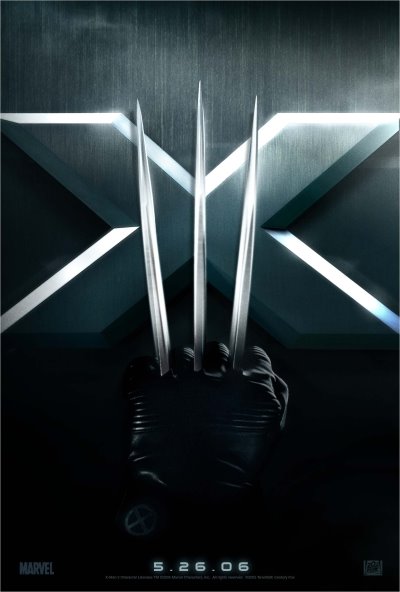
X-Men: The Last Stand (Wicked Little Critta)

¡WARNING: THIS REVIEW IS RIDDEN WITH SPOILERS!


Initial Reaction: Well, it goes to show that they’re right when they say “If you love something, kill it.”

I’ll be honest: X-Men and I were never close. We had been acquainted, but I’d never made any efforts to get to know it. I never really cared until, one day, friends told me that I needed to give it a chance because I didn’t know what I was missing. Thankfully I got to know X-Men, and realized its greatness and potential for making my life better and more enjoyable. I’m glad I have X-Men in my life.

However, as with any love relationship, the potential for heartbreak exists. X-Men and I have had a good run. Things just kept getting better and better, and with a new episode coming out, I anticipated a continuation if not improvement of this honeymoon phase. And in some ways, X-Men: The Last Stand met these expectations. For example, while some were better than others, I feel that the cast was exceptional and kept the high level of acting consistent throughout the film. I even have a hard time listing those that clearly stood out, because no one was lacking, in my opinion. But for the sake of this review, my favorites were: Patrick Stewart as Professor Charles Xavier, Kelsey Grammar as Beast, Ellen Page as Kitty Pryde, and Vinnie Jones as Juggernaut.

I also really appreciated the creativity and seamlessness in representing the various mutant powers. It was clear how each could be powerful in some situations while detrimental in others. This gave the audience a constantly shifting and entertaining focus while not distracting us from the storyline or the characters.

Even though I was warned ahead of time, I was surprised to see that X-Men: The Last Stand carried a weight of finality that its genre of film doesn’t usually take on. We’re immediately drawn into the movie with the opening flashbacks. We see the Professor and Magneto as allies, working together to help a young Jean Grey understand her incredible mutant power and wanting to help her control it. We also see a young boy who is crushed with the fact that he’s a mutant and has to face his father with his shame. After this, we’ve been set up for a decent dose of heavy movie-watching.

So, the story: Jean’s back! Surprise to some, anticipated by others, Jean Grey’s return turns this movie upside down. We’re at first left with a question of “what the heck happened to Scott?” after an odd reunion of the lovers at Alkali Lake is cut short. Once Jean is found and brought back to Xavier’s school, all of a sudden we are told about another side of Jean, literally. Xavier gives us this neat and nicely-packaged explanation about her other personality, the Phoenix, essentially saying that he had controlled Jean’s mind for years so that this other powerful personality wouldn’t get out of hand. Huh? Ok, that kinda makes sense. I guess. By the way, has anyone seen Scott?

Anyway, not much time passes before we meet the Phoenix. It’s weird. Overcome with her competing personalities, Jean goes back to her childhood home and is quickly followed by Xavier as well as Magneto. They both realize the potential for disaster, and so Xavier attempts to prevent it while Magneto wants to embrace it. “You killed Scott!” the Professor shouts at Jean in order to help her realize the danger of what she’s toying with. Whoa! Maybe I should’ve seen that coming, but the screenwriters were just so darn dismissive about it that I denied the possibility. This was betrayal number one. Then, practically in the next breath, (in a move that shocked even me,) the Phoenix kills Xavier in anger. While I’m still confused about where I am and what I’m doing, Magneto steps forward and takes Jean with him, we assume, to “the dark side.”

Geez! That was a lot to deal with, and we’re not even halfway through the movie! In short, The Last Stand is filled with these kinds of betrayals and heartbreaks. Mystique’s mutant gene is suppressed by a “cure” and Magneto turns his back on her. Rogue chooses the cure and loses her power as well. Finally, in the last scenes where the Phoenix is practically destroying anything and anyone in her path, Wolverine speaks to her and tries to win her over. He tells her that he loves her, and in an unexpected move (to me, anyway), kills her.

Ouch. Could someone please remove the 15 arrows sticking out of my back? I guess my big problem with this movie was with Jean Grey/the Phoenix. I don’t care how accurate it is according to her history or the comic book, I didn’t buy it. The fact that Jean, the sweet and kind woman who gave the ultimate sacrifice of love in X2 returns to us as a chaotic killer just didn’t work for me. Yeah, I’ve heard the argument about it not actually being “Jean,” but I don’t care. It sucked. Yes, I’m bitter, but I’ve been betrayed here.

Rating: 9

On a different note, The Last Stand had a very different feeling to me, kind of X-Men combined with Armageddon. A little over the top, too much to absorb, and not as purposeful of a plot as it could have had. This balanced with the cast, creativity and fun action prompts me to give this movie a 9. I walked away feeling hurt; the kind of hurt that comes when a relationship is damaged beyond repair. Sure, sometimes you get lucky and things are better than ever before, but usually not. I’m suppose I’m just unlucky in love. Why, Brett Ratner, why?

Thursday, June 15, 2006

X-Men: The Last Stand (Dr. Worm)

Let me start off by proclaiming that X-Men: The Last Stand is a good movie. All three X-Men movies are excellent, in fact, and if you haven't seen either of the first two, you need to stop reading this article and get down to your nearest video rental store posthaste. This article is directed at those of you who have seen the first two installments of the X-Men series and are anticipating seeing the third with this question in mind: Does it hold up?
Fortunately, the answer to this question is yes, for the most part, it does. But the remainder of this review will discuss the various ways that X3 is a minor step back from the first two films, with "minor" being the word to bear in mind here.
As many of you know, the X-Men series had changed directorial hands between films two and three, from Brian Singer to Brett Ratner. Much has been published about this shift, but when all is said and done, it's a fairly inconsequential shift. Ratner does his style-less thing, not ruining the series but not putting his stamp on it either. In fact, if you didn't know beforehand about the new director, I doubt you'd notice the difference.
The less publicized but more consequential change is the change in the writing team. And in truth, this seems the less consequential change: After swapping out Bryan Singer and Tom DeSanto wholesale for Zak Penn and David Hayter between X1 and X2, the shift to X3 seems tamer, with Zak Penn staying on and Simon Kinberg joining him.
Really, I don't know if it's the change from Hayter to Kinberg that made the difference, or if Zak Penn just tried too hard this time, but it's the screenplay itself that left the bad taste in my mouth.
I don't want to give away too much, so I'll describe the difference by analogy. Suppose you go a restaurant and order a clam chowder, expecting it to be just your standard, run-of-the-mill chowder. But when you eat it, it's far more delicious than you ever expected. So you go ask the chef his secret, and he says that he sprinkles a bit of garlic in there just to give it a bit more zip. So you compliment him on his decision and go your way.
Three years later, you happen to have a chance to go back to the same restaurant, andremembering the delicious chowder from last timeyou order it again. But this time, when you dig in, all you taste is garlic. It overwhelms all the other tastes that made the chowder such a sensuous symphony before, and leaves you disappointed, misunderstood, and with terrible bad breath.
You know what happened, of course. The chef figured that if the garlic is the best part, more of the best part can only make it better. But you and I both know things don't work that way. It's the subtle balance that made the initial chowder so savory, and it's the destruction of that balance that made the third X-Men somewhat dissatisfying.
That's the major problem. The other problem didn't affect this movie so much, but will certainly affect X4 if they decide to make it (which, judging by the ending, they certainly want to). And the problem hereto switch metaphors yet againis that they've painted themselves into a corner. Now, judging by the ending, they'll find a way out of that corner, but they'll do so in a way that changes the rules they made in this movie. It's a bit like playing sports with a nine-year-old who insists, whenever something doesn't go his way, that it didn't count. The writers of the fourth X-Men film will find a more creative way to do this, of course, but the end result will be the same: The third movie didn't count.
Now I'll repeat my assertion from the beginning of this review: Despite my critique, this was still a good movie. Given my intricate, 450-word dissertation on its faults, that may be hard to believe, but it really was. Kelsey Grammmer did a perfect job as Beast and Vinnie Jones was very entertaining as Juggernaut, both debuting in this installment of the series. Patrick Stewart, Ian McKellen, and Hugh Jackman are as awesome as they ever were, and no one else really craps the bed here, actingwise.
In the end, I'm forced to agree wholeheartedly with the average IMDB user rating for all three films.
For the original, it's a 7.3, which becomes a 10 on the 22 scale.
For X2, it's a 7.9, which is a 13 on the 22 scale.
For X-Men: The Last Stand it's a 7.0, or a 9 on the 22 scale.
All good movies, all occupying similar spots on the 22 scale, but X3, with its extra garlic powder, just isn't quite as delicious as its predecessors.

Wednesday, June 14, 2006

X-Men: The Last Stand (Stormy Pinkness)

“I don’t remember Patrick Stewart ever being that young! I don’t remember Magneto being that flamboyantly gay in the first 2 movies!” These were my first thoughts during X-Men: The Last Stand. I was very excited to see this movie. I LOVED the first two movies and I figured that this one wouldn’t be any different. As May 26th approached, I started to get really anxious about the movie; I had loved the first two so much that I could not wait to see the third. However, after the movie came out I started to read the reviews, and they weren’t too encouraging. I knew there was a new director on this film, but I didn’t think it would make a difference. Of course, within the first 30 minutes of the movie, I realized the childlike innocence of it all.
X-Men: The Last Stand is the third episode of the X-Men trilogy, which tells the story of Charles Xavier and his school of mutants. This time we find our heroes faced with the dilemma of whether or not to get rid of their mutancy. A “cure” has been discovered that suppresses the gene that causes the mutation. While back at Xavier’s School for Gifted Youngsters, Scott and Logan continue to mourn the death of Jean Grey, who sacrificed herself to save her friends, while the others try move on from an invasion of the school (which happened in the second episode). Scott, still haunted by memories of his love for Jean, feels drawn to the site of her death and is met with dire consequences. Unnerved by Scott’s continued absence, Logan and Storm fly to Alkali Lake and find not Scott, but the very friend who helped them escape from being drowned: Jean! Shortly after Jean returns to the Mansion to be treated by the professor, we are introduced to the Phoenix, Jean’s alter-ego. Also introduced to us is Beast, an old friend of Charles and Storm who is the Secretary of Mutant Affairs. Of course, Charles and his students try to find a peaceful way of combating this so-called cure as Magneto and his followers decide to use violence to challenge the same thing. What happens? I guess you will have to see the movie to find out. ; P
My favorite part of the movie was the theme that it had. Should the mutants accept the cure and conform to what everyone else thinks they should? Or should they stay true to how they were created? I loved the resonance it had with our society. We are told that we should all be the same way. Some conform, while others say “Screw it!” Either you way you choose, there are consequences to face. Should we get angry like Magneto and try to make everyone like we are? Or, if that does not work, should we try to hurt anyone in our way? Should we be like Rogue and possibly conform because it would make life easier? The choice needs to be made and there are repercussions for any option.
To put it plainly, I liked the movie, but I did not like what was happening. Throughout the whole movie there were moments of thinking “NO!”, “Wait, maybe……” and “WHAT?!” I saw all of this happening but wanted it not to happen to the characters that I had grown to love. With movie sequels there is always a chance that characters do not hold your interest as much as they once did. Luckily this did not happen in the movie. The characters that were in this movie are the same ones that I have enjoyed watching for the past two movies. The movie was well done, but could have focused a bit more on plot than cool special effects. Mr. Ratner (the new director) either felt that there was no need to expand upon the story or that the budget was already mostly spent on the all-star cast or the special effects. I enjoyed the special effects that were in this movie, but why couldn’t character development and special effects be balanced? All of the characters were developed, but I feel they could have been more. Overall, I give X-Men a 10. It was well done and had a very good ensemble cast. It shows that we all have to make decisions for ourselves, because who knows what kinds of people are out there to make them for us?