Tuesday, July 18, 2006

The Devil Wears Prada (Particle Man)

When I was about 13, we got a kitten. We hadn’t had a cat for a period of about 6 months; quite sometime for us to go without a cat. We had a dog and a bird, but it just wasn’t the same. We got this kitten that was all white except for a small black mark on her head. We named her Sasquatch, initially because she was all white. We later found out that the name was entirely appropriate because she was a total monster. On the other hand, she was so cute she could peel the paint off an ocean liner. Seriously, I think cuteness of that magnitude is illegal in some states.

The Devil Wears Prada is like Sasquatch. At first look, it appears, cute, fluffy, and harmless. You pet it, play with it with a ball of yarn, laugh and smile, and it playfully attacks your hand. But after you’re finished, you notice that your hand is all scratched up and bleeding from the kitten’s little claws and teeth. And you think, “did that little thing really do all this?”

Anne Hathaway (no, not the wife of Shakespeare) stars in this little comedy as Andy Sachs, though Meryl Streep gets top billing. Part of me thinks that’s unfair, but then I think, “hey, it’s Meryl Streep.” Speaking of Meryl, I cannot say enough good things about her performance in this movie. Instead of making us hate her character through loathsome and instantly enraging acts, she instead chooses crushing indifference. The way she lightly says “that’s all” simultaneously implies apathy, condescension, and finality. She’s calm, cool, collected, and in charge, and she doesn’t let anything ruffle her. Well, almost anything, but I don’t want to give a spoiler.

This is not to impugn Anne Hathaway’s performance, or the many great supporting performances. Anne simply glows with that charm and appeal she radiates as second nature. Given the right role, she has the ability to draw you in, even in saccharine Disney movies like The Princess Diaries or its sequel. Stanley Tucci and Emily Blunt are fantastic in their roles as scenery-chewing fashionistas, slaves to the whim of the almighty Miranda Priestly (Streep’s character). Even Adrian Greiner gives a competent performance as the boyfriend who stretches to ridiculous lengths in the wake of Andy’s transformation, but only so far.

The characters in The Devil Wears Prada aren’t one-dimensional or paper cutouts, as would be expected in a fluffy comedy like this one. It only appears fluffy, though. Like Sasquatch, it has unexpected claws. It ever-so-gently skewers the fashion industry, and you see the materialistic nature of it. Andy is definitely not a fashionista, but through working at Runway magazine, she starts to become one. The question that the movie presents is “does she want to advance in her job, or keep her integrity and humanness?” It’s a great job, but not one for her. We as the audience know that, but Andy at some point forgets.

This movie appears nice and quaint, and it is, but it also has barbs that you appreciate, mostly because they’re directed at the movie itself and not at you, the audience. Enjoy it, but be wary of its claws. It may be cute, but it’s really a Sasquatch.

Iconic lines:
“I’m on this new diet where I don’t eat, and then when I feel like I’m about to faint, I have a cheese cube. I’m one stomach flu away from reaching my goal weight.”
“That’s all.”
“The person whose calls you always take? That’s the relationship you’re in.”

22 Rating: 10

Particle Man

Thursday, July 13, 2006

Movie of the Month - July '06

The Devil Wears Prada

Stay tuned for our reviews coming up July 18th-22nd!
Lucky for you, They Might Be Critics hosts a regular movie of the month. During this exciting time, all (or most) of our critics post reviews of a chosen movie that is due to come out this month. We are all about providing a range of opinions and insights, and allowing for an open forum in which we discuss the film with each other and anyone who desires to participate. So, see The Devil Wears Prada, and join in!

Wednesday, July 12, 2006

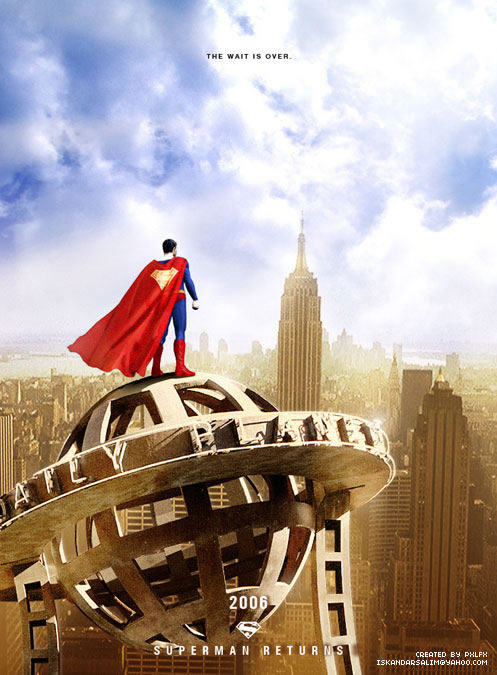
Superman Returns

Does the world need a Superman?

That's the question that a lot of people have asked, and a lot of people just can't get behind the idea. He's "too powerful," "too much of a goody two-shoes," "not dark enough," etc. I am not one of those people. I think that Superman works as a character ... how else would he have survived the last 68 years? But people do have a point in that he seems an ill-suited character for these dark times ... a point that is negated by the argument that in darker times, you need a bright icon like The Man of Tomorrow. But ... enough rhetoric.
Superman Returns takes place 5 years after the events of Superman II ... we are told that astronomers discovered the remains of Krypton, and Superman went to see it, and had been absent for 5 years. He returns to Earth to find that his world has changed: Lois Lane has a child, is engaged to be married, and has written a Pulitzer-winning story called "Why The World Doesn't Need Superman." Lex Luthor has gotten out of prison, thanks to his gold-digging of an old widow, and Superman not being around to testify at his trial (oops). What follows is the story of Clark/Superman getting back into his old life, and overcoming the obstacles presented before him.
This film is more ... orchestral in tone that most of the other superhero films we've seen in the last few years, save the transcendent Batman Begins. Bryan Singer set out to make an epic befitting the Man of Steel, and he succeeds nicely. The film doesn't feel any longer than it's 2 hour and 40 minute running time, and there are no script problems save a minor one that a new character presents and that I won't go into here ... too spoilery. The special effects are among the best I've ever seen, and Superman's powers are rendered impressively. I was impressed by Brandon Routh, who exudes authority as the Last Son of Krypton, and hits all the right comic notes as the hapless (?) Clark Kent. Kevin Spacey chews scenery as the orginal bald genius Lex Luthor, leaving Gene Hackman's hopelessly dated performances in the dust.* Kate Bosworth and Frank Langella turn in serviceable performances as Lois Lane and Perry White, and Sam Huntington shines as the enthusiastic Jimmy Olsen. Parker Posey also shines in a patented Parker Posey (tm) performance, as Kitty Kowalski, the "new" Miss Tessmacher.
This movie may not do as well as it deserves to because of the daunting box-office performance of POTC: Dead Man's Chest, but it is well, well worth your time. I give Superman Returns an 18 out of 22** on the 22 scale.

*To be fair, this isn't exactly Gene Hackman's fault. The old Lex Luthor was written as more of a Prankster/Funky Flashman type character, not the cunning and intimidating genius that Lex was/is.

** 18 is the lowest score I would give to something that I would actually deign to own on DVD ... normally.

Tuesday, July 11, 2006

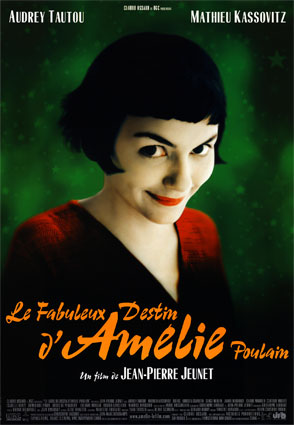
Amelie (Le Fabuleux Destin d'Amelie Poulain)

Initial Reaction: *big smile*

Watching the movie Amelie (Le Fabuleux Destin d’Amelie Poulain) is similar to strolling along a bright sunny beach with a group of best friends while eating an ice cream cone and belly-laughing at the funniest joke you’ve ever heard. Or eating Thanksgiving dinner after your team has won the football game and you know they’re serving your favorite dessert. Or skipping through a field of daisies holding hands with the Easter bunny and singing like Julie Andrews. In any case, whatever your cup of tea may be, Amelie is thoroughly delightful and smile-inducing from start to finish.

The main character is Amelie Poulain, our heroine. She is a shy, socially-awkward young woman who is nevertheless incredibly sweet. Her life consists of her job as a waitress, visiting her father, observing the people around her intently, and dreaming of the many fantastic possibilities that the world holds. Amelie is completely captivating, and fascinates the audience with her childlike aura and unique approach to life.

In most ways her life is very ordinary, but all this changes when she stumbles across an old tin filled with children’s treasures in her apartment. When she realizes it belonged to a little boy who must have lived there years ago, she is overcome with a desire to return the treasures to their owner. She imagines the wonderful moment when he finds it, and thrills herself with the idea that she might make someone’s life better. After some detective work to find the man (now middle-aged) it belonged to, she is able to return the tin, and she is pleased with his reaction to being reunited with this long-misplaced piece of his past. At this crucial point, Amelie decides that she will devote herself to helping people around her. The scenarios that follow are sweet, hilarious, and surprising as she—for better or worse—gets involved in people’s lives to help, as well as punish those that steal happiness!

We follow our beloved heroine through all these escapades, and incidentally, through a developing romance as well. In a twist of fate, she manages to meet someone just as wonderfully odd as herself, but because she doesn’t really know how to interact with people, she gets pretty darn creative in trying to woo him. The whole thing is unbelievably funny and sweet, and she makes some interesting friends that help her along the way.

Rating: 20

This movie, as you might have guessed, is a French film. I will recommend (as I always do) getting the version with English subtitles. In my opinion, it takes so much away from the movie when you are unable to hear the characters’ true voices. And these characters are worth every second of screen time they have. Each one is perfect in his or her role. Some that stand out are Audrey Tautou (Amelie), Rufus (Raphael Poulain), and Isabelle Nanty (Georgette). The director, Jean-Pierre Jeunet, did an excellent job. The plot moved smoothly, but still kept me thoroughly involved. There were an incredible amount of creative touches that made the movie complete and unique, a work of art. I can’t rave enough about this movie. If you are currently a member of TMBC and haven’t yet seen it, don’t see it without me! ;)

Excuse me, Partical Man, for using your “Iconic Lines” section, but I couldn’t resist.

Iconic Lines: “If Amélie chooses to live in a dream-world and remain an introverted young woman, she has every right to mess up her life!”

“With a prompter in every cellar window whispering comebacks, shy people would have the last laugh.”

Monday, July 03, 2006

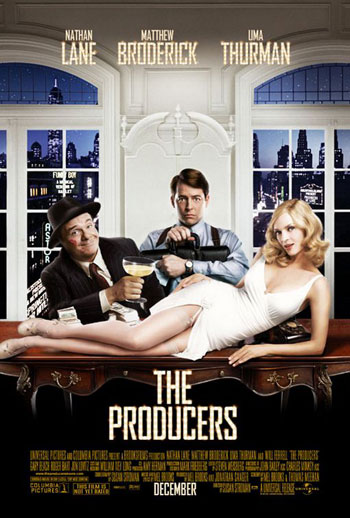
The Producers

Ever since I had heard it was coming to the stage, I'd been hoping to get a chance to see the musical version of Mel Brooks' 1968 classic The Producers. Unfortunately, it's impossible to get tickets. The multi-Tony-winning production is booked so far in advance, my best bet would be to order tickets now and then will them to my great-grandchildren, who could enjoy the show in 2116.

Fortunately, the makers of The Producers musical anticipated my plight, and selflessly made a big-screen adaptation of the Broadway hit that I could order from my Comcast On-Demand service for $3.99 and watch in my underwear on an idle Sunday evening in July.

But enough foreplay, onto the review. I'd love to answer the question of how this movie stacks up against its Broadway counterpart, but I'll instead have to compare it to the 1968 original, to which it remained commendably faithful. Of course, some changes are to be expected, since the remake is a musical and the original is not. As a result, we're treated to a few moments where characters reveal their thought processes via singing. (Audiences were forced to intuit thought processes in the original.) But the plot moves from point A to point B to point C in more or less the same way, with only a few major departures.

One such departure is the addition of a relationship between accountant Leo Bloom (Matthew Broderick) and secretary/receptionist Ulla (Uma Thurman), who, in another departure, also has a role in the film's showpiece musical: "Springtime for Hitler."

If you haven't seen either version, I may have lost you by now, so here's a quick rundown. Max Bialystock (Nathan Lane) is a down-on-his-luck Broadway producer; Leo Bloom is the accountant hired to do his books. When Bloom discovers a loophole in the system that would allow a producer to make more money from a flop than from a hit, Bialystock takes the idea and runs with it, dragging Bloom along with him. The pair set about finding the worst script, worst director, and worst actors they can find, eventually hiring a flamingly gay director to direct the neo-Nazi-written travesty "Springtime for Hitler." (In another departure from the original, the neo-Nazi (Franz Liebkind, played by Will Ferrell) ends up getting cast as the lead actor, only to be replaced on the eve of the show by gay director Roger DeBris (Gary Beach).) Needless to say, the audience mistakes the horrid show for a comedy and it becomes a hit, much to the chagrin of Bialystock and Bloom.

The whole show (both the original and the musical adaptation) is fused with Mel Brooks' not-so-subtle sense of humor. Physical comedy, ridiculous characters, and a whole lot of screaming are his comedic staples, garnished with the occasional one-liner or pun (always delivered with a big ol' wink, just to make sure no one misses the joke). But you know what? It's still funny. It's not sophisticated humor, by any means, but I still laughed out loud on more than one occassion.

Much of that is down to the quality of the acting, as the new cast does a fairly admirable job of living up to the standard set by the old cast. Leading the pack is Nathan Lane, playing a part that's probably better suited to him than it was to original actor Zero Mostel anyway. Both Lane and Mostel give excellent performances, and Lane to his credit walks that fine line between copying the original and making the part his own. Matthew Broderick is not as lucky, having to fill the shoes of the legendary Gene Wilder, andas Johnny Depp found out playing Willy Wonkathat's easier said than done. Broderick falls a good five or six steps shy of Wilder, but his performance is still passable (which I suppose is a testament to how brilliant Wilder's performance really was.)

Uma Thurman does a solid job as the female lead, not that her role is that taxing. She basically has to be tall, sexy, and speak in a ridiculous Swedish accent. Thurman's Swedish accent worked just fine, and I imagine it wasn't too much of a stretch for her to play tall and sexy. Will Ferrell gave a trademark over-the-top performance, but he's hurt by the fact that he's Will Ferrell. Watching him, you can't help but think, "Hey, you're not German! You're Will Ferrell!"

All things considered, though, I was quite satisfied with the musical adaptation of The Producers. It doesn't have everything the original had, but at the same time it brings new things to the table (i.e. songs). If you haven't seen the 1968 original yet, watch that first. But if you've seen and fallen in love with Zero and Gene, you won't be disappointed by Nathan and Matt. Zero and Gene gave unforgettable performances that netted the original an 8 on the 22 scale, while Nathan and Matt are just a shade behind them, earning the new The Producers a perfectly commendable 7.

Friday, June 30, 2006

The 40 Year Old Virgin

I seem to have contracted Dr. Worm’s illness of using food analogies, but watching The 40 Year Old Virgin is like eating a whole ton of Brussels sprouts. They taste horrendously terrible, and each bite is utter torture, but they’re filled with nutrients, vitamins and minerals, good stuff that your body needs, especially since you just got off that bender of Twinkies and peanut butter cups. The 40 Year Old Virgin has a really good message (though it’s buried), and generally promotes good feelings when it’s over. It’s the “before it’s over” period that’s the problem, and it’s a freakin’ huge problem.

I saw the unrated version, and I think that’s the only version available on DVD. So there was stuff in it that might have been taken out for its theater runs. If there was, I couldn’t actually tell except for in one part. Let me just say that this is the most vulgar, filthy, disgusting, base, and retch-inducing movie I have ever seen, and I’ve seen a lot of movies. At the same time, I kinda fell in love with it.

I should rephrase that: I fell in love with the main character. Actually, I should rephrase that, too, since the main character’s a man, and a fictional one at that. Andy Stitzer, played by the hilarious and endearing Steve Carell, is a virgin, meaning that he has never had sex. This is partly from a lack of opportunities, partly from bad luck, and partly from something that separates him from almost every other man on the planet: a slight lack of interest in sex. Don’t get me wrong, he definitely sees it as something he would like to do; it’s just not a high priority in his life, especially at this point. After all, he is 40 years old, and it doesn’t seem all that important anymore.

For the first hour of the movie, he is the only endearing character in the movie. The three guys he works with in a Circuit City/Best Buy type of store, who in desperation invite him as the fifth guy in a poker game, are ASSHOLES!!! Forgive me for my swearing, Stormy Pinkness, but there was no other word to describe their utter lack of any redeeming qualities whatsoever. When it is revealed (through gross but hilarious means) that he is a virgin, the three guys do everything in their power to end his dry spell. They teach him all their techniques, some of which are not only wrong-headed but reprehensible, and give him ridiculously bad advice. He tries it all out, much to the audience’s chagrin, with varying results. Why chagrin? Because we like Andy, and don’t want to see anything bad happen to him. Thankfully, he’s smart enough to let everything roll off him after a while.

His girlfriend, Trish, is great, too. Played with scenery-chewing expertise by Catherine Keener, she’s the perfect yin to Andy’s yang. If only his “friends” would stop interfering! The movie would be a lot shorter and a great deal less interesting if they would just shut up and leave him alone, but Andy is so endearing and we care about him so much that we’re willing to make that sacrifice. Also, Trish has the exact right reaction to finding out that Andy’s a virgin.

The message of the movie, amazingly, and going against everything that we as secular Americans are taught, is that virginity is something to cherish, to hold on to, and is not to be given away lightly. When you do finally give it away, you should make sure that the person to which you are giving it away truly deserves it, as Trish does for Andy. You can probably guess that by the end of the movie Andy is not a virgin anymore, so I’m not giving anything away. It’s very important to note that Andy has sex for the first time AFTER he gets married, because that says something very valuable about marriage as well. It suggests that like sex, the person you marry should truly deserve it as well, and it’s not something to be done lightly.

Iconic lines:
“Wanna know how I know you’re gay? Because you like Coldplay.”
“Andy, for the last time, I don’t want your big box of porn!”
“He’s performing a public colonoscopy. Isn’t that sweet.”

22 Rating: 0

Before now, I didn’t think I could ever give a movie 0, since 0 represents, for me, complete apathy, lack of feeling. Every movie generates some feeling in me, no matter how slight. Now I see another purpose for 0, and that is when a movie balances out. I want to give The 40 Year Old Virgin a 15 for its message and skill with character, but I also want to give it a -15 for it’s unbelievable vulgarity. So I guess it balances out.

Particle Man

Tuesday, June 27, 2006

The Weather Man

You know, I think we frequently take screenwriters, actors, and directors for granted. With every film they collaborate on, they have to—among other thingscreate protagonists that not only are flawed and real, but are also characters that the audience can root for. And you know what? Most of the time, they do an okay job at this. But that makes it very glaring when that subtle balance is off.
Such is the case, unfortunately, with The Weather Man, a movie that can best be described as good-yet-unsatisfying. It's well-shot, it tackles big and meaningful issues, it's entertaining, it's led by two Oscar-winning actors. And it's still unsatisfying.
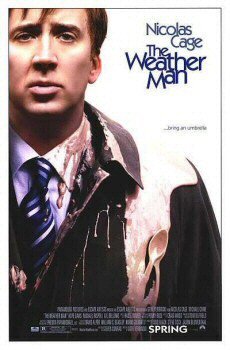
Some of that has to do with Nicholas Cage, who plays David Spritz, the titular weather man. Cage sports the exact look you see on the poster in the upper left corner of this review throughout 90 percent of his time on screen. I believe the only time we see him smile in the film is when his character is predicting the weather on television.
But some of the blame must also fall to director Gore Verbinski, who must be either asking Cage to act that way or allowing him to do so. The bigger problem, is that Verbinski and screenwriter Steve Conrad have done everything in their power to make us pity this character: his wife is involved with another man, his preteen daughter is obese and unhappy, he can't live up to the reputation set by his Pulitzer Prize-winning father (Michael Caine), his 15-year-old son (Nicholas Hoult, the kid from About a Boy) has very adult problems, and to top it all off, people occasionally throw fast food at him (again, note the poster). Yet Verbinski and Conradand to a lesser extent Cagedo nothing to make this character likeable: he's shallow, he's simple, he's largely self-centered, he's more or less a schmuck.
This is really disappointing, because the rest of the film is really, really good. It's interesting, it's thoughtful, it's well-shot and well-acted. But all that gets tainted by the unfortunate unlikeability of the main character. To use my second food metaphor in as many reviews: It's a bit like ordering a hamburger where the bun is soft and warm, the lettuce and tomato are crisp and ripe, the condiments are perfectly balanced and deliciousbut the burger itself is burnt to a crisp. So even while you'd love to be enjoying the bun, vegetables, and condiments, every bite you take tastes like ash.
Strangely enough, though, even with all that said, I'd still recommend seeing this movie. Don't rush out to rent it, and don't put it at the top of your Netflix queue, but if you get a chance, have a look at this movie. Just don't go in expecting to enjoy it. Go in expecting to learn from it. Because even with the overcooked main character, all the excellent surrounding elements are still enough to get this movie a 6.

Saturday, June 24, 2006

Wal-Mart: The High Cost of Low Price

Sometimes, a film garners merit not for the quality of storytelling, or how escapist it is, but by the importance of its message. This was going to be a review of Phantasm, but I'm towards the end of a film that appalled me so much, that I have to tell every person I know about it. This is a review of Wal-Mart:The High Cost of Low Prices.
Wal-Mart's first official store opened in 1962, and it has proceeded to become a true juggernaut, today grossing $315+ billion dollors in revenue, and employing 1.5 million employees. The company has however come under fire for such problems as not providing health care to its employees, inadequate safety measures in the parking lots, sexist and racist treatment of its employees, multiple violations of environmental laws, excessive store growth, sub-substandard wages for company employees, terrible pay and deplorable living conditions for overseas factory workers, and the negative impact it has on surrounding businesses. Whew! Did I forget anything? As of yet, Wal-Mart hasn't been found guilty of taking candy from babies (not literally, anyway), or raping people's pets. But give it time.
Wal Mart: The High Cost of Low Price is a documentary in a very simple style. There is no narration, and the director doesn't make his presence known. The story and the facts are told by people interviewed, footage from news stories and other sources, internal memos, and statistics. The tone is quiet, and a welcome respite from flashy Michael Moore style documentary storytelling. We hear about, and see, how 47% of Wal-Mart employees are without health insurance. About how Bill Gates has given 58% of his fortune to charity, and the Walton family (officially the richest family in the world) has given less than 1% of theirs. And so on. We talk to families whose businesses have been put out of business by Wal-Mart, while the city gave Wal-Mart generous stipends to get started in the area. To factory workers in China, who make less than $21 a week. To friends of a young woman who abducted from a Wal-Mart parking lot and later murdered. We are told that Wal-Mart has been fined by the EPA more than any other company in history.
I promised myself that I wouldn't use this forum as a soapbox, but I feel strongly about the problems talked about in this film, and felt even stronger about them after watching it. I feel that Wal-Mart is bad for every man, woman, and child in America. For every dog, cat, and blade of grass. This is important, important stuff that the films talks about, and everybody can benefit from it. The injustices this film discusses made me feel sick and disgusted.
But it's not all doom and gloom here. The last bit of the film focuses on Inglewood, CA, as they (successfully) fight Wal-Mart from entering their community, and touch upon other communities that go through the same thing.
I give Wal-Mart:The High Cost of Low Price a 10 of out 22 for film/quality value, and an 18 out of 22 for the social and civic responsibility it shows by tackling this subject. I urge everybody reading this review to see this film, and to tell everybody you know about it.

Sunday, June 18, 2006

Metropolis

Okay, people, time for a history lesson! This is really Stormy Pinkness’ area, but I’ll give it a whirl. At the place where I work, there’s this guy named Dave. He’s 25, like me, but he was born about 80 years too late. He wears a golfer’s cap, smokes pipes, likes 30’s jazz, and has an infinite store of knowledge about old movies. And when I say old I mean old; think 1915 to 1940. He let me borrow a few DVDs, one of which was Metropolis, from 1927.

If you’re going to watch Metropolis, you have to forget everything that you know about movies. You have to behave like you have never seen a movie, and indeed have never even heard of a movie. That’s the mindset the people who saw this movie when it first came out had. I don’t even know if movies with actual dialogue (called “talkies”) had come out yet. The term “silent films,” of which Metropolis is one, is really a misnomer. These movies are not completely silent; they have a soundtrack, but it is all music. All the words spoken in the movie are spelled out on black screens in between shots. It takes a bit of getting used to, watching a movie with no actual dialogue. In fact, the entire experience of watching this movie, and others from that time period, will be unlike any other movie-going experience you have ever had.

The storyline involves a futuristic society run by the “thinkers,” but that works on the backs of the “workers.” Does this sound like socialism to anyone else? It centers around the son of the head honcho, a boy named Freder. He is having fun and loving life in a place called the Club of the Sons. When it’s entered by a woman by the name of Maria, he is captivated, and goes out to find her when she leaves. Once he leaves the Club of the Sons, he discovers a world of steel and machinery, a harsh landscape that allows him to live his life of leisure. Also in the story are his father, Fredersen, who is in charge of, I guess, everything. There is also Rotwang, the mad scientist, and Josephat, Fredersen’s right hand man, who fails early in the film and attempts suicide. He is saved by Freder, and then becomes Freder’s partner in crime. Maria is sort of a prophetess for the “workers,” and says that there must be a mediator between the workers and the thinkers. She finds it in Freder, and the two become romantically involved. But Fredersen has other plans, and uses Rotwang to capture Maria and make a clone of her, then uses the clone to incite the workers to riots, destroying the Heart Machine, thus flooding the workers’ city and killing them all. Got all that?

Other things happen, but the plot isn’t as important as the foundational aspect of this film. The Mad Scientist, the Identity Mix-Up, the Human-Shaped Robot; all of them come from this. Nearly every other sci-fi movie (The Matrix, 2001, Star Wars, Blade Runner, Independence Day) uses this movie as its foundation, whether they know it or not. It doesn’t seem it now, because we have all these other (and better) movies to compare it to, but Metropolis is really innovative. Fritz Lang made a movie in 1927 when special effects were a thin piece of metal and some peppercorns, and you can’t see the strings. MST3K would have a field day with this movie; not because it’s bad (it’s definitely not), but because it has the potential to be extremely bad. Instead of laughable, it’s terrifying, and instead of kitschy, it’s really kind of beautiful.

Iconic lines:
“Between the head and hands there must be the heart.”

22 Rating: 9

Particle Man

Friday, June 16, 2006

X-Men: The Last Stand (Wicked Little Critta)

¡WARNING: THIS REVIEW IS RIDDEN WITH SPOILERS!


Initial Reaction: Well, it goes to show that they’re right when they say “If you love something, kill it.”

I’ll be honest: X-Men and I were never close. We had been acquainted, but I’d never made any efforts to get to know it. I never really cared until, one day, friends told me that I needed to give it a chance because I didn’t know what I was missing. Thankfully I got to know X-Men, and realized its greatness and potential for making my life better and more enjoyable. I’m glad I have X-Men in my life.

However, as with any love relationship, the potential for heartbreak exists. X-Men and I have had a good run. Things just kept getting better and better, and with a new episode coming out, I anticipated a continuation if not improvement of this honeymoon phase. And in some ways, X-Men: The Last Stand met these expectations. For example, while some were better than others, I feel that the cast was exceptional and kept the high level of acting consistent throughout the film. I even have a hard time listing those that clearly stood out, because no one was lacking, in my opinion. But for the sake of this review, my favorites were: Patrick Stewart as Professor Charles Xavier, Kelsey Grammar as Beast, Ellen Page as Kitty Pryde, and Vinnie Jones as Juggernaut.

I also really appreciated the creativity and seamlessness in representing the various mutant powers. It was clear how each could be powerful in some situations while detrimental in others. This gave the audience a constantly shifting and entertaining focus while not distracting us from the storyline or the characters.

Even though I was warned ahead of time, I was surprised to see that X-Men: The Last Stand carried a weight of finality that its genre of film doesn’t usually take on. We’re immediately drawn into the movie with the opening flashbacks. We see the Professor and Magneto as allies, working together to help a young Jean Grey understand her incredible mutant power and wanting to help her control it. We also see a young boy who is crushed with the fact that he’s a mutant and has to face his father with his shame. After this, we’ve been set up for a decent dose of heavy movie-watching.

So, the story: Jean’s back! Surprise to some, anticipated by others, Jean Grey’s return turns this movie upside down. We’re at first left with a question of “what the heck happened to Scott?” after an odd reunion of the lovers at Alkali Lake is cut short. Once Jean is found and brought back to Xavier’s school, all of a sudden we are told about another side of Jean, literally. Xavier gives us this neat and nicely-packaged explanation about her other personality, the Phoenix, essentially saying that he had controlled Jean’s mind for years so that this other powerful personality wouldn’t get out of hand. Huh? Ok, that kinda makes sense. I guess. By the way, has anyone seen Scott?

Anyway, not much time passes before we meet the Phoenix. It’s weird. Overcome with her competing personalities, Jean goes back to her childhood home and is quickly followed by Xavier as well as Magneto. They both realize the potential for disaster, and so Xavier attempts to prevent it while Magneto wants to embrace it. “You killed Scott!” the Professor shouts at Jean in order to help her realize the danger of what she’s toying with. Whoa! Maybe I should’ve seen that coming, but the screenwriters were just so darn dismissive about it that I denied the possibility. This was betrayal number one. Then, practically in the next breath, (in a move that shocked even me,) the Phoenix kills Xavier in anger. While I’m still confused about where I am and what I’m doing, Magneto steps forward and takes Jean with him, we assume, to “the dark side.”

Geez! That was a lot to deal with, and we’re not even halfway through the movie! In short, The Last Stand is filled with these kinds of betrayals and heartbreaks. Mystique’s mutant gene is suppressed by a “cure” and Magneto turns his back on her. Rogue chooses the cure and loses her power as well. Finally, in the last scenes where the Phoenix is practically destroying anything and anyone in her path, Wolverine speaks to her and tries to win her over. He tells her that he loves her, and in an unexpected move (to me, anyway), kills her.

Ouch. Could someone please remove the 15 arrows sticking out of my back? I guess my big problem with this movie was with Jean Grey/the Phoenix. I don’t care how accurate it is according to her history or the comic book, I didn’t buy it. The fact that Jean, the sweet and kind woman who gave the ultimate sacrifice of love in X2 returns to us as a chaotic killer just didn’t work for me. Yeah, I’ve heard the argument about it not actually being “Jean,” but I don’t care. It sucked. Yes, I’m bitter, but I’ve been betrayed here.

Rating: 9

On a different note, The Last Stand had a very different feeling to me, kind of X-Men combined with Armageddon. A little over the top, too much to absorb, and not as purposeful of a plot as it could have had. This balanced with the cast, creativity and fun action prompts me to give this movie a 9. I walked away feeling hurt; the kind of hurt that comes when a relationship is damaged beyond repair. Sure, sometimes you get lucky and things are better than ever before, but usually not. I’m suppose I’m just unlucky in love. Why, Brett Ratner, why?

Thursday, June 15, 2006

X-Men: The Last Stand (Dr. Worm)

Let me start off by proclaiming that X-Men: The Last Stand is a good movie. All three X-Men movies are excellent, in fact, and if you haven't seen either of the first two, you need to stop reading this article and get down to your nearest video rental store posthaste. This article is directed at those of you who have seen the first two installments of the X-Men series and are anticipating seeing the third with this question in mind: Does it hold up?
Fortunately, the answer to this question is yes, for the most part, it does. But the remainder of this review will discuss the various ways that X3 is a minor step back from the first two films, with "minor" being the word to bear in mind here.
As many of you know, the X-Men series had changed directorial hands between films two and three, from Brian Singer to Brett Ratner. Much has been published about this shift, but when all is said and done, it's a fairly inconsequential shift. Ratner does his style-less thing, not ruining the series but not putting his stamp on it either. In fact, if you didn't know beforehand about the new director, I doubt you'd notice the difference.
The less publicized but more consequential change is the change in the writing team. And in truth, this seems the less consequential change: After swapping out Bryan Singer and Tom DeSanto wholesale for Zak Penn and David Hayter between X1 and X2, the shift to X3 seems tamer, with Zak Penn staying on and Simon Kinberg joining him.
Really, I don't know if it's the change from Hayter to Kinberg that made the difference, or if Zak Penn just tried too hard this time, but it's the screenplay itself that left the bad taste in my mouth.
I don't want to give away too much, so I'll describe the difference by analogy. Suppose you go a restaurant and order a clam chowder, expecting it to be just your standard, run-of-the-mill chowder. But when you eat it, it's far more delicious than you ever expected. So you go ask the chef his secret, and he says that he sprinkles a bit of garlic in there just to give it a bit more zip. So you compliment him on his decision and go your way.
Three years later, you happen to have a chance to go back to the same restaurant, andremembering the delicious chowder from last timeyou order it again. But this time, when you dig in, all you taste is garlic. It overwhelms all the other tastes that made the chowder such a sensuous symphony before, and leaves you disappointed, misunderstood, and with terrible bad breath.
You know what happened, of course. The chef figured that if the garlic is the best part, more of the best part can only make it better. But you and I both know things don't work that way. It's the subtle balance that made the initial chowder so savory, and it's the destruction of that balance that made the third X-Men somewhat dissatisfying.
That's the major problem. The other problem didn't affect this movie so much, but will certainly affect X4 if they decide to make it (which, judging by the ending, they certainly want to). And the problem hereto switch metaphors yet againis that they've painted themselves into a corner. Now, judging by the ending, they'll find a way out of that corner, but they'll do so in a way that changes the rules they made in this movie. It's a bit like playing sports with a nine-year-old who insists, whenever something doesn't go his way, that it didn't count. The writers of the fourth X-Men film will find a more creative way to do this, of course, but the end result will be the same: The third movie didn't count.
Now I'll repeat my assertion from the beginning of this review: Despite my critique, this was still a good movie. Given my intricate, 450-word dissertation on its faults, that may be hard to believe, but it really was. Kelsey Grammmer did a perfect job as Beast and Vinnie Jones was very entertaining as Juggernaut, both debuting in this installment of the series. Patrick Stewart, Ian McKellen, and Hugh Jackman are as awesome as they ever were, and no one else really craps the bed here, actingwise.
In the end, I'm forced to agree wholeheartedly with the average IMDB user rating for all three films.
For the original, it's a 7.3, which becomes a 10 on the 22 scale.
For X2, it's a 7.9, which is a 13 on the 22 scale.
For X-Men: The Last Stand it's a 7.0, or a 9 on the 22 scale.
All good movies, all occupying similar spots on the 22 scale, but X3, with its extra garlic powder, just isn't quite as delicious as its predecessors.

Wednesday, June 14, 2006

X-Men: The Last Stand (Stormy Pinkness)

“I don’t remember Patrick Stewart ever being that young! I don’t remember Magneto being that flamboyantly gay in the first 2 movies!” These were my first thoughts during X-Men: The Last Stand. I was very excited to see this movie. I LOVED the first two movies and I figured that this one wouldn’t be any different. As May 26th approached, I started to get really anxious about the movie; I had loved the first two so much that I could not wait to see the third. However, after the movie came out I started to read the reviews, and they weren’t too encouraging. I knew there was a new director on this film, but I didn’t think it would make a difference. Of course, within the first 30 minutes of the movie, I realized the childlike innocence of it all.
X-Men: The Last Stand is the third episode of the X-Men trilogy, which tells the story of Charles Xavier and his school of mutants. This time we find our heroes faced with the dilemma of whether or not to get rid of their mutancy. A “cure” has been discovered that suppresses the gene that causes the mutation. While back at Xavier’s School for Gifted Youngsters, Scott and Logan continue to mourn the death of Jean Grey, who sacrificed herself to save her friends, while the others try move on from an invasion of the school (which happened in the second episode). Scott, still haunted by memories of his love for Jean, feels drawn to the site of her death and is met with dire consequences. Unnerved by Scott’s continued absence, Logan and Storm fly to Alkali Lake and find not Scott, but the very friend who helped them escape from being drowned: Jean! Shortly after Jean returns to the Mansion to be treated by the professor, we are introduced to the Phoenix, Jean’s alter-ego. Also introduced to us is Beast, an old friend of Charles and Storm who is the Secretary of Mutant Affairs. Of course, Charles and his students try to find a peaceful way of combating this so-called cure as Magneto and his followers decide to use violence to challenge the same thing. What happens? I guess you will have to see the movie to find out. ; P
My favorite part of the movie was the theme that it had. Should the mutants accept the cure and conform to what everyone else thinks they should? Or should they stay true to how they were created? I loved the resonance it had with our society. We are told that we should all be the same way. Some conform, while others say “Screw it!” Either you way you choose, there are consequences to face. Should we get angry like Magneto and try to make everyone like we are? Or, if that does not work, should we try to hurt anyone in our way? Should we be like Rogue and possibly conform because it would make life easier? The choice needs to be made and there are repercussions for any option.
To put it plainly, I liked the movie, but I did not like what was happening. Throughout the whole movie there were moments of thinking “NO!”, “Wait, maybe……” and “WHAT?!” I saw all of this happening but wanted it not to happen to the characters that I had grown to love. With movie sequels there is always a chance that characters do not hold your interest as much as they once did. Luckily this did not happen in the movie. The characters that were in this movie are the same ones that I have enjoyed watching for the past two movies. The movie was well done, but could have focused a bit more on plot than cool special effects. Mr. Ratner (the new director) either felt that there was no need to expand upon the story or that the budget was already mostly spent on the all-star cast or the special effects. I enjoyed the special effects that were in this movie, but why couldn’t character development and special effects be balanced? All of the characters were developed, but I feel they could have been more. Overall, I give X-Men a 10. It was well done and had a very good ensemble cast. It shows that we all have to make decisions for ourselves, because who knows what kinds of people are out there to make them for us?

Tuesday, June 13, 2006

X-Men: The Last Stand (Particle Man)

This recent trend of comic book movies is really hit or miss, with some of them succeeding and a few failing miserably. The Spider-Man movies were pretty good, Sin City was freakin’ brilliant, and V for Vendetta was at least thought-provoking. But then there was Daredevil, The Punisher, and Elektra, which made me wretch as much as Sin City made me cheer. So really, when you do a comic book movie, you’re playing a dangerous game. For people who actually know the source material, they’ll crucify you if you don’t follow the comic book exactly, both in content and in style. But then for the people who don’t know it, you risk alienating them. It’s a difficult tightrope to walk. Luckily, the makers of the X-Men movies satisfied both sets of people.

X-Men: The Last Stand is the best of the three X-Men movies, in my opinion. Every actor was at the peak of their skill for the character, since they had lived with each of their characters for six years. Most of the principals were excellent, with Hugh Jackman and Famke Jansen as standouts. Halle Berry, like in the previous two movies, is so-so as Storm, but massively disadvantaged by the fact that she is simply not right for the role. I know she’s an Oscar-winning actress, but there are so many others who are better than her. Sophie Okonedo (Hotel Rwanda) would be a much better choice for Storm. Ian McKellen and Patrick Stewart continue to be absolutely stellar in their form-fitting roles, and performances of this caliber are no surprise from these Shakespearian actors. Hugh Jackman was great, but I’ll have difficulty seeing him in any other role but Wolverine. Even the newcomers are great, especially Ellen Page as Kitty (I see blockbusters and astronomical salaries in her future for sure) and Kelsey Grammer as Beast. His performance had multiple layers to it, each equally excellent. When you have an all-star ensemble cast like this, and almost all of them are great, you can expect a review to be a little bit gushing.

Cast aside, the theme of the movie was even more poignant and discussion-provoking than the previous two. Issues like homosexuality, stem-cell research, and abortion all come to light, as well as the morality of expelling or keeping those things. The movie is rich with arguable issues. Are certain behaviors really bred in the bone, and if so, can they be biologically suppressed? Is suppressing them a good thing? Is there really any such thing as “normal,” or is what’s normal just being different from everyone else? In addition to the questions it brings up, it’s very entertaining as well. The action is very involving and clever (particularly the way Kitty outsmarts Juggernaut), and it's not just "blow stuff up." The costumes are only sometimes cheesy, and the most gripping and character-driven scenes are where there’s some sort of action where one mutant’s power is matched up against another’s. This is a different director, yes, but the director is not as important as the franchise he’s directing, and in well-established pop culture items like this one, he can’t be. We learned that lesson with Harry Potter. So in the hit-or-miss world of comic book movies, X-Men: The Last Stand is definitely a hit.

Iconic lines:
“Charles always wanted to build bridges.”
“That was my last cigar!”
“They wish to cure us… and I say we are the cure.”

22 Rating: 14

Particle Man

Monday, June 12, 2006

X-Men: The Last Stand (Your Racist Friend)

When we last saw Charles Xavier and his mutant X-Men, they had weathered an attempt by William Striker to start a war between mutants and humans, but had lost Jean Grey in the process. X3 begins with two flashbacks: Charles Xavier and Magneto visiting a young Jean Grey to tell her about the Xavier Academy, and a young blond boy locked in his family's bathroom, deperately trying to saw off the wings which have started to grow on his back. These images set the tone for the third film about Charles Xavier and his X-Men, the mutant superheroes who have "sworn to protect a world that hates and fears them."
There was a lot of negative buzz surrounding this project, and approximately 98% of it came from internet gossipmonger/misanthrope/"film critic" Harry Knowles of aintitcool.com. But who would you rather believe, the man who gave glowing reviews to such dire days in the history of cinema such as Godzilla and Blair Witch 2, or me, your friendly neighborhood comic expert and film geek? Yeah, that's what I thought.
The plot of X3 revolves around a "cure" for the mutant gene created by Warren Worthington II, the father of the aforementioned blonde be-winged boy, Warren Worthington III, aka Angel (Ben Foster). He makes the cure available to the public, igniting a controversy and provoking the ire of Magneto (Ian McKellen) and his "Brotherhood." But the X-Men are hardly in a position to respond: Cyclops is shattered over Jean's death, forcing Storm and Wolverine into a more prominent leadership position at the school. Along to help them deal with the crisis is original student Henry McCoy, aka Beast. But Jean mysteriously re-emerges early in the film, and sets into motion a tragic chain of events that come to a head in an epic battle on Alcatraz Island.
But enough about the plot, how was X3, anyway? I thought it was pretty good. Brett Ratner pulls off the handling of directorial reins from Bryan Singer, who left to handle Superman Returns. The thing about Ratner is that he doesn't really have much of a style, so the tone of the film is very consistent with the first two. I think that the plot would have been a bit tighter if Bryan Singer was still at the helm, but these are fairly small details: X3 is great popcorn entertainment, just like the first two. If I had to scale it, then I would say that I enjoyed it more than the first one, but that I don't think it's as good as the second installment.
Hugh Jackman, Patrick Stewart, and Ian McKellen are all still very good as Wolverine, Professor X, and Magneto, respectively. Wolverine is a bit tamer, but that's the writer's fault, not Hugh's. As long as he gets to drop the occasional streetlight, or eviscerate about 10 mutants whilst sneaking into the Brotherhood's camp, I'm happy. Halle Berry is a little better as Storm this time around, thanks to vastly increased screen time and a treatment of Storm in the script that is more in line with the comics version of the character. Kelsey Grammer shines in a letter-perfect performance of Beast, the conflicted Secretary of Mutant Affairs for the U.S. Government. It is also worth noting that Grammer is the 2nd casting of a character in the films that virtually all of fandom clamored for (the first being Stewart as Professor X), and it looks like they were right. Stealing every second of his sparse screen time is Guy Ritchie staple and ex-footballer Vinnie Jones (of Lock, Stock, and Two Smoking Barrels and Snatch) as the unstoppable Juggernaut. I was a little concerned as to how the Juggernaut, a longtime favorite villain would be brought to the screen, but I wasn't disappointed.
This review will be expanded later on, but I had a lot of fun at this movie. The plot doesn't bear quite the significance and weight of the second film, but it moves well and doesn't drag. If anything, I think a few minutes could have been added to flesh out some characters and relationships. I give X3 a 16 out of 22 on the 22 scale.

Thursday, June 08, 2006

X-Men: The Last Stand

X-Men: The Last Stand

Stay tuned for our reviews coming up June 12th-16th!Lucky for you, They Might Be Critics hosts a regular movie of the month. During this exciting time, all (or most) of our critics post reviews of a chosen movie that is due to come out this month. We are all about providing a range of opinions and insights, and allowing for an open forum in which we discuss the film with each other and anyone who desires to participate. So, see X-Men: The Last Stand, and join in!

Tuesday, June 06, 2006

The Da Vinci Code

Hello, all! I'm Your Racist Friend, the newest critic! This is my first of many, many reviews to come, so enjoy!

Unlike a lot of Americans, I didn't get very far into The Da Vinci Code.....the book, that is. I read the first chapter or two, and kind of forgot about it. I do remember thinking "This is pretty darn pulpy.....is this what America's reading now?"
Fast forward a few years: A friend lets me borrow Angels and Demons, which I am able to finish. Again with the pulpiness, and it was a quick read, but I had some problems with it. I see Dan Brown as English Professor Wish Fufillment Lit, because of certain elements in his stories. The brainy guy saves the day, because he can speak Sumerian, or something. That brilliant lady scientist? Take her glasses off, and she's a sexy supermodel! That curmudgeonly old guy? Shhhhh, don't tell anybody, but he's secretly the villain!
Fast-forward another year, to the release of The Da Vinci Code film. I planned on not seeing this movie with the rest of America, at first. Not only could I not care less about the source material, but the advance reviews....23% on rottentomatoes.com???? No, thank you! However, I did get roped into seeing this Memorial Day weekend before a screening of X3, so here it is.
For the five of you in the country who have no familiarity with the story whatsoever, TDVC is the continuing adventure of Robert Langdon (Tom Hanks), a Harvard University professor of symbology, who gets mixed up in a conspiracy to cover up the "real truth" about Jesus Christ and his lineage. On the run with him is Sophie Neveu (Audrey Tautou), and eccentric Englishman Sir Leigh Teabing (Ian McKellen, making himself more invaluable each year). On their trail is albino monk assassin (yes, you read that right....) Silas (Paul Bettany, not doing himself any favors here.)
I should stop for a minute, and address the religious controversy over this picture, especially to Catholics. I will say that I can understand why some people would be upset over the assertations in this movie, but I will address that with two statements.

1) It's a work of fiction, so everything's cool, ok?
2) It's a very ridiculous work of fiction, so that's even more......that. I think if people took a hard look at how laughable some of the source material here is, they wouldn't be so offended. I mean, an albino monk assasin for crying out loud?

Ahem. Anyway, I thought this movie was going to be Plan 9 From Outer Space bad, but it wasn't, it was just merely bad. I would describe it as a slightly smarter National Treasure with a religious bent. Tom Hanks clearly understands the character, and does as good a job as anybody could do. Audrey Tautou does an ok job in her first (I think.....) English language role. Ian McKellen understands that this kind of material calls for a performance that borders on melodrama, and tears into his role with the kind of abandon we really only see from him, Kevin Spacey, Geoffrey Rush, etc. Paul Bettany's performance is truly reprehensible and ridiculous, but I guess he didn't have much to work with in the first place. Still, I hope that those rumors flying about that he's going to play the Joker in the next Batman movie are just that. The dialogue is mostly fine, although there are some lines of dialogue that border on the unbelievable.

Sophie: "You have eidetic memory?" (Photographic memory, for you non-fancy people.)
Robert: "No, but I can bring up things in my mind that I saw earlier."

*smacks forehead*

In addition, there are other things that don't make sense. In one part, it seems like it's curtains for Robert and Sophie in the back of a truck. Robert carefully pushes a spent handgun shell into the groove of the truck door. When the truck door get closed, the shell goes off, whacking the bad guy in the face! But, it's a spent shell? Maybe it was magic......

I really can't give this movie more than a 1 on the 22 scale. Read a good book instead, but preferably not anything by Dan Brown.

Saturday, June 03, 2006

Thirteen

As I understand it, the process that produced this movie as its end result was not the typical Hollywood story. Nikki Reed was going through some massively difficult times, some tumultuous transformations, and some traumatic experiences. Feeling lost, she oddly goes to her father’s girlfriend, Catherine Hardwicke. Hardwicke encourages her to write about her experiences in a diary, but Reed writes a screenplay instead. It’s largely autobiographical. She shows it to Hardwicke, and they fine-tune it and polish it up. About a year later, they shoot the movie, Hardwicke directing and Reed playing one of the leads. In reality, Reed had a friend that got her involved in sex, drugs, theft, lying, and all the other things you don’t want your teenager doing. In the movie, Reed plays the part of that friend.

The part based on Reed is played by Evan Rachel Wood. In the beginning of the movie, neither character is very well developed at all. None of the cast is, really. Because of that, it took a while for us as the audience to buy into the characters’ actions. We get kind of a documentary feel to it, sort of like Kids, but it’s just a little too contrived and perfectly shot to make the feeling 100% like Kids. The similarities between that movie and Thirteen are quite striking, not the least of which is the stylish, MTV quality to the cinematography. All the trappings of teenage-ism are there (irresponsible sex, petty crime, makeshift drugs, piercings, staying out late). They’re not presented as being fun or glamorous, but the great consequences that such actions carry are never brought to full fruition, either.

The biggest problem with this movie is that the plot doesn’t have proper flow, and even worse, rhyme or reason. Instead of being directed on a somewhat consistent path, Thirteen feels like it’s jerking us around. This isn’t the intent of the screenplay, but a lack of skill on the part of the screenwriters. That being said, the performances are anywhere from pretty good to fabulous. Evan Rachel Wood in particular is phenomenal as Tracy. She is totally sold out to her role, and is entirely convincing, perhaps because she was so close to the age that she was playing. Nikki Reed is even more convincing, though significantly less skilled as an actress. Reed’s portrayal of Evie is dead-on because she actually did a lot of the things that Evie does in the movie. Holly Hunter is great as Mel, Tracy’s mom who means well, but has absolutely no control over her daughter. I really appreciated that the central characters didn’t seem like cardboard cutouts, that they actually had a little depth. However, that depth was injected by the actors instead of the screenplay.

Another problem with the film is that it didn’t have a very good resolution. Honestly, I got about halfway through it and started think it couldn’t possibly have a good resolution that wasn’t completely cheesy and unconvincing, two things that the movie definitely was not. The fact that the teenagers in this movie get involved with the things they do is terrifying to me, but not at all surprising. Kids are growing up a lot faster than they used to, but at the same time, they’re not. They are dealing with very adult things and situations, a lot of the time willingly, but not doing it as adults. Nine times out of ten, they are flagrantly irresponsible with the power granted to them (sometimes unwittingly) by their parents. Well, I don’t want this review to turn into a diatribe on parenting techniques, since I have absolutely no grounds to speak on that subject.

In short, this movie had an important thing to say, but I had already heard it from many other sources, not just film. It didn’t educate me, and it didn’t even entertain me all that much. Mostly I was just saddened by seeing a girl go exactly where I knew she would go. I do, however, think this would be a worthwhile film for a parent and a teenager to watch together, and then talk about afterward.

Iconic lines:
“Mothers, lock up your sons!”
“No. Bad. Danger, Will Robinson, danger. You’re jailbait.”
“I love you and your brother more than anything in the world. I would die for you, but I won’t leave you alone right now."

22 Rating: 2

Particle Man

Saturday, May 20, 2006

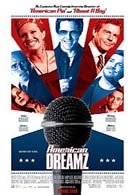
American Dreamz (Wicked Little Critta)

Initial Reaction: “Ok…”

The American Dream. As I sit here eating my Wendy’s grilled chicken sandwich, I reflect on what the American Dream was, and what it has become. And, after seeing it about two weeks ago, I think that I finally understand what the movie American Dreamz was trying to say.

We all know that it was meant to poke fun at our country. If any of you have seen or even heard of the American Pie movies, also directed by Paul Weitz, you’ll be able to figure out that much. American Dreamz does make fun of America, and it’s funny—because we Americans know what it’s talking about. Inside jokes are always funnier from the inside, and as an insider, I thought the humor was great. I’m sorry, as disrespectful as it may be, I’ll be honest with you: I loved Dennis Quaid as President Staton. He portrays our president a southern, fairly conservative, Christian man whose facial expression most often conveys a sense of “I can’t help it…” or “Who, me?” in dealing with publicity and public issues. I think my favorite line of his was when he earnestly says to his advisor: “Did you know that there are three types of Iraqistanis?”

The film focused on three themes: politicians, the American entertainment industry, and terrorism. A fantastically creative mix, in my opinion. The politicians are either clueless or crooked, the entertainment industry demonstrates an attitude of “do anything and hurt anyone to achieve fame,” and the terrorists? Let’s just say that Omer, a terrorist on a “mission” in America to take out the president, ends up being the most likeable and unscathed character in the entire movie. Why? Maybe American Dreamz is pointing out the backwardness of our American Dreams.

So, what do we take away from this? At first I wasn’t sure. It’s point (assuming I’m on the right track here) was a bit nebulous at times, trading in clarity for more laughs, as Dr. Worm and Stormy Pinkness both talk about in their reviews. But the more I think back on various scenes and quotes, the more I see it: We’re ridiculous. I even felt ridiculous after I saw the movie, and I wasn’t entirely sure why. The characters are caricatures, but they were done fairly well. Each character shows this in a different way, and all of these ways are prominent in our American culture. Mandy Moore plays diva Sally Kendoo who is almost impossible to like. Since I’ve seen Moore in other roles that are essentially the same, I’m beginning to wonder if this is her true personality, or the only role she can play. Hugh Grant plays Martin Tweed, a selfish TV show host who also only wants success for himself at the expense of others. I really don’t know what to say about Grant playing this role, except that his character was convincing. Chris Klein plays Sally’s fiancé who, no matter how evil Sally is, only wants to be with her because they’re “in love.” Klein pushed this character, named William Williams, to the edge. He seemed so crazily lovestruck throughout the film that I feel like if I asked him how many fingers I was holding up, he’d have no idea what I was talking about.

President Staton is oblivious to pretty much everything, and whines that—even though he’s the president—things just don’t go his way. Complementing this character, Willem Dafoe plays the president’s Chief of Staff, who clearly has a hidden agenda and jerks President Staton around like a marionette.

Its faults lie in many areas. For one, there are too many stories to follow to actually understand its point. Maybe if the movie were adjusted so that there were two main characters, it would have been stronger. But this movie seemed too wrapped up in the “do stupid stuff to make people laugh” approach. This style is very distracting when you’re trying to make a point. *SPOILER* Also, there’s no redemption in the end, so you spend all that time watching terrible people do terrible things, and that’s pretty much all you get. The resolution, if you can call it that, is unexpected and a bit…unresolved. Sometimes this works really well, but I didn’t like that style matched up with this movie. *END SPOILER*

Almost the entire cast demonstrates an aspect of the ridiculousness of our culture, and it makes us love the character who represents the most anti-American force we can currently imagine. The movie develops a distaste in its audience for 80% of its main characters, which can tend to rub audience members the wrong way, so I’m not too surprised that this movie wasn’t as huge as it could’ve been. It’s also very likely that strong Bush supporters (you’re out there, right?) will not be going out to buy this movie on DVD.

But should we all smash our TVs with hammers, defenestrate our politicians, and make friends with terrorists? I doubt it. But let’s not take ourselves too seriously. I mean, c’mon, look at us.

Rating: 8

American Dreamz was funny, interesting, and just the slightest bit eye-opening. I give it an 8 on the -22 to 22 scale. Quite entertaining and creative, but lacking some direction and clarity. Not bad.

Tuesday, May 16, 2006

American Dreamz (Stormy Pinkness)

Imagine, if you will, Hugh Grant playing a completely narcissistic celebrity who NEVER learns the error of his ways. Mandy Moore playing a character that you pretty much dislike almost from her introduction in the movie. Chris Klein playing a lovesick dope who cannot see things that are clearly in front of his face. If you can imagine this, you can pretty much imagine American Dreamz.
American Dreamz is a movie that is based on today’s society’s tendency to choose entertainment to escape life and the world instead of facing it. At first you are introduced to Martin Tweed (played by Hugh Grant). You then realize that he is the host of the show “American Dreamz.” Next you are introduced to Sally Kendoo, played by Mandy Moore. She is a lower-class singer who dreams of making it as a star and has the type of personality and heartlessness necessary to achieve that goal. Along with this you meet another contestant, Omer, who is a terrorist in training when he is sent away to America to prevent him from further embarrassing the terrorist camp. While in America, he is selected to appear on “American Dreamz” along with dozens of other American hopefuls, including a Jewish cantor who likes to rap.
The second story line of the movie involves President Staton (played by Dennis Quaid). We meet him on the morning after he has been re-elected as he is woken up by his Chief of Staff, played by Willem Dafoe. Staton’s Chief of Staff is eager to get the President going and started out strong on his second term. However, the President instead decides to stay in and read the newspaper. It soon becomes clear that this president is nothing more than a figurehead who knows nothing about what is going on in the world. Shocked by this realization, he is thrown into an obsession to find out what is going on. Due to his absence—caused by his obsessive reading of the newspaper—people start wondering about the President’s mental state. His Chief of Staff decides to put him on a “publicity blitz,” including being a celebrity judge on the TV show “American Dreamz.”
When I first heard about this movie I was thoroughly interested in seeing it. Finally, a movie was going to show what is wrong with America, that people are more interested in things that entertain them than the things that actually affect their lives. American Dreamz touched on this subject, but not in the way that I was hoping. It seemed to be flaking about the point it was making, and it seemed afraid to offend anyone. But why? Why not show people what they look like through a foreigner’s eyes? I went to this movie looking for a strong statement about today’s society. I did not think that this was too demanding a request. What I found was a movie that was so afraid of offending viewers—thereby cutting into its profits—that it said, “Here is the very toned-down version of the point of the movie. Now look at all these funny people!”
The movie was more entertaining than it was good. However, Hugh Grant plays Martin Tweed very well, although we all know that Hugh Grant can play a complete jerk. Mandy Moore also does well at playing Sally Kendoo, who thinks she is the best thing ever and doesn’t really realize that she is actually a horrible person. Sam Golzari does exceedingly well as Omer, who is the most loveable show-tune-singing terrorist I have ever seen. While I laughed many times throughout the movie, I wanted it to stand up for itself and say, “Screw it! This is our point! If you don’t like it then too bad.”
. The acting in American Dreamz was good and there were not any glaring mistakes that caught my eye. But since the movie did not want to offend anyone by saying what it really wanted to, I became very frustrated and disillusioned with it. I give it a 7 on a scale of -22 to 22. Why do people not say what they mean? I know that everyone is entitled to their own opinion, but why does that always mean giving way to the majority opinion? If you want to make a point, don’t soften the blow just to save yourself. Say what you mean, and it will feel so much better!


~Stormy Pinkness

Saturday, May 13, 2006

American Dreamz (Dr. Worm)

For those too busy to read an entire review, I’ll sum up American Dreamz in just one word: schmatire.

To break that down for those of you still reading: satire is defined as a “work in which vices, follies, stupidities, abuses, etc. are held up to ridicule and contempt.” And the “schm-” prefix indicates that the word it is affixed to should not be taken too seriously.

In it’s dealings with the president, for example, American Dreamz is a satire with all the cutting edge of a feather. Dennis Quaid plays President Staton—the name is really the only thing notably different from our current commander-in-chief. As the movie opens, Staton has just been elected to a second term. But instead of rushing out the next morning to triumphantly greet his constituency, he decides he wants to stay in his pajamas and—apparently for the first time in his life—read the newspaper. When this continues for several weeks, the public starts speculating on President Staton’s condition, while his right-hand-man Wally (Willem Dafoe channeling Karl Rove) decides that the president will appear on the wildly popular show “American Dreamz” in order to improve his sagging poll numbers.

Which brings us to satire target number two: “American Idol.” Here, Hugh Grant becomes Simon Cowell (renamed Martin Tweed in the movie) by reprising his self-interested-bastard role from About a Boy. It is here that the movie really shows its satiric claws. Whereas Quaid’s President Staton (Bush) is a lovable bumpkin—slow, but good-hearted—Grant’s Tweed (Cowell) is, for lack of better words, a prick. But, like Cowell, he’s a prick that’s fun to watch, so long as his prickliness isn’t directed at you.

Also starring in the reality-show story line are: Mandy Moore as Sally Kendoo, a white-trash girl desperate to become famous; Chris Klein as William Williams, Sally’s amusingly simple and genuine boyfriend, and Sam Golzari as Omer, a terrorist and the only legitimately likeable person in the film. His ineptitude, combined with his love-of-show-tunes, gets him sent away from his terrorist training camp, but when he gets cast as a contestant on the titular show, his terror cell decides to use him to get to the president.

Golzari is one of the few characters in the movie not guilty of what a former director of mine called "schmacting" (note the schm- prefix). Schmacting—in this case—refers to overplaying or caricaturing your character. It's a good way to a quick, cheap laugh, but it also weakens a character, making them ultimately less interesting to watch.

As I mentioned, Golzari avoids schmacting. So do Hugh Grant, Willem Dafoe, and Jennifer Coolidge (playing Mrs. Kendoo). Seth Meyers, as Sally Kendoo's agent, does an excellent job of being funny without schmacting. Chris Klein comes dangerously close, but still stays just on the right side of the schmactor line. But Mandy Moore? She does some major schmacting. As does Dennis Quaid as the President, and Marcia Gay Harden as his wife. And Tony Yalda as Golzari's cousin? Schmactacular.

In the end, I think that's what prevented the movie from being all it could be. Whether it was the director's choice or the actors', I don't know, but the recurrent overplaying of characters and jokes—in essence, telling the audience "laugh now, this is supposed to be funny!"—really weakened a movie that had the capacity to be much, much sharper.

With a bit more restraint, the movie could have been a ten. But, because it frequently lazily opted for a cheaper laugh, that ten is really just a schmen (which, translated into layman's terms, is actually just a five.)

Thursday, May 11, 2006

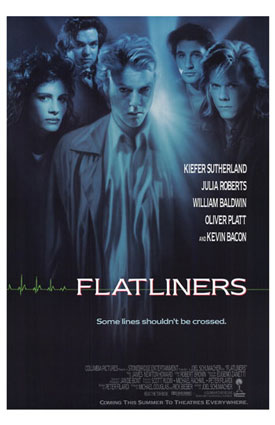
Flatliners

What lies beyond once we shuffle off this mortal coil? Is it heaven, or hell, or earth again in a different body, or just a black inky nothingness? It’s a great question, and perhaps the fact that it cannot be answered is what makes it great. There has been lots of conjecture on the subject over the centuries, and a few people have even claimed to have experienced it and come back. Wouldn’t it be interesting to definitively answer the question forevermore, figure out a piece of God’s puzzle and become more God-like, and in the process get filthy rich?

Wait a minute, this is sounding like a movie plot. Oh yeah, Flatliners! This is now a pretty old movie (it seems weird that a movie made in 1990 would be considered old, but that was 16 years ago), and it is certainly not the only movie made that explores the questions of death and eternity. But an important point is that this movie does not claim to have the answers. Four people “die” in this movie, and they all experience something just a little bit different. This movie is based on the question, not the answer.

It involves five medical students who are like typical medical students: bold, ambitious, competitive, and incredibly arrogant. One of them (Kiefer Sutherland, AKA Jack Bauer) is so arrogant that he takes fantastic risks with his own life and those of others. He proposes an experiment to see the other side of death, an experiment that has great potential to end very badly. The others are reluctant at first, but when it works, most of them are bucking to be the next guinea pig. And they keep up-ing the length of time they’ll be technically dead.

Whether or not this movie is medically plausible, I don’t really care. It thinks it’s medically plausible, and executes the idea with a modicum of competence, so that’s enough. All five of the principal actors are pretty good. This is an all-star cast that would surely command an astronomical budget nowadays, but the movie was filmed when these actors weren’t really the huge names that they are now. Arguably, the star is Kevin Bacon as David. At the beginning he is a professed atheist, but by the end he is the only character to address God directly. He often lets his ambition get the better of him, but he’s good-hearted and passionate, and does something relentlessly till he gets the result he wants. Julia Roberts is ho-hum as Rachel, as she is just supposed to be the token female character who sleeps with the main character and is seen in a bra. She does great things with a character the script doesn’t really have time to develop, though. William Baldwin is very good as Joe, the likable scumbag. He’s a rake, but he’s genuinely sensitive as well. He carries these two character traits with grace and subtlety, and doesn’t over-play them, as would be easy to do.

What eventually happens because they played with death is interesting, but has the potential to be incredibly cheesy. Luckily, the movie avoids this by having all the actors be totally sold out to the idea. I also really liked that as godless and arrogant as these characters are, they cannot escape God. They conduct their experiments in an abandoned church, where stained-glass windows and divine statues are all around, and what started out as their experiment quickly spirals out of control. The religious imagery in this movie is very strong, a little too strong at times, but it brings up a very good point. I’m very glad this movie didn’t do the typical Hollywood thing, which is to remove God from all the proceedings, as other movies about this same subject have done. What Flatliners brought out for me is that God is a lot smarter than we are, and try as we might, we can’t out-do him.

Iconic lines:
“Hoka hey.” (today is a good day to die)
“Philosophy failed. Religion failed. Now it’s time for medical science to try.”
“Good thing I didn’t flatline. My 350-pound babysitter would be chasing me for the half-eaten pastrami sandwich I stole from her.”

22 Rating: 7

Particle Man

Tuesday, May 09, 2006

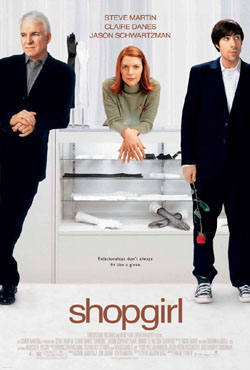
Shopgirl

Initial Reaction: Did that movie have Steve Martin in it?

As the Shopgirl DVD was held in front of my face at Blockbuster, I was intrigued. Steve Martin and Claire Danes? Interesting… As I remember, the cover said something about it being funny, and I’ve never seen a Steve Martin movie I didn’t get a good couple of laughs out of. Sure, why not?

You ever meet one of those unlikable people that you like? No, I didn’t type that wrong, I’m serious. Have you ever met someone that bugs you in so many ways, and you could make a list of the reasons why you shouldn’t like them, but for some reason you do? They’re annoying. They never shut up. They always criticize you. They couldn’t chew any louder if they tried. Why do you like them? And yet, the next day you miss them and can’t stop yourself from calling them up.

I liked this movie, but didn’t want to like it. Even now as I write this review, I want to criticize it, inflate its flaws, maybe even create some. I wouldn’t see it again, and I wouldn’t even recommend it to many people. But for some reason, I liked it.

Let me explain. This wasn’t a funny movie, which totally derailed my movie train. Looking at Steve Martin’s face and not expecting to laugh took some getting used to, and even hearing his voice as the narrator made me smirk for absolutely no reason. But the mood of the film was not a comedic one. The silly, laugh-out-loud moments were few and far between, and I can only remember one of those parts involving Steve Martin’s character. Shopgirl had a very distinct mood. The music really did it for me, it painted this mood clearly and beautifully, filling me with a sense of bittersweet love and desire …

The movie Shopgirl went where most movies avoid going when it put two potential lovers in the life of its main character, Mirabelle Buttersfield (Claire Danes). These kinds of movies can leave people with a bitter taste in their mouths that “fate” might have absolutely nothing to do with finding love, and that actually being in true love is our own personal choice. (Perish the thought.) I actually appreciated this, but on the other hand I do understand the draw of a story whose lovers, no matter what the circumstances, will end up in each others arms in the end. I guess.

I really like Claire Danes. Maybe not the most versatile actress in the world, but I think she does what she does well. She plays the good-yet-tragic Danes character, and you can’t help but like her. She’s just an average young woman on her own, dreaming of having a love that is fulfilling and true. Not surprisingly, she gets put into the path of Jeremy (Jason Schwartzman). This guy is a fool. I actually at one point pleaded with the movie to change its mind in the choice of romantic interest #1, because this guy is the least charming, least socially-polished guy I’ve ever seen play a romantic lead in a film. Plus, he’s not that attractive. He doesn’t seem to have much potential for anything, nevermind making it with the likeable Danes. I will say, however, that Schwartzman was amazingly successful in his role… I was actually genuinely embarrassed for him several times.

Alright, so Steve Martin? Very surprising. He plays the rich, older man who enters Mirabelle’s life and sweeps her off her feet. It’s really no contest at first, Mirabelle has her head on straight enough to see that Ray, a rich, gentle, caring and polite man, knocks Jeremy out of the ring. But who is right for her?

It seems obvious, but then it isn’t. Both men love Mirabelle, but she only wants one of them: Ray. Ray, however, is older and doesn’t want anything serious or long-term with Mirabelle. He basically wants to get laid whenever he’s in town. But he’s everything a girl wants in a man, and she believes that he loves her and will come around. Jeremy goes off on his own “quest” to try and find himself, and while he does change for the better in many ways, he still remains himself, and a part of himself is still crazy about Mirabelle.

Shopgirl made me uncomfortable because it focused on the fact that love can come from very unexpected places and people, and sometimes we don’t recognize it. It’s nice as an audience to just be spoon-fed a story and know that your expectations will be fulfilled. It’s a nice escape from a reality that always takes us by surprise. Shopgirl moved away from meeting expectations, and just evolved. Because of this, I appreciated Steve Martin’s honesty with us, it’s nice to not be lied to. But at the same time, I enjoy escaping reality sometimes. Reality, after all, is messy.

Rating: 6

In any case, I liked it, but I wouldn’t see it again and I won’t recommend it to you, unless you are intrigued by this review. If you are, go and see it, and let me know what you think. I give Shopgirl a 6 on the -22 to 22 scale. It was a good story that was well done and well acted, but seeing it was like hearing my mother tell me that my boyfriend is no good—a reality check I never asked for.

Monday, May 08, 2006

Movie of the Month - May '06

American Dreamz

Stay tuned for our reviews coming up May 15th-19th!
Lucky for you, They Might Be Critics hosts a regular movie of the month. During this exciting time, all (or most) of our critics post reviews of a chosen movie that is due to come out this month. We are all about providing a range of opinions and insights, and allowing for an open forum in which we discuss the film with each other and anyone who desires to participate. So, see American Dreamz, and join in!