Tuesday, June 13, 2006

X-Men: The Last Stand (Particle Man)

This recent trend of comic book movies is really hit or miss, with some of them succeeding and a few failing miserably. The Spider-Man movies were pretty good, Sin City was freakin’ brilliant, and V for Vendetta was at least thought-provoking. But then there was Daredevil, The Punisher, and Elektra, which made me wretch as much as Sin City made me cheer. So really, when you do a comic book movie, you’re playing a dangerous game. For people who actually know the source material, they’ll crucify you if you don’t follow the comic book exactly, both in content and in style. But then for the people who don’t know it, you risk alienating them. It’s a difficult tightrope to walk. Luckily, the makers of the X-Men movies satisfied both sets of people.

X-Men: The Last Stand is the best of the three X-Men movies, in my opinion. Every actor was at the peak of their skill for the character, since they had lived with each of their characters for six years. Most of the principals were excellent, with Hugh Jackman and Famke Jansen as standouts. Halle Berry, like in the previous two movies, is so-so as Storm, but massively disadvantaged by the fact that she is simply not right for the role. I know she’s an Oscar-winning actress, but there are so many others who are better than her. Sophie Okonedo (Hotel Rwanda) would be a much better choice for Storm. Ian McKellen and Patrick Stewart continue to be absolutely stellar in their form-fitting roles, and performances of this caliber are no surprise from these Shakespearian actors. Hugh Jackman was great, but I’ll have difficulty seeing him in any other role but Wolverine. Even the newcomers are great, especially Ellen Page as Kitty (I see blockbusters and astronomical salaries in her future for sure) and Kelsey Grammer as Beast. His performance had multiple layers to it, each equally excellent. When you have an all-star ensemble cast like this, and almost all of them are great, you can expect a review to be a little bit gushing.

Cast aside, the theme of the movie was even more poignant and discussion-provoking than the previous two. Issues like homosexuality, stem-cell research, and abortion all come to light, as well as the morality of expelling or keeping those things. The movie is rich with arguable issues. Are certain behaviors really bred in the bone, and if so, can they be biologically suppressed? Is suppressing them a good thing? Is there really any such thing as “normal,” or is what’s normal just being different from everyone else? In addition to the questions it brings up, it’s very entertaining as well. The action is very involving and clever (particularly the way Kitty outsmarts Juggernaut), and it's not just "blow stuff up." The costumes are only sometimes cheesy, and the most gripping and character-driven scenes are where there’s some sort of action where one mutant’s power is matched up against another’s. This is a different director, yes, but the director is not as important as the franchise he’s directing, and in well-established pop culture items like this one, he can’t be. We learned that lesson with Harry Potter. So in the hit-or-miss world of comic book movies, X-Men: The Last Stand is definitely a hit.

Iconic lines:
“Charles always wanted to build bridges.”
“That was my last cigar!”
“They wish to cure us… and I say we are the cure.”

22 Rating: 14

Particle Man

Monday, June 12, 2006

X-Men: The Last Stand (Your Racist Friend)

When we last saw Charles Xavier and his mutant X-Men, they had weathered an attempt by William Striker to start a war between mutants and humans, but had lost Jean Grey in the process. X3 begins with two flashbacks: Charles Xavier and Magneto visiting a young Jean Grey to tell her about the Xavier Academy, and a young blond boy locked in his family's bathroom, deperately trying to saw off the wings which have started to grow on his back. These images set the tone for the third film about Charles Xavier and his X-Men, the mutant superheroes who have "sworn to protect a world that hates and fears them."
There was a lot of negative buzz surrounding this project, and approximately 98% of it came from internet gossipmonger/misanthrope/"film critic" Harry Knowles of aintitcool.com. But who would you rather believe, the man who gave glowing reviews to such dire days in the history of cinema such as Godzilla and Blair Witch 2, or me, your friendly neighborhood comic expert and film geek? Yeah, that's what I thought.
The plot of X3 revolves around a "cure" for the mutant gene created by Warren Worthington II, the father of the aforementioned blonde be-winged boy, Warren Worthington III, aka Angel (Ben Foster). He makes the cure available to the public, igniting a controversy and provoking the ire of Magneto (Ian McKellen) and his "Brotherhood." But the X-Men are hardly in a position to respond: Cyclops is shattered over Jean's death, forcing Storm and Wolverine into a more prominent leadership position at the school. Along to help them deal with the crisis is original student Henry McCoy, aka Beast. But Jean mysteriously re-emerges early in the film, and sets into motion a tragic chain of events that come to a head in an epic battle on Alcatraz Island.
But enough about the plot, how was X3, anyway? I thought it was pretty good. Brett Ratner pulls off the handling of directorial reins from Bryan Singer, who left to handle Superman Returns. The thing about Ratner is that he doesn't really have much of a style, so the tone of the film is very consistent with the first two. I think that the plot would have been a bit tighter if Bryan Singer was still at the helm, but these are fairly small details: X3 is great popcorn entertainment, just like the first two. If I had to scale it, then I would say that I enjoyed it more than the first one, but that I don't think it's as good as the second installment.
Hugh Jackman, Patrick Stewart, and Ian McKellen are all still very good as Wolverine, Professor X, and Magneto, respectively. Wolverine is a bit tamer, but that's the writer's fault, not Hugh's. As long as he gets to drop the occasional streetlight, or eviscerate about 10 mutants whilst sneaking into the Brotherhood's camp, I'm happy. Halle Berry is a little better as Storm this time around, thanks to vastly increased screen time and a treatment of Storm in the script that is more in line with the comics version of the character. Kelsey Grammer shines in a letter-perfect performance of Beast, the conflicted Secretary of Mutant Affairs for the U.S. Government. It is also worth noting that Grammer is the 2nd casting of a character in the films that virtually all of fandom clamored for (the first being Stewart as Professor X), and it looks like they were right. Stealing every second of his sparse screen time is Guy Ritchie staple and ex-footballer Vinnie Jones (of Lock, Stock, and Two Smoking Barrels and Snatch) as the unstoppable Juggernaut. I was a little concerned as to how the Juggernaut, a longtime favorite villain would be brought to the screen, but I wasn't disappointed.
This review will be expanded later on, but I had a lot of fun at this movie. The plot doesn't bear quite the significance and weight of the second film, but it moves well and doesn't drag. If anything, I think a few minutes could have been added to flesh out some characters and relationships. I give X3 a 16 out of 22 on the 22 scale.

Thursday, June 08, 2006

X-Men: The Last Stand

X-Men: The Last Stand

Stay tuned for our reviews coming up June 12th-16th!Lucky for you, They Might Be Critics hosts a regular movie of the month. During this exciting time, all (or most) of our critics post reviews of a chosen movie that is due to come out this month. We are all about providing a range of opinions and insights, and allowing for an open forum in which we discuss the film with each other and anyone who desires to participate. So, see X-Men: The Last Stand, and join in!

Tuesday, June 06, 2006

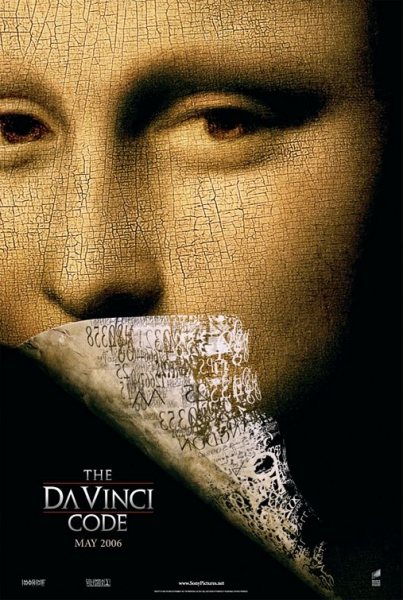
The Da Vinci Code

Hello, all! I'm Your Racist Friend, the newest critic! This is my first of many, many reviews to come, so enjoy!

Unlike a lot of Americans, I didn't get very far into The Da Vinci Code.....the book, that is. I read the first chapter or two, and kind of forgot about it. I do remember thinking "This is pretty darn pulpy.....is this what America's reading now?"
Fast forward a few years: A friend lets me borrow Angels and Demons, which I am able to finish. Again with the pulpiness, and it was a quick read, but I had some problems with it. I see Dan Brown as English Professor Wish Fufillment Lit, because of certain elements in his stories. The brainy guy saves the day, because he can speak Sumerian, or something. That brilliant lady scientist? Take her glasses off, and she's a sexy supermodel! That curmudgeonly old guy? Shhhhh, don't tell anybody, but he's secretly the villain!
Fast-forward another year, to the release of The Da Vinci Code film. I planned on not seeing this movie with the rest of America, at first. Not only could I not care less about the source material, but the advance reviews....23% on rottentomatoes.com???? No, thank you! However, I did get roped into seeing this Memorial Day weekend before a screening of X3, so here it is.
For the five of you in the country who have no familiarity with the story whatsoever, TDVC is the continuing adventure of Robert Langdon (Tom Hanks), a Harvard University professor of symbology, who gets mixed up in a conspiracy to cover up the "real truth" about Jesus Christ and his lineage. On the run with him is Sophie Neveu (Audrey Tautou), and eccentric Englishman Sir Leigh Teabing (Ian McKellen, making himself more invaluable each year). On their trail is albino monk assassin (yes, you read that right....) Silas (Paul Bettany, not doing himself any favors here.)
I should stop for a minute, and address the religious controversy over this picture, especially to Catholics. I will say that I can understand why some people would be upset over the assertations in this movie, but I will address that with two statements.

1) It's a work of fiction, so everything's cool, ok?
2) It's a very ridiculous work of fiction, so that's even more......that. I think if people took a hard look at how laughable some of the source material here is, they wouldn't be so offended. I mean, an albino monk assasin for crying out loud?

Ahem. Anyway, I thought this movie was going to be Plan 9 From Outer Space bad, but it wasn't, it was just merely bad. I would describe it as a slightly smarter National Treasure with a religious bent. Tom Hanks clearly understands the character, and does as good a job as anybody could do. Audrey Tautou does an ok job in her first (I think.....) English language role. Ian McKellen understands that this kind of material calls for a performance that borders on melodrama, and tears into his role with the kind of abandon we really only see from him, Kevin Spacey, Geoffrey Rush, etc. Paul Bettany's performance is truly reprehensible and ridiculous, but I guess he didn't have much to work with in the first place. Still, I hope that those rumors flying about that he's going to play the Joker in the next Batman movie are just that. The dialogue is mostly fine, although there are some lines of dialogue that border on the unbelievable.

Sophie: "You have eidetic memory?" (Photographic memory, for you non-fancy people.)
Robert: "No, but I can bring up things in my mind that I saw earlier."

*smacks forehead*

In addition, there are other things that don't make sense. In one part, it seems like it's curtains for Robert and Sophie in the back of a truck. Robert carefully pushes a spent handgun shell into the groove of the truck door. When the truck door get closed, the shell goes off, whacking the bad guy in the face! But, it's a spent shell? Maybe it was magic......

I really can't give this movie more than a 1 on the 22 scale. Read a good book instead, but preferably not anything by Dan Brown.

Saturday, June 03, 2006

Thirteen

As I understand it, the process that produced this movie as its end result was not the typical Hollywood story. Nikki Reed was going through some massively difficult times, some tumultuous transformations, and some traumatic experiences. Feeling lost, she oddly goes to her father’s girlfriend, Catherine Hardwicke. Hardwicke encourages her to write about her experiences in a diary, but Reed writes a screenplay instead. It’s largely autobiographical. She shows it to Hardwicke, and they fine-tune it and polish it up. About a year later, they shoot the movie, Hardwicke directing and Reed playing one of the leads. In reality, Reed had a friend that got her involved in sex, drugs, theft, lying, and all the other things you don’t want your teenager doing. In the movie, Reed plays the part of that friend.

The part based on Reed is played by Evan Rachel Wood. In the beginning of the movie, neither character is very well developed at all. None of the cast is, really. Because of that, it took a while for us as the audience to buy into the characters’ actions. We get kind of a documentary feel to it, sort of like Kids, but it’s just a little too contrived and perfectly shot to make the feeling 100% like Kids. The similarities between that movie and Thirteen are quite striking, not the least of which is the stylish, MTV quality to the cinematography. All the trappings of teenage-ism are there (irresponsible sex, petty crime, makeshift drugs, piercings, staying out late). They’re not presented as being fun or glamorous, but the great consequences that such actions carry are never brought to full fruition, either.

The biggest problem with this movie is that the plot doesn’t have proper flow, and even worse, rhyme or reason. Instead of being directed on a somewhat consistent path, Thirteen feels like it’s jerking us around. This isn’t the intent of the screenplay, but a lack of skill on the part of the screenwriters. That being said, the performances are anywhere from pretty good to fabulous. Evan Rachel Wood in particular is phenomenal as Tracy. She is totally sold out to her role, and is entirely convincing, perhaps because she was so close to the age that she was playing. Nikki Reed is even more convincing, though significantly less skilled as an actress. Reed’s portrayal of Evie is dead-on because she actually did a lot of the things that Evie does in the movie. Holly Hunter is great as Mel, Tracy’s mom who means well, but has absolutely no control over her daughter. I really appreciated that the central characters didn’t seem like cardboard cutouts, that they actually had a little depth. However, that depth was injected by the actors instead of the screenplay.

Another problem with the film is that it didn’t have a very good resolution. Honestly, I got about halfway through it and started think it couldn’t possibly have a good resolution that wasn’t completely cheesy and unconvincing, two things that the movie definitely was not. The fact that the teenagers in this movie get involved with the things they do is terrifying to me, but not at all surprising. Kids are growing up a lot faster than they used to, but at the same time, they’re not. They are dealing with very adult things and situations, a lot of the time willingly, but not doing it as adults. Nine times out of ten, they are flagrantly irresponsible with the power granted to them (sometimes unwittingly) by their parents. Well, I don’t want this review to turn into a diatribe on parenting techniques, since I have absolutely no grounds to speak on that subject.

In short, this movie had an important thing to say, but I had already heard it from many other sources, not just film. It didn’t educate me, and it didn’t even entertain me all that much. Mostly I was just saddened by seeing a girl go exactly where I knew she would go. I do, however, think this would be a worthwhile film for a parent and a teenager to watch together, and then talk about afterward.

Iconic lines:
“Mothers, lock up your sons!”
“No. Bad. Danger, Will Robinson, danger. You’re jailbait.”
“I love you and your brother more than anything in the world. I would die for you, but I won’t leave you alone right now."

22 Rating: 2

Particle Man

Saturday, May 20, 2006

American Dreamz (Wicked Little Critta)

Initial Reaction: “Ok…”

The American Dream. As I sit here eating my Wendy’s grilled chicken sandwich, I reflect on what the American Dream was, and what it has become. And, after seeing it about two weeks ago, I think that I finally understand what the movie American Dreamz was trying to say.

We all know that it was meant to poke fun at our country. If any of you have seen or even heard of the American Pie movies, also directed by Paul Weitz, you’ll be able to figure out that much. American Dreamz does make fun of America, and it’s funny—because we Americans know what it’s talking about. Inside jokes are always funnier from the inside, and as an insider, I thought the humor was great. I’m sorry, as disrespectful as it may be, I’ll be honest with you: I loved Dennis Quaid as President Staton. He portrays our president a southern, fairly conservative, Christian man whose facial expression most often conveys a sense of “I can’t help it…” or “Who, me?” in dealing with publicity and public issues. I think my favorite line of his was when he earnestly says to his advisor: “Did you know that there are three types of Iraqistanis?”

The film focused on three themes: politicians, the American entertainment industry, and terrorism. A fantastically creative mix, in my opinion. The politicians are either clueless or crooked, the entertainment industry demonstrates an attitude of “do anything and hurt anyone to achieve fame,” and the terrorists? Let’s just say that Omer, a terrorist on a “mission” in America to take out the president, ends up being the most likeable and unscathed character in the entire movie. Why? Maybe American Dreamz is pointing out the backwardness of our American Dreams.

So, what do we take away from this? At first I wasn’t sure. It’s point (assuming I’m on the right track here) was a bit nebulous at times, trading in clarity for more laughs, as Dr. Worm and Stormy Pinkness both talk about in their reviews. But the more I think back on various scenes and quotes, the more I see it: We’re ridiculous. I even felt ridiculous after I saw the movie, and I wasn’t entirely sure why. The characters are caricatures, but they were done fairly well. Each character shows this in a different way, and all of these ways are prominent in our American culture. Mandy Moore plays diva Sally Kendoo who is almost impossible to like. Since I’ve seen Moore in other roles that are essentially the same, I’m beginning to wonder if this is her true personality, or the only role she can play. Hugh Grant plays Martin Tweed, a selfish TV show host who also only wants success for himself at the expense of others. I really don’t know what to say about Grant playing this role, except that his character was convincing. Chris Klein plays Sally’s fiancĂ© who, no matter how evil Sally is, only wants to be with her because they’re “in love.” Klein pushed this character, named William Williams, to the edge. He seemed so crazily lovestruck throughout the film that I feel like if I asked him how many fingers I was holding up, he’d have no idea what I was talking about.

President Staton is oblivious to pretty much everything, and whines that—even though he’s the president—things just don’t go his way. Complementing this character, Willem Dafoe plays the president’s Chief of Staff, who clearly has a hidden agenda and jerks President Staton around like a marionette.

Its faults lie in many areas. For one, there are too many stories to follow to actually understand its point. Maybe if the movie were adjusted so that there were two main characters, it would have been stronger. But this movie seemed too wrapped up in the “do stupid stuff to make people laugh” approach. This style is very distracting when you’re trying to make a point. *SPOILER* Also, there’s no redemption in the end, so you spend all that time watching terrible people do terrible things, and that’s pretty much all you get. The resolution, if you can call it that, is unexpected and a bit…unresolved. Sometimes this works really well, but I didn’t like that style matched up with this movie. *END SPOILER*

Almost the entire cast demonstrates an aspect of the ridiculousness of our culture, and it makes us love the character who represents the most anti-American force we can currently imagine. The movie develops a distaste in its audience for 80% of its main characters, which can tend to rub audience members the wrong way, so I’m not too surprised that this movie wasn’t as huge as it could’ve been. It’s also very likely that strong Bush supporters (you’re out there, right?) will not be going out to buy this movie on DVD.

But should we all smash our TVs with hammers, defenestrate our politicians, and make friends with terrorists? I doubt it. But let’s not take ourselves too seriously. I mean, c’mon, look at us.

Rating: 8

American Dreamz was funny, interesting, and just the slightest bit eye-opening. I give it an 8 on the -22 to 22 scale. Quite entertaining and creative, but lacking some direction and clarity. Not bad.

Tuesday, May 16, 2006

American Dreamz (Stormy Pinkness)

Imagine, if you will, Hugh Grant playing a completely narcissistic celebrity who NEVER learns the error of his ways. Mandy Moore playing a character that you pretty much dislike almost from her introduction in the movie. Chris Klein playing a lovesick dope who cannot see things that are clearly in front of his face. If you can imagine this, you can pretty much imagine American Dreamz.
American Dreamz is a movie that is based on today’s society’s tendency to choose entertainment to escape life and the world instead of facing it. At first you are introduced to Martin Tweed (played by Hugh Grant). You then realize that he is the host of the show “American Dreamz.” Next you are introduced to Sally Kendoo, played by Mandy Moore. She is a lower-class singer who dreams of making it as a star and has the type of personality and heartlessness necessary to achieve that goal. Along with this you meet another contestant, Omer, who is a terrorist in training when he is sent away to America to prevent him from further embarrassing the terrorist camp. While in America, he is selected to appear on “American Dreamz” along with dozens of other American hopefuls, including a Jewish cantor who likes to rap.
The second story line of the movie involves President Staton (played by Dennis Quaid). We meet him on the morning after he has been re-elected as he is woken up by his Chief of Staff, played by Willem Dafoe. Staton’s Chief of Staff is eager to get the President going and started out strong on his second term. However, the President instead decides to stay in and read the newspaper. It soon becomes clear that this president is nothing more than a figurehead who knows nothing about what is going on in the world. Shocked by this realization, he is thrown into an obsession to find out what is going on. Due to his absence—caused by his obsessive reading of the newspaper—people start wondering about the President’s mental state. His Chief of Staff decides to put him on a “publicity blitz,” including being a celebrity judge on the TV show “American Dreamz.”
When I first heard about this movie I was thoroughly interested in seeing it. Finally, a movie was going to show what is wrong with America, that people are more interested in things that entertain them than the things that actually affect their lives. American Dreamz touched on this subject, but not in the way that I was hoping. It seemed to be flaking about the point it was making, and it seemed afraid to offend anyone. But why? Why not show people what they look like through a foreigner’s eyes? I went to this movie looking for a strong statement about today’s society. I did not think that this was too demanding a request. What I found was a movie that was so afraid of offending viewers—thereby cutting into its profits—that it said, “Here is the very toned-down version of the point of the movie. Now look at all these funny people!”
The movie was more entertaining than it was good. However, Hugh Grant plays Martin Tweed very well, although we all know that Hugh Grant can play a complete jerk. Mandy Moore also does well at playing Sally Kendoo, who thinks she is the best thing ever and doesn’t really realize that she is actually a horrible person. Sam Golzari does exceedingly well as Omer, who is the most loveable show-tune-singing terrorist I have ever seen. While I laughed many times throughout the movie, I wanted it to stand up for itself and say, “Screw it! This is our point! If you don’t like it then too bad.”
. The acting in American Dreamz was good and there were not any glaring mistakes that caught my eye. But since the movie did not want to offend anyone by saying what it really wanted to, I became very frustrated and disillusioned with it. I give it a 7 on a scale of -22 to 22. Why do people not say what they mean? I know that everyone is entitled to their own opinion, but why does that always mean giving way to the majority opinion? If you want to make a point, don’t soften the blow just to save yourself. Say what you mean, and it will feel so much better!


~Stormy Pinkness

Saturday, May 13, 2006

American Dreamz (Dr. Worm)

For those too busy to read an entire review, I’ll sum up American Dreamz in just one word: schmatire.

To break that down for those of you still reading: satire is defined as a “work in which vices, follies, stupidities, abuses, etc. are held up to ridicule and contempt.” And the “schm-” prefix indicates that the word it is affixed to should not be taken too seriously.

In it’s dealings with the president, for example, American Dreamz is a satire with all the cutting edge of a feather. Dennis Quaid plays President Staton—the name is really the only thing notably different from our current commander-in-chief. As the movie opens, Staton has just been elected to a second term. But instead of rushing out the next morning to triumphantly greet his constituency, he decides he wants to stay in his pajamas and—apparently for the first time in his life—read the newspaper. When this continues for several weeks, the public starts speculating on President Staton’s condition, while his right-hand-man Wally (Willem Dafoe channeling Karl Rove) decides that the president will appear on the wildly popular show “American Dreamz” in order to improve his sagging poll numbers.

Which brings us to satire target number two: “American Idol.” Here, Hugh Grant becomes Simon Cowell (renamed Martin Tweed in the movie) by reprising his self-interested-bastard role from About a Boy. It is here that the movie really shows its satiric claws. Whereas Quaid’s President Staton (Bush) is a lovable bumpkin—slow, but good-hearted—Grant’s Tweed (Cowell) is, for lack of better words, a prick. But, like Cowell, he’s a prick that’s fun to watch, so long as his prickliness isn’t directed at you.

Also starring in the reality-show story line are: Mandy Moore as Sally Kendoo, a white-trash girl desperate to become famous; Chris Klein as William Williams, Sally’s amusingly simple and genuine boyfriend, and Sam Golzari as Omer, a terrorist and the only legitimately likeable person in the film. His ineptitude, combined with his love-of-show-tunes, gets him sent away from his terrorist training camp, but when he gets cast as a contestant on the titular show, his terror cell decides to use him to get to the president.

Golzari is one of the few characters in the movie not guilty of what a former director of mine called "schmacting" (note the schm- prefix). Schmacting—in this case—refers to overplaying or caricaturing your character. It's a good way to a quick, cheap laugh, but it also weakens a character, making them ultimately less interesting to watch.

As I mentioned, Golzari avoids schmacting. So do Hugh Grant, Willem Dafoe, and Jennifer Coolidge (playing Mrs. Kendoo). Seth Meyers, as Sally Kendoo's agent, does an excellent job of being funny without schmacting. Chris Klein comes dangerously close, but still stays just on the right side of the schmactor line. But Mandy Moore? She does some major schmacting. As does Dennis Quaid as the President, and Marcia Gay Harden as his wife. And Tony Yalda as Golzari's cousin? Schmactacular.

In the end, I think that's what prevented the movie from being all it could be. Whether it was the director's choice or the actors', I don't know, but the recurrent overplaying of characters and jokes—in essence, telling the audience "laugh now, this is supposed to be funny!"—really weakened a movie that had the capacity to be much, much sharper.

With a bit more restraint, the movie could have been a ten. But, because it frequently lazily opted for a cheaper laugh, that ten is really just a schmen (which, translated into layman's terms, is actually just a five.)

Thursday, May 11, 2006

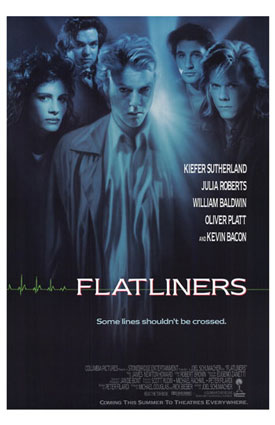
Flatliners

What lies beyond once we shuffle off this mortal coil? Is it heaven, or hell, or earth again in a different body, or just a black inky nothingness? It’s a great question, and perhaps the fact that it cannot be answered is what makes it great. There has been lots of conjecture on the subject over the centuries, and a few people have even claimed to have experienced it and come back. Wouldn’t it be interesting to definitively answer the question forevermore, figure out a piece of God’s puzzle and become more God-like, and in the process get filthy rich?

Wait a minute, this is sounding like a movie plot. Oh yeah, Flatliners! This is now a pretty old movie (it seems weird that a movie made in 1990 would be considered old, but that was 16 years ago), and it is certainly not the only movie made that explores the questions of death and eternity. But an important point is that this movie does not claim to have the answers. Four people “die” in this movie, and they all experience something just a little bit different. This movie is based on the question, not the answer.

It involves five medical students who are like typical medical students: bold, ambitious, competitive, and incredibly arrogant. One of them (Kiefer Sutherland, AKA Jack Bauer) is so arrogant that he takes fantastic risks with his own life and those of others. He proposes an experiment to see the other side of death, an experiment that has great potential to end very badly. The others are reluctant at first, but when it works, most of them are bucking to be the next guinea pig. And they keep up-ing the length of time they’ll be technically dead.

Whether or not this movie is medically plausible, I don’t really care. It thinks it’s medically plausible, and executes the idea with a modicum of competence, so that’s enough. All five of the principal actors are pretty good. This is an all-star cast that would surely command an astronomical budget nowadays, but the movie was filmed when these actors weren’t really the huge names that they are now. Arguably, the star is Kevin Bacon as David. At the beginning he is a professed atheist, but by the end he is the only character to address God directly. He often lets his ambition get the better of him, but he’s good-hearted and passionate, and does something relentlessly till he gets the result he wants. Julia Roberts is ho-hum as Rachel, as she is just supposed to be the token female character who sleeps with the main character and is seen in a bra. She does great things with a character the script doesn’t really have time to develop, though. William Baldwin is very good as Joe, the likable scumbag. He’s a rake, but he’s genuinely sensitive as well. He carries these two character traits with grace and subtlety, and doesn’t over-play them, as would be easy to do.

What eventually happens because they played with death is interesting, but has the potential to be incredibly cheesy. Luckily, the movie avoids this by having all the actors be totally sold out to the idea. I also really liked that as godless and arrogant as these characters are, they cannot escape God. They conduct their experiments in an abandoned church, where stained-glass windows and divine statues are all around, and what started out as their experiment quickly spirals out of control. The religious imagery in this movie is very strong, a little too strong at times, but it brings up a very good point. I’m very glad this movie didn’t do the typical Hollywood thing, which is to remove God from all the proceedings, as other movies about this same subject have done. What Flatliners brought out for me is that God is a lot smarter than we are, and try as we might, we can’t out-do him.

Iconic lines:
“Hoka hey.” (today is a good day to die)
“Philosophy failed. Religion failed. Now it’s time for medical science to try.”
“Good thing I didn’t flatline. My 350-pound babysitter would be chasing me for the half-eaten pastrami sandwich I stole from her.”

22 Rating: 7

Particle Man

Tuesday, May 09, 2006

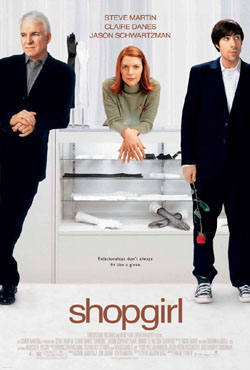
Shopgirl

Initial Reaction: Did that movie have Steve Martin in it?

As the Shopgirl DVD was held in front of my face at Blockbuster, I was intrigued. Steve Martin and Claire Danes? Interesting… As I remember, the cover said something about it being funny, and I’ve never seen a Steve Martin movie I didn’t get a good couple of laughs out of. Sure, why not?

You ever meet one of those unlikable people that you like? No, I didn’t type that wrong, I’m serious. Have you ever met someone that bugs you in so many ways, and you could make a list of the reasons why you shouldn’t like them, but for some reason you do? They’re annoying. They never shut up. They always criticize you. They couldn’t chew any louder if they tried. Why do you like them? And yet, the next day you miss them and can’t stop yourself from calling them up.

I liked this movie, but didn’t want to like it. Even now as I write this review, I want to criticize it, inflate its flaws, maybe even create some. I wouldn’t see it again, and I wouldn’t even recommend it to many people. But for some reason, I liked it.

Let me explain. This wasn’t a funny movie, which totally derailed my movie train. Looking at Steve Martin’s face and not expecting to laugh took some getting used to, and even hearing his voice as the narrator made me smirk for absolutely no reason. But the mood of the film was not a comedic one. The silly, laugh-out-loud moments were few and far between, and I can only remember one of those parts involving Steve Martin’s character. Shopgirl had a very distinct mood. The music really did it for me, it painted this mood clearly and beautifully, filling me with a sense of bittersweet love and desire …

The movie Shopgirl went where most movies avoid going when it put two potential lovers in the life of its main character, Mirabelle Buttersfield (Claire Danes). These kinds of movies can leave people with a bitter taste in their mouths that “fate” might have absolutely nothing to do with finding love, and that actually being in true love is our own personal choice. (Perish the thought.) I actually appreciated this, but on the other hand I do understand the draw of a story whose lovers, no matter what the circumstances, will end up in each others arms in the end. I guess.

I really like Claire Danes. Maybe not the most versatile actress in the world, but I think she does what she does well. She plays the good-yet-tragic Danes character, and you can’t help but like her. She’s just an average young woman on her own, dreaming of having a love that is fulfilling and true. Not surprisingly, she gets put into the path of Jeremy (Jason Schwartzman). This guy is a fool. I actually at one point pleaded with the movie to change its mind in the choice of romantic interest #1, because this guy is the least charming, least socially-polished guy I’ve ever seen play a romantic lead in a film. Plus, he’s not that attractive. He doesn’t seem to have much potential for anything, nevermind making it with the likeable Danes. I will say, however, that Schwartzman was amazingly successful in his role… I was actually genuinely embarrassed for him several times.

Alright, so Steve Martin? Very surprising. He plays the rich, older man who enters Mirabelle’s life and sweeps her off her feet. It’s really no contest at first, Mirabelle has her head on straight enough to see that Ray, a rich, gentle, caring and polite man, knocks Jeremy out of the ring. But who is right for her?

It seems obvious, but then it isn’t. Both men love Mirabelle, but she only wants one of them: Ray. Ray, however, is older and doesn’t want anything serious or long-term with Mirabelle. He basically wants to get laid whenever he’s in town. But he’s everything a girl wants in a man, and she believes that he loves her and will come around. Jeremy goes off on his own “quest” to try and find himself, and while he does change for the better in many ways, he still remains himself, and a part of himself is still crazy about Mirabelle.

Shopgirl made me uncomfortable because it focused on the fact that love can come from very unexpected places and people, and sometimes we don’t recognize it. It’s nice as an audience to just be spoon-fed a story and know that your expectations will be fulfilled. It’s a nice escape from a reality that always takes us by surprise. Shopgirl moved away from meeting expectations, and just evolved. Because of this, I appreciated Steve Martin’s honesty with us, it’s nice to not be lied to. But at the same time, I enjoy escaping reality sometimes. Reality, after all, is messy.

Rating: 6

In any case, I liked it, but I wouldn’t see it again and I won’t recommend it to you, unless you are intrigued by this review. If you are, go and see it, and let me know what you think. I give Shopgirl a 6 on the -22 to 22 scale. It was a good story that was well done and well acted, but seeing it was like hearing my mother tell me that my boyfriend is no good—a reality check I never asked for.

Monday, May 08, 2006

Movie of the Month - May '06

American Dreamz

Stay tuned for our reviews coming up May 15th-19th!
Lucky for you, They Might Be Critics hosts a regular movie of the month. During this exciting time, all (or most) of our critics post reviews of a chosen movie that is due to come out this month. We are all about providing a range of opinions and insights, and allowing for an open forum in which we discuss the film with each other and anyone who desires to participate. So, see American Dreamz, and join in!

Sunday, April 30, 2006

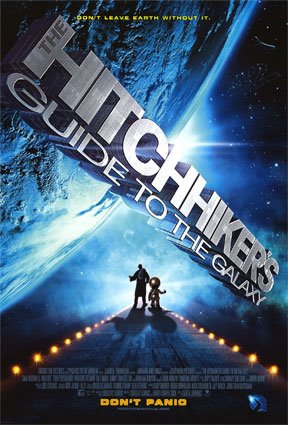
The Hitchhiker's Guide to the Galaxy

A couple of years ago, I was in the hospital during my birthday. Being in the hospital at any time is loads of no-fun, but being there for your birthday is 10 times more so. To cheer me up, my parents gave me a movie that they really enjoyed. It was called The Adventures of Buckaroo Banzai Across the Eighth Dimension. No joke. Needless to say, since I was in the hospital, I was not in the best frame of mind to really enjoy it, though I get the feeling I would not have enjoyed it even if I had just had the best sex of my life after being dipped in a vat of chocolate. It was a sci-fi movie, but also a spoof on sci-fi movies, pointing out the complete ridiculousness of the entire genre. The thing is that sci-fi people know that they are completely ridiculous, and really kind of enjoy it, so spoofs of them are generally well-received. However, the production values of Buckaroo Banzai were staggeringly low, and the time was simply not right for that movie. Well, sci-fi people, put on your party hats/dunce caps, because the time is now.

The Hitchhiker’s Guide to the Galaxy is a most extraordinary book, and that’s more that just the first words of the actual book, first published in 1979 and written by Douglas Adams. Adams has successfully achieved demigod status, and he co-wrote the screenplay for the movie, which came out shortly after his death. Accordingly, it remains fiercely faithful to the book, and lampoons the sci-fi society every ounce as well as the book does. The book is regarded as the premiere sci-fi book that is actually funny, and is required reading for anyone with a sci-fi bent. Seriously, any book that contains the passage “In the beginning, the universe was created. This made a lot of people very angry, and was generally considered a bad move,” would have to be.

I will say, however, that the movie is NOT for people who haven’t read the book AND really enjoyed it. If you are one of those unenlightened masses who have not and/or did not, you will not get the jokes, will not understand the plot or what is so funny about it, and will not appreciate the particular brand of humor it presents. That’s not a cut on you. In fact, it’s more of a cut on those of us who do understand it. This is a great movie, but it’s for a very specific crowd of people, and everyone else would be a lot better off just seeing something else.

Martin Freeman plays Arthur Dent, the hapless earthling just along for the ride, upset at his circumstances but not able to escape thoughts of love. His performance is brilliantly British, which you can take any way you like. Mos Def is a very strange choice to play Ford Prefect, but that’s kind of the point. He does a good job as the guy who knows everything about everything, but isn’t obnoxious about it. Sam Rockwell is simply great as Zaphod Beeblebrox, President of the galaxy. He has said that his portrayal is a mix of Elvis Presley and Bill Clinton, and that just shows that he truly understands the character. Zooey Deschanel is meh as Trillian, except in the scene where she shoots Zaphod several times with the point-of-view gun, where she momentarily breaks out of her shell and shows more than one emotion on her face, a strange thing for a sci-fi movie or a comedy, even stranger for both. The movie is filled with fabulous supporting performances, Alan Rickman, Bill Nighy, and Anna Chancellor not among the least of them.

Honestly, this movie made me laugh like no movie has in the past year. It is because I appreciated all the jokes from having read the book. For someone who hasn’t read the book, the jokes might still be funny, but they would not have that familiarity with them that only reading the book can bring. However, this is one of the Bibles of the sci-fi world, so chances are that you have read it, as well. And if you have, congratulations, because you have discovered a pleasant, inoffensive, deliciously funny movie that wins over and over again.

Iconic lines:
“I think you should know that I’m feeling very depressed.”
“He’s got a TOWEL!!!”
“I never could get the hang of Thursdays.”

22 Rating:
I’m kind of split on this, so I’m actually giving it two ratings.
For people who have read the book (and liked it): 15
For people who haven’t: -1

Particle Man

Tuesday, April 25, 2006

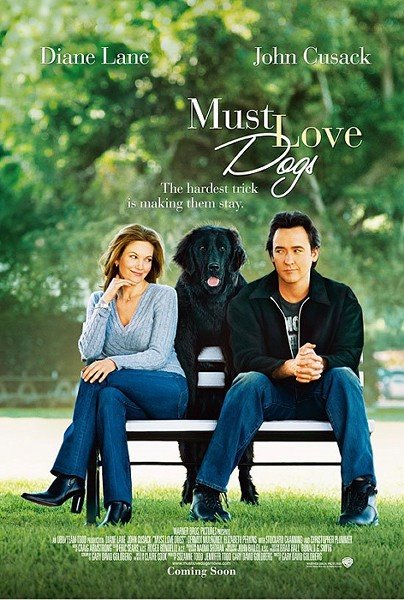
Must Love Dogs

Ok, think of every clichĂ© that commonly appears in chick flicks. Got some in mind? Good! You could find most of the clichĂ©s that are in your head in the movie Must Love Dogs. This movie was based on a novel written by a local woman. While I would like to show pride for someone from my part of Boston doing something noteworthy, in this case, I just can’t.
Let me explain. This movie begins by introducing us to the main characters, which seems like a promising start until you actually meet them. Sarah Nolan (portrayed by Diane Lane) is a divorcĂ©e who is convinced by her family to start dating again. They try to set her up on blind dates and set up profiles for her on matchmaking Web sites. Then you meet Jake (portrayed by John Cusack), a man getting over a breakup, who is strangely obsessed with boats. They both find each other on a Web site and the story begins from there. I don’t want to spoil too much for those wishing to be unjustly robbed of two hours of their life.
When I began watching the movie I was hoping that it would be a nice, cute movie, which I could write a nice review about. This movie actually tortured me so much that I had to shut it off halfway through. With encouragement from my sister, I decided to watch the remainder. (Good advice, sis.) She told me that it got better. She lied to me when I was kid, so I don’t know why I was surprised when she lied to me about this. Now let me explain why my feelings about this movie were slightly negative.
I saw no originality at all in this movie. First of all, you have the two people who are completely broken from previous relationships and don’t know how they will ever be able to trust anyone again (clichĂ© 1). They try to go on a number of dates which convinces them that there are no good prospects out there, and then they meet their “match” (clichĂ© 2). On their first date, they each think that the other person isn’t right for them and figure there will be no repeat dates (clichĂ© 3). Upon spending time together they realize they have things in common and almost get together but a really big misunderstanding happens and they are torn apart (clichĂ© 4). They both realize that they were right for each other and that they were fools for forgetting about one another (clichĂ© 5). They are both miserable and then one decides to make one big romantic gesture that makes everything all better (clichĂ© 6). This is not even all the clichĂ©s that are in this movie, but I went with this generalization to illustrate how this movie is like every other chick flick out there.
The really funny thing is that I like chick flicks. If you ask anyone on They Might be Critics, they would say that Stormy Pinkness is definitely a chick-flick watcher. Normally they would be right; however, in this instance they would be on crack. To say it plainly this was not a good movie. The acting was meh and I feel that it was the fault of the story itself rather than the actors. I can just imagine the actors thinking, “Well, if the writer doesn’t really care about making this exciting or different, I guess I don’t need to.”
And now for my favorite part of the review, the rating! I give this movie a -13. I would not recommend it to anyone. It just wouldn’t be a good idea. If someone feels that they absolutely must see it, I suggest a lobotomy.

Saved!

Saved! makes me feel like I’ve just been slapped in the face at .0007 feet per second, so slow that the slap felt like a caress. It makes me laugh with its irreverence, but also makes me squirm in my seat because it is so dead on. It exposes us as Christians, reveals our bigotry and short-sightedness with an accuracy that makes me think one thing: the person who made this movie HAS to be a Christian. No one else would know our ins and outs so perfectly and how to satirize us in exactly the right way. It takes one to know one, after all.

But this isn’t just a send-up, a cautionary tale. If it were, it would be vulgar and gratuitous, even if it would have a very good and relevant point. But no, it’s not. It’s also a really good story, populated by very real and complex people. This movie is so smart and savvy that it deftly sidesteps the pitfall of making even a single character one dimensional. Every person in the movie is a fully realized individual, and the movie has enough respect for them to not let us simply write them off as one thing or another, even the villain.

My personal opinion is that Saved! is Oscar-worthy, but they never give Oscars to teenagers unless they’re in ridiculously arty films, which Saved! is not. Jena Malone is pitch perfect as Mary, a sincere Christian girl who listened to the wrong people, came to the wrong conclusions, and made a very bad decision for all the right reasons. And in the end, God used her very bad decision to bring about a joyful event. Mandy Moore’s Hilary Faye (Tammy Faye?) is a great villain, because she generates feelings of loathing and anger in the audience. So many villains in the movies are sympathetic, and while that has its place, it’s good to see a movie villain that we can hate and feel no guilt over. Even so, she’s not just a concept, but a real person. Perhaps what makes her so vile and contemptible to me is that she is so real, that I’ve actually met people like that. She uses her Christianity as an excuse for her hate, and also as a tool for making herself better than everyone else. There are actually Christians who do that. But the real jewel is Patrick Fugit. There are Christians exactly like his character (also named Patrick) as well. He’s never judgmental or over-the-top, and he behaves just like a typical good-hearted boy of his age would. His performance has confidence as well as uncertainty, funniness as well as gentle seriousness, all at the same time.

The questions that Saved! raises are not to be lightly brushed off. Is the Bible black and white? Is homosexuality an abomination, or a personality trait, or both? Do we use salvation as an excuse for bad behavior? Is exposing the bad acts of people truly justice, or would mercy be a better option? The fact that a movie ask these questions that we may or may not know the answers to makes it worthwhile. I hesitate to say that everyone should see this movie, however, since the satirizing of Christianity, while completely necessary, is one-sided, and might make non-Christians think that the Christianity in this movie is the only one there is. The thing this movie illustrates, however, is that Christians, and indeed humans, all contain within them the capacity for good and evil, and being a Christian does not exempt you from the evil. In fact, that puts even more responsibility on your shoulders, an makes the consequences for choosing evil that much more harsh.

Iconic lines:
“Why did God make us all different if he wanted us to be the same?”
“And no more muffins for you! The muffin store is closed!”
“I crashed my van into Jesus!”

22 Rating: 18

Particle Man

Friday, April 14, 2006

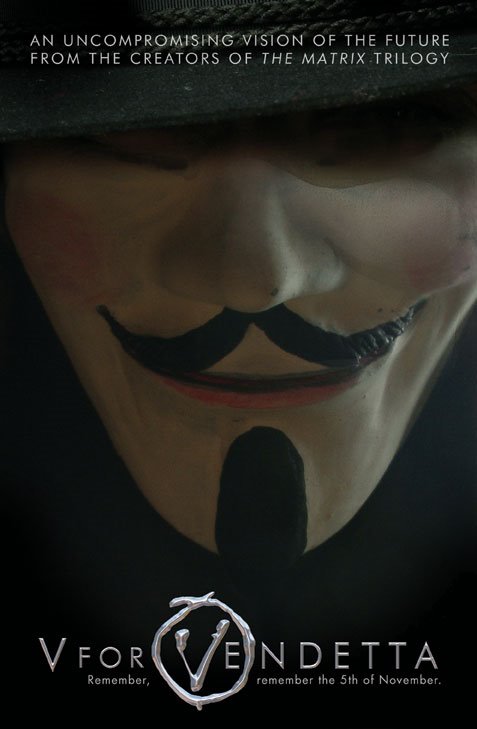
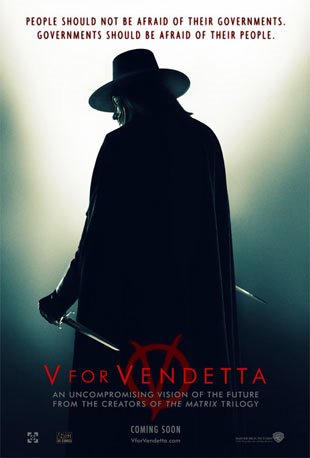
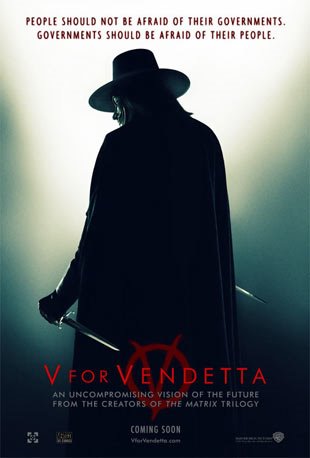
V for Vendetta (Particle Man)

I must say, this movie holds the record for number of hours (days) I’ve spent thinking about or discussing a movie. I saw it almost two weeks ago, and have not gotten it out of my head the entire time. People who know me at least reasonably well know that I am a pretty hard person to offend. I usually take things in my stride, and it takes a lot of bigotry, sightlessness, conceit or ignorance to get me going. With all that being said, V for Vendetta did it. It touched a nerve, or crossed a line, or pushed a button, or something, and it offended me.

I’m glad I put in for the last slot in the week to review it, because that gave me time to process it to greatest effect. In retrospect, I realize that it was supposed to be somewhat offensive. Comic book movies, and indeed comic books themselves, try to do a lot at one time. They try to vastly entertain you while giving you a very clear social and philosophical message. One only has to look to the many examples in the past to see this: Sin City, X-Men, The Punisher, Superman, The Matrix, Hulk, the list goes on. V for Vendetta didn’t have as many comic book conventions as other movies, and it played more elements completely straight and realistic.

The original author of the graphic novel, Alan Moore, has distanced himself from this project, as he did with his past comic book/movie adaptations. He says the movie turned it into something it was never intended to be, that the Wachowski brothers took it and ran with it, apparently quite a distance from where it was supposed to go. I think if they wanted to make a political satire of Bush, they shouldn’t have tried to couch it in a completely unrelated storyline.

I had incredibly numerous problems with V for Vendetta, not the least of which was with the character of V himself. What is he? I originally saw him as a monster and a psychopath with an expansive vocabulary, and still do. I believe in V’s ideas in a very hazy, conceptual sense, but I definitely do not agree with his methods. Blowing up buildings and killing people doesn’t seem like the way to affect positive change. I’ll admit that the English major in me got off when he delivered his initial speech, the one with all the v words. There is no connection between what he says he believes and what he does, however. And when there is a connection, it’s not an honorable one. He murders the TV host and blows up Parliament, but I didn’t understand how acts of violence got his point across. Later, when he murdered all the scientists, I understood it completely, and it was not what he attested to. He did it in revenge for what they did to him, not in righteous fury for what they did to the world at large.

V is an anti-hero. Like Cool Hand Luke, Wolverine, Boo Radley, and Jack Bauer, he’s a very nasty guy who fights for good. Like with any anti-hero, it up to the story to convince us that what the anti-hero does is necessary for the greater good. “The greater good” is a Marxist idea, however, and it doesn’t work on a large scale. Marxism is good for micromanagement, and that’s it. V’s ideas, though very good, cannot be put into practice in the grand scale, like he tries to do, without costing things that shouldn’t be spent.

Hazy concepts aside, I thought the movie itself was okay, but I was expecting so much more. The comic book trappings are replaced by realism, and more often than not, that fails. Hugo Weaving does an incredible job as V, with the limit of being trapped behind a mask for the entire movie, eliminating an actor’s most useful tool. Natalie Portman is supposed to make up for it, being the yin to his yang, but falls far short. I was surprised by her woodenness and single dimensionality, because she was so brilliant in Garden State. I guess it’s hit or miss with her. While she is remarkably appealing, her emotional repertoire seemed very limited in this movie. Her main problem is that it is never explained why she’s essential to the plot. The role Evey played could have been filled by anyone, not just Evey. A main character should be instantly accessible and completely indispensable, and she wasn’t. Stephen Rea was superb as Finch, the cop who just wanted to do the right thing. He played him as a truly good man of the law, one who wants to do what society expects of him, but eventually finds that the tenets of the society he lives in are not consistent with what he knows to be right in his heart. His performance was filled with subtlety and British dryness, which hit all the right notes.

This movie has stirred things up in my group of friends like few things can. While that doesn’t make it a good movie, it makes it an important and worthwhile one. I can’t say I liked it, because I definitely did not. However, I can’t say it wasn’t a good experience, or that you shouldn’t see it. The entertaining aspects of the movie were not quite enough to balance out the messages, and in the end it came out on the negative side. Some movies, like Elephant, Requiem for a Dream, A Civil Action, and 8MM, are in a class by themselves. They are incredibly deep movies that carry huge social issues and ask very important questions, but they’re not very entertaining. Obviously, V for Vendetta can be argued to be very entertaining, but for me it wasn’t. I don’t think I was able to see past the social issues to see the movie itself. In light of that, I need to see it again.

Iconic lines:
“A revolution without dancing is a revolution not worth having.”

22 Rating: -5

Thursday, April 13, 2006

V for Vendetta (Stormy Pinkness)

“Remember, remember the fifth of November.” I heard this line too many times throughout the movie V for Vendetta, in my opinion. V for Vendetta is the story of a revolutionary following in the steps of Guy Fawkes. Guy Fawkes was an Englishman who decided that there needed to be a change in the government. To bring about this change, he decided that he should blow up Parliament. His attempt was unsuccessful, and V feels the need to finish what was started centuries ago. This revolutionary saves and recruits a young woman to help him for his cause. I am very glad that they retold the story of Guy Fawkes accurately, something I look for often as a historian, but that one line did not need to be said as many times as it was throughout the film.
Overall, the movie was well-made, had some good action sequences, and acting that exceeded my expectations. This is especially true on the part of Natalie Portman, who has been tarnished in my mind ever since the debacle that was the more recent Star Wars series. Hugo Weaving plays the lead character, named V. He is a revolutionary who is constantly masked and never seems to give simple answers. As someone who is constantly masked, Hugo Weaving had to rely on his voice and body language to convey what he was attempting to get across. This he does accomplish. However, after seeing that mask about five freaking million times during the movie, I wanted to break it.
Natalie Portman plays a young woman who is saved by the character V from being jacked up by supposed “lawmen”. This begins her journey to self-discovery and her relationship with the mask-wearing rebel known as V. She did a good job conveying that her character had questions about the futuristic society she lived in, but was not sure whether she wanted to pursue the answers to those questions. However, after public display by V, she is forced to pursue those answers. The one problem I had with her character was that she seemed to trust V too quickly. Yes, he saved her, but in the kind of society she lived in, I would have been suspicious that he was just another form of the law that could potentially get her into a lot of trouble, given the corruption of the law that was occurring at that time. Another thing that bugged me about her trusting V is that she never saw his face; he was always wearing that mask, which more than once reminded me of a chubby cherub from medieval paintings. However, this fault lies with the story itself and not with the acting. Well done, Natalie! You are starting to win back my esteem.
The one major problem that I had with this movie was the feeling that I was constantly missing something. Not only did I feel this way, which was annoying, but I could not put my finger on it, which was even more annoying. I almost felt like the movie was telling me that it would explain itself to me when I was older. I do not know why I felt this way, but it was a feeling that I could not shake for the entirety of the movie.
Overall, this was a well-made movie, with a good job done by its actors. The set design was interesting. The costume of V was a tad too strange for my taste, and if his hair got any longer it would look like it was Morticia Adams behind that mask. I have heard some people say they loved this movie and also some people say that they hated it. I did not like it or hate it. This was simply not my type of movie. There is no better way to explain it.
Now it is time for the ratings portion of this review. Because of the vagueness of my regard for this movie I have rated this on two different scales. The first is how well the movie was done, which received a 10 from me. However, on a scale that rates my enjoyment I gave it a -5. I hope you all remember the fifth of November.

Wednesday, April 12, 2006

V for Vendetta (Dr. Worm)

Right from the get-go, V for Vendetta grabs both your brain and your balls and scarcely loosens its grip until the movie is over.

Set in a future dystopian London, V for Vendetta tells the story of its title character, V, and his attempts to blow up the government. We first meet V, the man in the mask, saving his partner-in-crime-to-be, Evey, from a group of “fingermen”—plainclothes policemen/thugs whose job it is to make sure people abide by the many, many laws of this totalitarian society. Upon saving Evey, V convinces her to accompany him to the rooftops, ostensibly to listen to a concert. And while Evey does hear music, Tchaikovsky's 1812 Overture pumped through the city’s PA system, it’s merely the incidental music of the main show: the demolition of the Old Bailey, London’s Central Criminal Court.

V’s maniacal laughter throughout this show reveals him for what he is: a terrorist. But V is not the villain of this film. He is the hero. In fact, this movie’s thesis is that terrorism is not always evil, and in fact it is sometimes necessary.

Needless to say, that hits us right where we live. “Terrorist” has become the new buzzword for everything we hate, like Communist was back in the 50s. V for Vendetta does not flinch from its controversial message, however, and in fact takes more than a few potshots—some subtle, some overt—at America’s current ruling regime.

Based on Alan Moore and David Lloyd’s graphic novel of the same title, the movie was written for the screen by Andy and Larry Wachowski of Matrix fame. And V bears many similarities to The Matrix, from the stylized action to the heavy ideas to the subversive message. Unlike The Matrix, however, the Wachowski brothers turned over the keys to James McTeigue, making his directorial debut (though he was the Wachowski brothers’ first assistant director on The Matrix set). The rookie McTeigue does a bang-up job: The movie still has a distinctly Wachowskian feel, but McTeigue also makes it his own, eschewing the Wachowski brothers’ need to make everything artsy-looking and shooting a somewhat more straightforward film.

McTeigue is helped by two lead actors who make everything look easy. Hugo Weaving plays V, and somehow manages to convey convincing emotion despite being trapped behind a completely immobile mask. That’s not a feat to be underestimated—you try getting an audience to not only understand you, but like you, when they can never see your real eyes or smile. He has an able counterpart, as well, in Natalie Portman, who turns in what must certainly be her best acting performance to date.

Portman isn’t as handicapped by the mask as Weaving, but it makes certain aspects of her character tricky as well. To the movie’s credit, it never ignores either the benefits or the drawbacks that the mask provides. The mask gives V universality and an unrivaled ability to provoke fear, but for that he has to trade in intimacy and personality.

Which, to answer the naysayers who find the mask disconcerting, is really the point. You can’t become a cause and still remain yourself. V understands this, and seems to fight against it at times, but never denies it. In so doing, V—the terrorist—actually becomes the most unselfish character in the film.

It’s not a perfect movie, some early segments drag a bit, and V displays an unexplained adeptness at pretty much everything, as well as a peculiar inability to fail at anything he does. (I, for one, am glad that the terrorists that currently oppose our country aren’t as impossibly skilled as he is.) But even so, V for Vendetta still clocks in at a rock-solid 15.

Tuesday, April 11, 2006

V for Vendetta (Wicked Little Critta)

Initial Reaction: (A bit taken aback) “That movie was an assault on my soul. In a good way.”

This movie took my expectations and twisted and warped them, seemingly into the shape of the letter V. From seeing previews, I was prepared to see the typical angry hero whose hellish past triggers an unheard-of plot to get back at some higher power in order to satisfy his need for revenge. Some who saw V for Vendetta might have walked away with just that, but I think that most people walked away with something more as well; a desire to see truth reign and unity among people.
The beginning was a bit too here and there for me. The first few minutes gave us the history of our story, taking place on November the 5th, 1605, when Guy Fawkes and other conspirators attempted their “Gunpowder Plot” to destroy British Parliament and upset the government under James I. They were caught and hanged, the plan never succeeding. After this little touching history lesson, we are thrown into future England. It’s not very pretty, either. The United States has imploded due to civil war, and England seems to have become, for some reason, the only country left in the world. Its government is controlling a country that seems to have lost a sense of itself, and the truth. The scary thing for me was that the government was clearly evil—eerily reminiscent of Nazi Germany in its attempt to brainwash, experiment, and control. While this was clear to the audience, we are shown the subtle ways that this manipulation overshadowed the people and lulled them into accepting it. Lies, cover-ups, political agendas and church scandals, sound familiar?
In the midst of this terror is a man with a vendetta against his government and with an intention to destroy it, and a woman who begrudgingly gets caught in the middle. V (our hero) is a kind of Zorro-esque character whose distinguishing feature is his Guy Fawkes mask. I will admit that the mask was a bit off-putting at times, especially in the moments when we are being asked to see deeply into his emotions and motivations. But what was intended by the mask is by the end clearly shown, in that V did not only exist as a man, but as an idea.
Natalie Portman was wonderful to watch. As the character Evey, she was pulled by her family into political unrest at an early age, and had put it behind her for years afterward until she accidentally encountered V. It seems as though her destiny is to rise against the controlling powers of England, and yet she is fearful and avoids doing so. V sees this in her, and takes matters into his own hands. This is the part that hurt, what V does to Evey.
Ouch. This part (which I will not spoil for the yet-to-be viewers) almost murdered this movie for me, but I learned as the movie continued that V isn’t about love, he isn’t about sacrifice, and he definitely isn’t about being the nice guy. He is solely “Vendetta.” He knows his goal, and he does what is necessary (if not painful) to help a friend grow stronger and learn how to live in their country.

Rating: 17
V for Vendetta is incredible. It is an amazing mix of past legacy and futuristic possibilities and it leaves the future of our world in our hands. The mask allows us to be V, a symbol of what it takes to enlighten, spread truth, and make change. This film speaks to our humanness and the power that we hold if we stand together for a common purpose. Way to go, Wachowski brothers, you’ve done it again. Everyone please consider the bar raised once more.

Monday, April 10, 2006

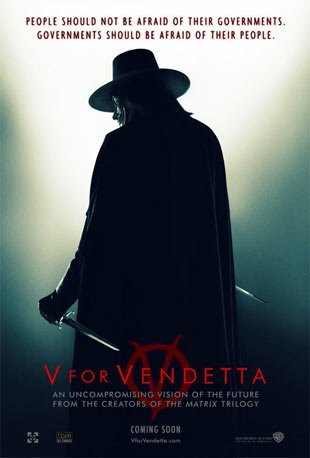
V for Vendetta (Subliminal)

What’s that? Subliminal works here? Oh yes, yes he does. Hello everyone and welcome to my first review. As you can probably see by the picture, my very first review will be the film V for Vendetta. I will avoid recounting the plot of the movie. Instead, I will describe my general reactions to scenes, characters, and themes that I found interesting.

First Reaction: Great movie. I really enjoyed seeing Hugo Weaving (V) shine in a different light. Natalie Portman (Evey) is also in excellent form in this movie.

All I knew as I went to see this movie was that it was similar in form to the book 1984 and set in the not-too-distant future. Having no expectations for this movie other than the theme of dystopian, I eagerly sat and awaited the film. Immediately upon starting the movie a preaching propagandist (who I thought looked and sounded like some famous radio hosts) and an announcement of an 11:00 p.m. curfew illustrated the total control of the government. Then, as the beautiful Natalie Portman makes her way to a date with an as yet unknown man, the corruption in the government is made apparent by a group of three government special agents that are intent on raping Portman.

Enter the hero. Waxing poetic, Hugo Weaving arrives on scene apparently by coincidence. Since I had only seen Weaving in the Matrix trilogy (Agent Smith) and in the Lord of the Rings trilogy (Lord Elrond), I was totally unprepared for the fluid and melodic meter of V. Through alliteration V shows his contempt for the government agents and what they stand for. The theme of the well-mannered and cultured individual that is V continues throughout the film. The honesty of the character and the ideals portrayed by V were appreciated by this humble viewer.

Another theme that this humble viewer appreciated was the movie’s portrayal of homosexuality as simply a relationship between two people. To me, the governmental suppression of homosexuals in the movie seemed to be a hyperbole to the way someone who is homosexual is treated now. Through several sources, the movie attempts to illustrate that the oppression is wrong and that people that are in love with someone of the same gender show the same passion, care, commitment, devotion, and love as anyone else in the world. It is my opinion that the movie’s theme is manifold, speaking out against tyranny as well as against oppression. While this theme in the movie didn’t court as much controversy as Brokeback Mountain, I believe that it will be a more effective step towards ending oppression of the homosexual community.

Was there something that I didn’t enjoy about the movie? Yes. There were a few scenes that sort of act as character fantasies or beliefs about the future. In these scenes, which were mostly good, a few characters are used that were used during the movie. This ends up being really confusing at the end when you say, “Hey I thought this happened to them, or that, how are they back here?”

16 out of 22. Great acting, great story, great themes, poetry, and Natalie Portman in a cute costume.

Friday, April 07, 2006

Good Night, and Good Luck - 2nd review

Dr. Worm beat me to the punch, reviewing the movie before I had a chance to see it. But I just couldn’t resist throwing my two cents in.

Good Night, and Good Luck is a very simple movie, with no special effects and a minimal soundtrack. The responsibility then rests solely on the actors to put forth a compelling movie, and this cast succeeds admirably. David Straitharn more than deserved his Oscar nomination, but that tends to minimize other performances in the movie that were just as spectacular, most notably George Clooney, Jeff Daniels, and Frank Langella. This was very straightforward movie-making, without frills or excess. The movie and the director didn’t try to make you feel a certain way or guide you in a particular direction; it had faith that you would go exactly where it intended you to go. It is odd that a movie with such a clear political stance would be like that, letting you form your own opinions instead of pushing its own on you.

It strikes me that things have basically turned completely around from the time of the McCarthy hearings. Back then, we had everyone scared of communism, so much so that even the smallest hint of deviance from the values of conservatism from someone caused them to be accused of being a communist. Basically, conservatives were running amok, and the liberals, especially in the press, were backing down and biting their tongues, afraid of reprisal and condemnation. Now, we have nearly the exact opposite. Liberals in the press reign supreme, and they let their opinions rule them to the point that some of them aren’t really journalists anymore. Because the liberal ideology is so prevalent and all-pervading, most conservatives are now biting their tongues, afraid of being labeled racists, homophobes, or totalitarians. My, how the tables have turned.

I disagree with George Clooney on basically every issue he has spoken about, but I respect his ability to speak. When he directs movies like this, it’s a little easier to understand his viewpoint, and they make me respect him as an intelligent and critical thinker. That doesn’t change the fact that my own opinions are diametrically opposed to his on just about everything. I guess people can ask questions in exactly the same manner and come up with completely different answers.

22 Rating: 9

Particle Man

Tuesday, April 04, 2006

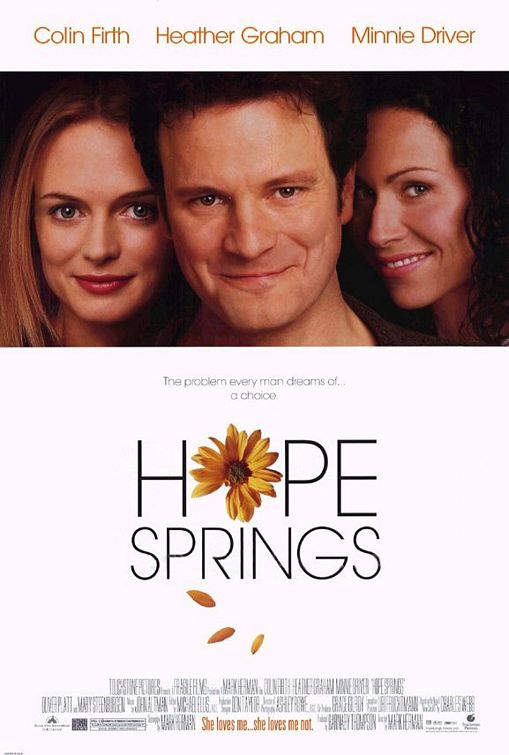
Hope Springs

Initial Reaction: Um, can I have my 90 minutes back, please?

If you're a movie fan who enjoys nonsensical characters, sloppy plot, and dull script, this is the movie for you! I actually watched this movie twice, once on my own, and the second time so that my boyfriend and I could tear it to pieces together. In case you haven't figured it out, I did not enjoy this movie. In the past, I have greatly enjoyed Colin Firth's work, but I wonder what potential he saw in this one.
Firth's character, Colin, leaves his home in England after finding out that his long-time fiancee, Vera (Minnie Driver), is getting married to another man. Depressed and feeling hopeLESS, he winds up in Hope, a small town in New England where he rents a room in a motel in order to work on his art while either escaping from or dwelling on his problems. I'm not sure which one.
Before too long, he is thrown into the path of Mandy (Heather Graham), who immediately insists on dragging him along on her ridiculous escapades. While I'm sure we're supposed to get the warm, happy feeling of a man realizing the potential of a love he's never had, we're only given the sudden attraction an ex-fiance-in-mourning has for a cute blond who belongs in a padded room. Seriously, there is no chemistry between the two characters, and the audience is given no reason to believe that Colin and Mandy are "meant to be," as all rom coms at least attempt to do. The characters in Hope are quirky and supposed to be endearing, but they end up just plain annoying. Oliver Platt appears in a weak subplot as an elite member of the tiny town who is crooked and egoistic. In a better movie Platt's fun performance might have been a humorous touch, but in this already downward spiral of a film, it just added more weight.
The acting wasn't bad, but it wasn't very good either. I'd say the character that shines here is Minnie Driver, but in the end, she also is doomed to succumb to the ridiculousness of the script as she for some reason is made the new Queen of Hope.
Now, I'm not above silly or ridiculous movies in general. In fact, some of my favorite types of humor are centered around the far-fetched and nonsensical. But if you're trying to make a fun, silly movie out of a romantic comedy, don't try to make it silly and serious at the same time. And at least give us something, or someone, to believe in. Or something to be interested in. Please, just give us some hope.

-22 to 22 Rating: -10
If I had three wishes, I would wish that 1) I never meet a real person like Mandy, 2) that the director and others behind this film would learn from their experience and maybe change their identity, and 3) that everyone who has ever seen this film (including those that enjoyed it) would henceforth have it erased from their memory. Trust me, you're better off.

Monday, April 03, 2006

Movie of the Month - April '06

V for Vendetta

Stay tuned for our reviews coming up April 10th-14th!

Sunday, April 02, 2006

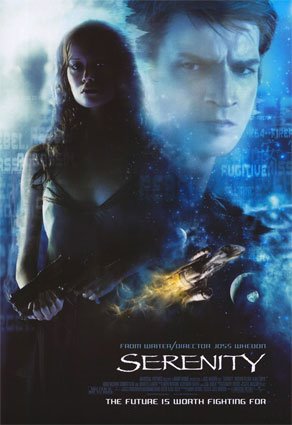
Serenity/Firefly

Why, oh why, was this show cancelled?!? There are so few shows on television that show maturity of writing as well as complexity of theme. Most shows are either trashy reality shows, soap operas disguised as dramas, or comedies that appeal to the lowest common denominator of humanity, which is staggeringly low. And when a show like Firefly comes along that takes the opposite tack, that challenges people to go up to a higher plane and really pay attention to what they’re watching, it gets shown scathing disrespect, and then gets cancelled after half a season. I don’t get it.

Joss Whedon, creator of Buffy the Vampire Slayer and Angel, said in an interview that he doesn’t grieve well, and when Firefly was cancelled, he decided to forge ahead and find a way to make the rest of this story heard. Three years later, we had Serenity. All the actors from the TV show signed on for the movie, as this was a project they all believed in. It shows, too. All the characters seem like they are full and complete people, and have been lived in.

Only a few people actually saw the original Firefly when it aired, but even if you did, the episodes were shown out of order, so it’s best if you get the DVD set of the show. I saw Serenity before I had watched Firefly, and I don’t think it’s terribly important to see it first, but it helps. If you totally love Serenity like I did, you should watch Firefly, because it will give you a chance to see those characters again, and enjoy the world that it’s set in for hours more.

I won’t reveal plot details, but the show and the movie center on the crew of the Firefly ship Serenity, particularly its captain, Malcom Reynolds. It’s sci-fi to be sure, as it takes place 500 years in the future. The area in which it differs wildly from lots of other sci-fi movies is that there are no aliens. We left earth and didn’t find anyone else in the entire universe. Also, it’s a western. Now, lots of other sci-fi movies and shows are westerns in theme, being that they are about good guys and bad guys facing off, and it’s either that the bad guys are the law and the good guys operate outside the law (The Magnificent Seven, Silverado) or the other way around (Tombstone, True Grit). And dozens of sci-fi shows have followed the same thematic pattern, from Battlestar: Gallactica to Star Wars. What’s unique about Firefly is that it is western in setting as well as theme. Here you have the typical good-guy-bad-guy paradigm, but you also have six-shooters, horses, accents, and a distinctive lexicon. The crew of Serenity are cowboys.

I’m so glad that Joss Whedon got the chance to give these characters another shot, and that the actors got to play them again. These characters are so deep and involved that the depths of their secrets can only be hinted at in a movie and half a TV season. Unfortunately, there aren’t a lot of possibilities for the story to go even further, for reasons I won’t reveal.

I should caution you, however, that this isn’t for everyone. As sci-fi shows go, it contains much less techno-speak and futuristic babble than pretty much any other show. Whedon has really tried to make it like the present +500 years, and to not include vast changes to the human character, like on Star Trek. Even so, this is still a sci-fi show and movie, and will simply not appeal to some demographics. That’s a shame, however, since a large part of the movie deals with basic concepts of right and wrong, and that is something every demographic can relate to. But it also deals with spaceships and interplanetary travel, and that is not everyone’s cup of tea, I know. But it is mine, so there you go.

Iconic lines:
“I am a leaf on the wind… watch how I soar…”
“You know the first rule of flying? Love. You can know all the math in the 'verse, but you take a boat up in the air that you don’t love and she’ll shake you up just as sure as a turn in the whirls. Love keeps her in the air when she should fall. Love lets you know she’s hurtin' 'fore she keels over.”
“It’s been nigh onto a year since I had anything 'twixt my nethers that ain’t battery powered!”

22 Rating: 18

Particle Man

Saturday, April 01, 2006

Good Night, and Good Luck

As it was selected by the Academy as one of the five best movies of last year, I had high expectations for Good Night, and Good Luck. And while I wasn't disappointed, I wouldn't say I was particularly blown away, either.
Good Night, and Good Luck tells the story of Edward R. Murrow, the American journalist and broadcaster, and specifically his dealings with Senator Joseph McCarthy. If you read The Crucible in high school and had an English teacher with any merit, you probably learned about McCarthy. He was that guy from the 50s who called everyone who opposed him a communist, creating a "witch hunt" known as the Red Scare. Jim Carrey famously stood up to him in The Majestic, a significantly less historically accurate film.
And Good Night, and Good Luck is nothing if not historically accurate. In fact, much of the film is, in fact, history. McCarthy, for example, is played by himself, as director George Clooney decided--like Murrow's CBS news crew in the film--to allow McCarthy's bigotry and fearmongering speak for itself. It's a nice touch, as I'm certain any actor handed the McCarthy role today would be tempted to oversell it.
The acting in this movie is, by the way, superb. David Straitharn does a brilliant job as Murrow, earning an Oscar nomination in the process. Clooney also does a commendable job as Murrow's co-producer Fred Friendly, but highlighting individuals almost seems worthless in a cast that was uniformly stellar.
The film's failings, if they may be called that, perhaps are just a result of it not being quite ambitious enough. It's nothing more or less than a straight-up homage to Murrow and panning of McCarthy. The action seldom leaves the CBS newsroom--shot, like everything else, in black and white--and the film barely cracks 90 minutes. That's enough to tell the story and explore its characters, but it keeps it from becoming a truly epic film.
But perhaps that's for the better. Perhaps adding additional scenes, characters, and minutes to this movie would just dillute its message. Because as it stands, it's a firmly engaging little biopic, if maybe a bit too A&E.
Which means, on the 22 scale, it can only get a 10. But as that's all it really reached for, I don't think it can be too disappointed.